


An international ppc agency should not be viewed as a simple media buyer; it is a global risk operator for your growth mandate.
Its real value is protecting your CAC as you scale into volatile markets, opaque platforms, and fragmented data environments.
The thesis of this article is straightforward yet uncomfortable for many CMOs.
Your agency either hardwires localization, measurement, and governance into every campaign, market by market, or your global acquisition costs quietly spiral behind algorithmic black boxes and partial reporting on (Google).
International PPC Agency: Proving Incremental Lift Market-by-Market
International PPC is no longer a media buying problem; it is a risk management problem.
As your brand expands, every new market multiplies your exposure to rising CAC, opaque platform automation, and fragmented reporting.
The only defensible role for an international PPC agency is to operate as a global risk partner that proves incremental lift by country before you commit serious budget.
Without that discipline, global search and social platforms quietly absorb your spend while your true acquisition economics remain unclear.
Continuous Incremental Lift Outperforms Static Demand Capture
Most cross-border PPC programs simply harvest existing demand and label it growth.
That may look efficient on a blended dashboard, but it does not tell you if you are generating new customers at a sustainable CAC in each market.
With roughly $232B in global search ad spend forecast in 2024 according to (Statista), competitive pressure means that static, set-and-forget demand capture quickly plateaus and erodes margin.
What you need from an international PPC agency is continuous proof of incremental lift at the country level.
That means structured experiments that isolate paid impact from organic and brand traffic, then validate both CAC and contribution margin before you scale budgets.
The agency should be able to test in a single market, split funnels to separate prospecting from pure demand capture, and show you how much true net-new revenue you gain from each additional dollar invested.
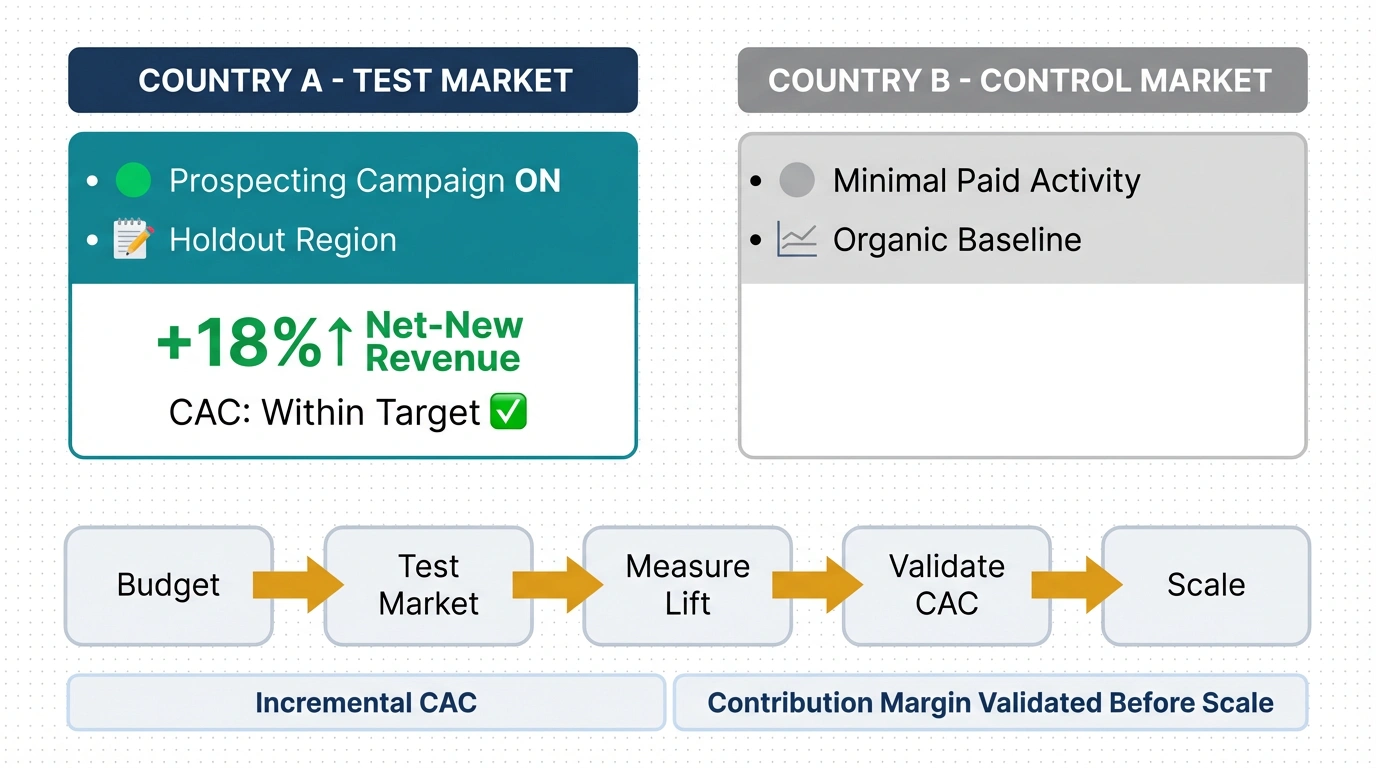
Consider a DTC brand moving from the US into key EU markets.
Instead of cloning US campaigns, their agency treated each country as a separate risk profile, running staged experiments that sized demand, stress-tested CAC, and validated payback before full rollout.
The result was a sequenced expansion where underperforming markets were paused early, while high-lift markets earned accelerated investment and local resource support.
For CMOs, this approach reframes the agency from a cost center to a global risk operator.
It creates a repeatable way to answer three questions market-by-market: Do we have incremental lift, at an acceptable CAC, with measurement we trust.
Only when the answer is yes should you unlock material budget and automate more of the day-to-day bidding and optimization.
Localization Is Key: Translation Alone Fails to Convert
International PPC fails most often not in the ad account, but on the landing page.
Roughly 15% of Google searches are new every day, which means query intent is constantly shifting across regions.
Simply translating US creative into another language, or reusing English assets in same-language markets, ignores local search behavior, expectations, and trust signals.
High-performing agencies build localization into the core of their operating model.
They align ad copy, offers, pricing, and landing page structure with local norms, from currency and payment options to social proof and compliance requirements.
Even within the same language, a UK buyer and an Australian buyer may respond to very different hooks, urgency cues, and value propositions.
Real performance gains show up when agencies are willing to rebuild rather than reuse.
A SaaS company that had flat results across its English, Spanish, and French lead gen campaigns only broke through when the agency designed region-specific landing pages tuned to local pain points and conversion habits.
The shift from copied templates to truly localized experiences turned soft, low-intent leads into pipeline-worthy opportunities and gave finance a clearer view of CAC by region.
Blended Channel Management Yields Measurable Gains
Search does not exist in isolation from social anymore, particularly in new markets where brand familiarity is low.
With global social ad spend forecast at around $243B and 54% of consumers using social to research products according to (Sprout Social), siloed channel management leaves incremental opportunities on the table and muddies attribution.
Modern CMOs are wary of platform automation that trades control and transparency for short-term efficiency.
In many accounts, Performance Max and similar products drive mixed traffic that is difficult to unpack by market or funnel stage.
Your international PPC agency should counter this by orchestrating paid search and paid social together, using shared audiences, creative frameworks, and consistent measurement to protect incremental lift.
Multi-market retailers that unify Shopping and social campaigns by region typically see higher impression share where it matters, more resilient ROAS, and clearer readouts of incremental performance.
By treating each country as an integrated ecosystem instead of a channel silo, the agency can reallocate budget faster, control CAC inflation, and report on true cross-platform lift with the rigor your board expects.
International PPC Agency: Enforcing Data, Account Ownership, and Measurement Standards
As you scale into new regions, an international PPC agency should function as a global risk operator, not just a media buyer.
Its real value is protecting account ownership, standardizing measurement, and proving incremental lift market by market so your CAC does not quietly spike behind opaque automation.
Without clear ownership rules and consistent measurement, every new country adds legal, brand, and financial risk.
The agencies that win globally make governance a product, not an afterthought.
Strict Account/Data Ownership Prevents Long-Term Risk
Reddit practitioners in threads like “Hiring a PPC agency: what to watch out for?” repeatedly flag the same red flag: agencies holding accounts, data, and reporting hostage.
In a multi-region setup, that opacity scales into permanent dependence, distorted performance narratives, and leverage you can never fully regain.
Your international PPC agency should hardwire client-side ownership into the operating model:
you own the ad accounts, pixels, analytics properties, product feeds, and audiences, while the agency owns processes and playbooks, not the infrastructure.
Non‑negotiables that materially reduce long-term risk include:
- All platforms created on your corporate domain with admin access retained in-house.
- Detailed changelogs documenting budgets, bids, creative, and targeting edits by market.
- Standardized offboarding packs with campaign structures, audiences, scripts, and naming taxonomies.
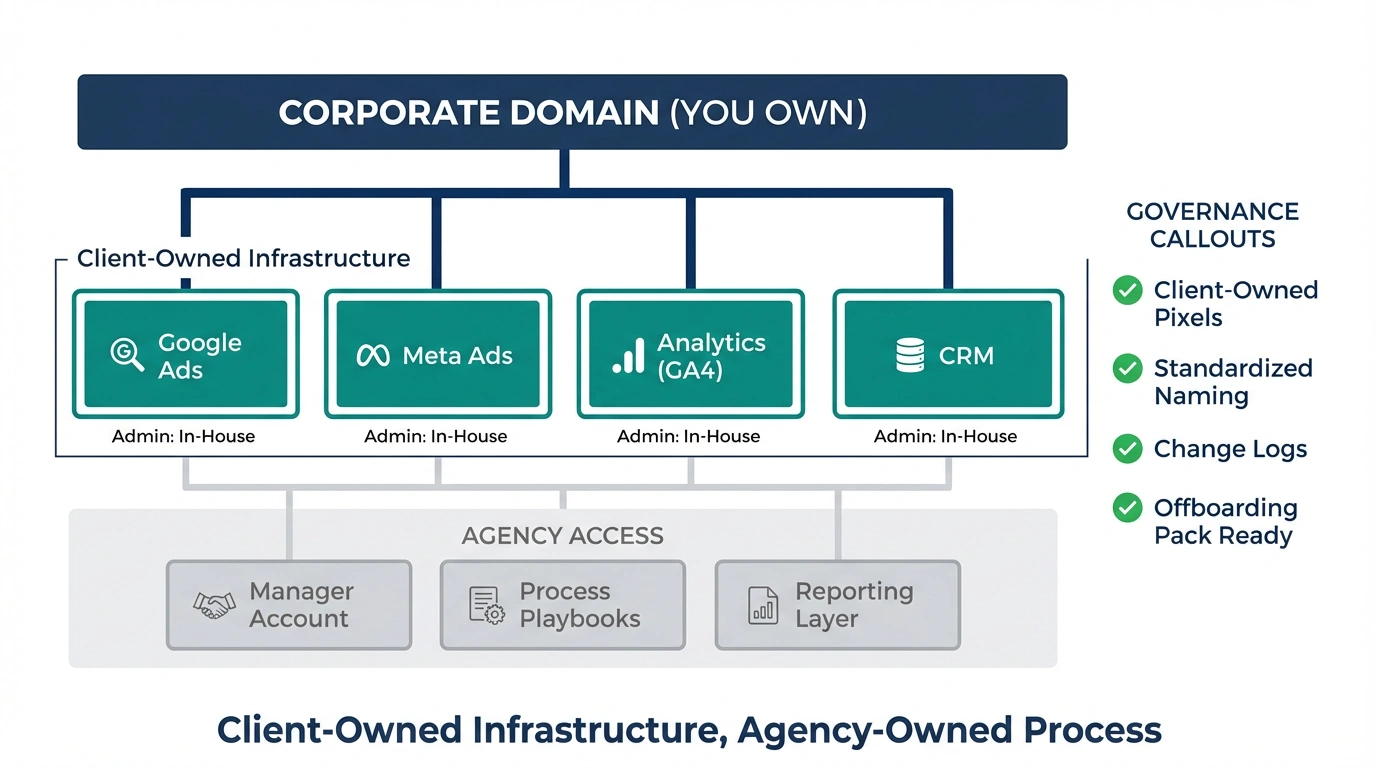
Consider a SaaS brand entering four new regions that insisted on client-owned ad accounts and analytics.
When strategy shifted two years later, they exited the agency with full access to historic search terms, audience performance, and localized creative learnings, avoiding lock-out fights and “transition fees.”
That data now fuels in-house experimentation and vendor negotiations globally.
Standardized Measurement: The Antidote to Cross-Market Fragmentation
Global social media now counts roughly 3.96 billion users according to [DataReportal](https://datareportal.com), which means your behavioral signals are fragmented across devices, identities, and regulations.
Layer in variable consent rates, attribution windows, and offline buying journeys, and raw ROAS comparisons by region become strategically useless.
A capable international PPC agency normalizes how performance is defined before scaling spend:
one global measurement framework, then local nuance on top.
Key disciplines include:
- Standardized conversion definitions (MQL, SQL, Opportunity, Closed Won) consistently applied across platforms and markets.
- Server-side tracking and CRM integrations to capture events that cookies miss.
- Geo experiments and incrementality tests to isolate true regional lift from organic or brand noise.
One B2B SaaS agency re-instrumented its client’s global PPC so that offline CRM outcomes (MQL to SQL progression) were imported back into ad platforms.
By bidding only on sales-qualified signals, they proved real incremental contribution by region, doubled down on high-lift markets, and cut underperforming geos where click-based ROAS had previously looked deceptively strong.
Automated Platforms Demand Strong Measurement Discipline
Automation products like Performance Max and Meta Advantage+ compress dozens of levers into a single black box.
Left unmanaged, you get blended results that hide which markets, audiences, and creatives are actually carrying performance.
Experienced Reddit practitioners comparing “Performance Max/automation vs. control” converge on the same solution:
do not fight automation, feed it better data and enforce strict reporting structures.
International PPC agencies that succeed with automation in multiple countries focus on:
- Clean, hierarchical feed hygiene with country, language, and product attributes clearly tagged.
- Market-level UTM and naming conventions that map back into a unified reporting layer.
- Always-on experiments that adjust audiences, creatives, and bids by region while keeping the global framework intact.
Multi-market retailers that once saw wild ROAS swings stabilized performance only after their agency rebuilt data structures by country and tag.
With disciplined inputs and market-level reporting, the same automated systems evolved from opaque risk to a scalable, measurable growth engine.
International PPC Agency: Delivering Localization, Governance, and Platform Compliance at Scale
For CMOs, global PPC is no longer about finding cheaper clicks in new markets. It is about controlling risk while you scale into dozens of regions, platforms, and regulatory regimes.
Your international PPC agency should act as a global risk operator that stress-tests markets, hardwires localization into every touchpoint, and protects account ownership and data integrity as you grow.
When that discipline is missing, automated platforms quietly inflate global CAC while fragmented reporting hides where the leakage occurs.
When it is present, you get a repeatable motion for entering new markets with confidence, not guesswork.
True Localization Hardwires Conversion, Not Just Reach
Translation gets you impressions; localization gets you revenue.
With 15% of Google queries being net-new every day and almost 4 billion social users shifting behavior by region, generic messaging cannot reliably convert across markets.
Standard translation looks efficient on a media plan, but it erodes conversion rates and silently inflates CAC as algorithms chase ever-broader audiences.
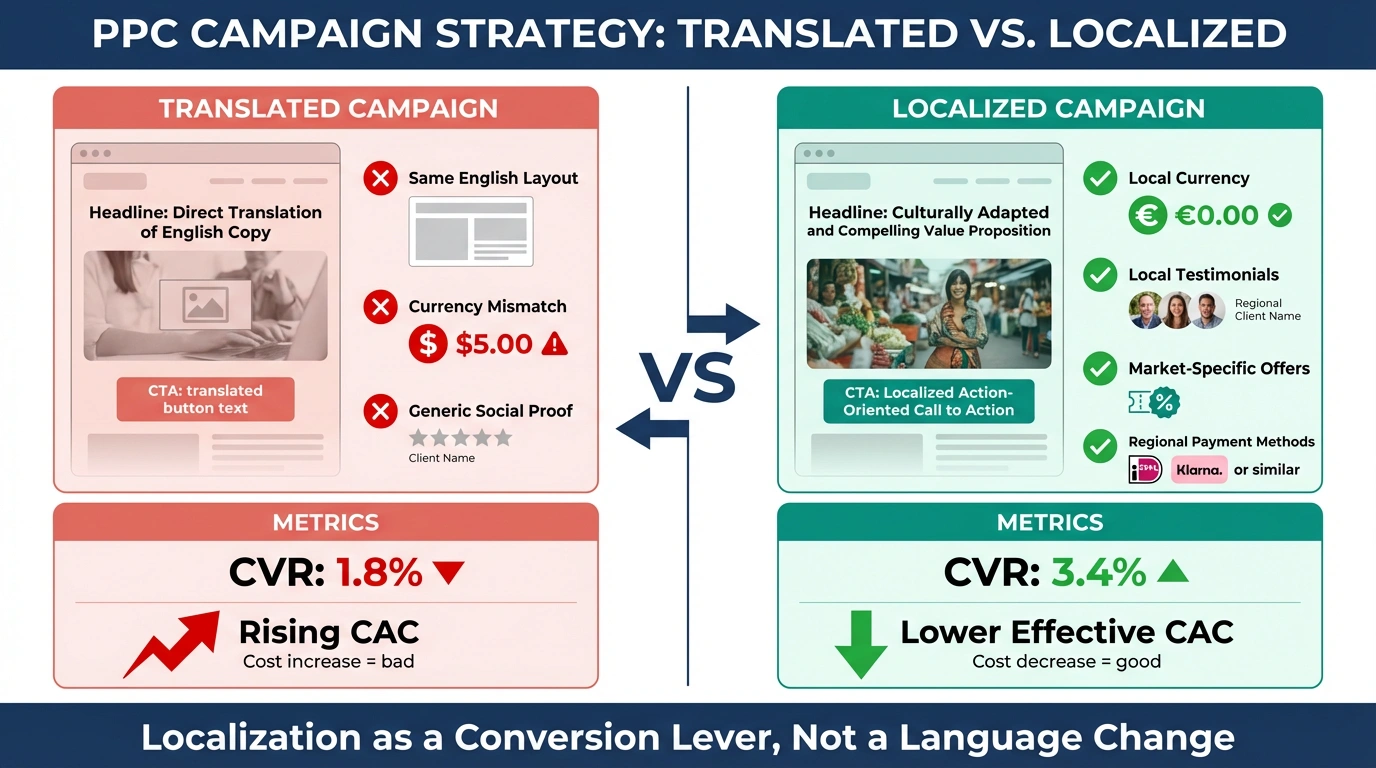
High-performing international programs treat localization as a conversion lever, not a label change.
Agencies should be testing creative, offers, and landing pages in-market, using local queries, slang, formats, and trust cues that reflect how buyers actually evaluate risk and value in each country.
In community threads, practitioners repeatedly highlight the conversion gap when localization stops at language.
Reddit discussions describe identical campaigns that “look localized” but underperform because the proposition, proof points, and payment or shipping expectations do not match local norms.
This is where a strong agency partner earns its keep: by instrumenting market-level testing instead of copy-pasting winning US or UK assets into new regions.
Consider a global DTC brand that moved from generic English creative to fully localized journeys by country.
They rebuilt offers, pricing frames, guarantees, and social proof for each market, then aligned landing page UX with local expectations.
The result was a measurable improvement in localized CAC and payback windows compared with their previous one-size-fits-all approach, without any increase in overall media budgets.
Governance Playbooks Reduce Launch Delays and Disapprovals
As global search ad spend climbs toward $232B, the operational risk of expansion scales with it.
International programs stumble not because the strategy is wrong, but because launches get stuck in approval loops, billing issues, or misaligned naming and budget structures that no one can untangle later.
World-class agencies counter this with a global governance framework that standardizes how campaigns are planned, launched, and monitored across markets.
The objective is simple: fewer surprises, faster launches, and minimal downtime when issues do arise.
Effective playbooks typically codify:
- Approval flows for creative, audiences, and bids so markets move fast without bypassing brand or legal.
- Global naming conventions, budget hierarchies, and change logs that finance and analytics teams can interpret at a glance.
- Compliance QA steps that check privacy, disclosures, and required country-level assets before launch, not after disapproval.
Retailers that implemented standardized global policies with defined local exceptions saw campaign setup times shrink and launch quality improve.
A central team owned the framework, while local teams had bounded freedom to adjust offers and creative within clear rules.
This hybrid model keeps scale from turning into chaos, especially when layering on new formats like Performance Max or Shopping across multiple regions.
Local Compliance and Brand Safety: A Non-Negotiable for Scale
Beyond launch mechanics, CMOs must treat compliance and brand safety as a core part of international PPC design, not a reactive support task.
Platform disapprovals, restricted-category rules, and privacy claims can stall your entry into a market or quietly throttle reach for weeks.
Experienced international agencies structure accounts by country and language to reflect how policies are enforced in the real world.
Practitioners in forums debating “international PPC setup: structure by country vs. language?” consistently point to country-first structures as more resilient for troubleshooting, budgeting, and compliance control.
Smart partners localize both policy interpretation and creative execution.
That means understanding which product categories trigger extra scrutiny, which disclosures or age gates are required, and how data usage or consent language must change by region or platform.
It also means building QA routines that run through every feed and asset before scale is applied.
For one international retailer, splitting Shopping campaigns and feeds by country, then QA’ing each against local policies, kept their programs live and stable even as rules shifted.
Instead of broad, fragile setups, they had compartmentalized campaigns where a localized issue could be contained and fixed without pulling down revenue elsewhere.
This is the level of control CMOs should expect from an international PPC agency that claims to be a global growth partner, not just a media buyer.
For a deeper view on how user behavior and platform standards vary by market, see the analysis from (Backlinko).
Why CMOs Must Rethink Their International PPC Agency Mandate
To keep global CAC in check, CMOs need their international PPC agency to act as a risk operator, not a volume buyer of clicks.
Your mandate should be to prove incremental lift by market, protect data and account ownership, and enforce localization and compliance as core disciplines, not extras.
That starts with treating localization as a conversion lever.
Insist on in-market testing of creative, offers, and landing pages so each country experience reflects local behavior, trust cues, and expectations, rather than recycled assets from your home market.
Next, require a formal governance framework that standardizes approvals, naming, budgets, and QA across regions.
This is how you shorten launch cycles, reduce disapprovals, and keep finance and analytics aligned while automation and new formats like Performance Max scale in the background.
Finally, anchor the relationship in local compliance and brand safety.
Accounts should be structured for country-level control, with proactive policy interpretation and QA so issues are contained without jeopardizing revenue in other markets.
When your international PPC agency operates this way, global expansion becomes a repeatable, measurable motion rather than a collection of disconnected bets.
The result is sustained international growth with clear accountability for every incremental dollar of performance.
