

TL;DR:
- Structured qualification frameworks separate high-probability prospects from time-wasters, with organizations implementing systematic scoring achieving 138% ROI versus 78% for unqualified pipelines.
- MQL-to-SQL conversion averages only 13-21% across B2B industries, revealing that 79-87% of marketing-generated leads fail sales criteria—making attribution-informed qualification critical for channel optimization.
- Lead source intelligence enables predictive qualification by correlating historical conversion patterns with origination channels, technology profiles, and journey touchpoints before sales engagement.
What Is a Qualified Lead?
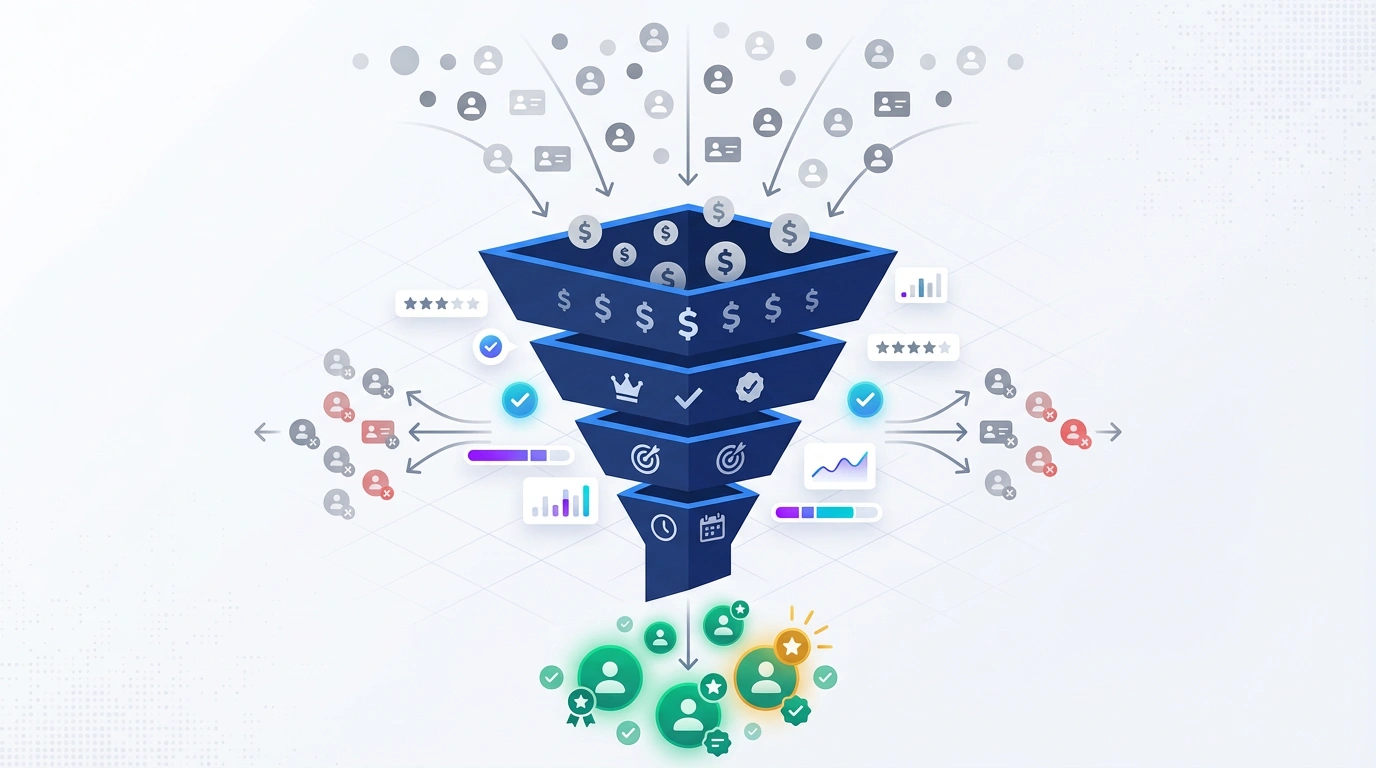
A Qualified Lead represents a prospect who meets predefined criteria indicating genuine purchase intent, budget authority, and organizational fit, distinguishing them from raw contacts requiring further nurturing or disqualification.
The classification splits into two primary categories: Marketing Qualified Leads (MQLs) demonstrate engagement thresholds warranting sales attention, while Sales Qualified Leads (SQLs) pass direct validation confirming active buying process participation.
Modern qualification extends beyond binary pass/fail determinations to incorporate scoring models assigning probability weights based on firmographic attributes, behavioral signals, technology stack alignment, and historical conversion correlation data.
Organizations deploying structured qualification report 59% higher conversion rates and 77% shorter sales cycles by concentrating resources on prospects exhibiting validated buying signals rather than pursuing undifferentiated inquiry volume.
Attribution integration transforms qualification from static criteria evaluation into dynamic intelligence where lead source performance, journey complexity, and channel touchpoint sequences inform real-time scoring adjustments and prioritization algorithms.
Test LeadSources today. Enter your email below and receive a lead source report showing all the lead source data we track—exactly what you’d see for every lead tracked in your LeadSources account.
Qualification Framework Methodologies
BANT Framework evaluates Budget authority, purchasing Authority, identified Need, and defined Timeline as the foundational qualification structure developed by IBM for enterprise software sales.
The methodology requires confirming $X budget allocation, decision-maker engagement, articulated pain points addressing your solution category, and procurement windows within 3-12 months to classify prospects as sales-ready.
MEDDIC expands qualification rigor through Metrics quantification, Economic buyer identification, Decision criteria documentation, Decision process mapping, paper champion Identification, and Competition analysis.
Organizations implementing MEDDIC report 40% higher win rates in complex enterprise deals by surfacing procurement blockers and stakeholder dynamics before proposal investment, though the framework requires 3-5 discovery conversations to complete.
CHAMP reorients qualification priority toward Challenges verification, Authority confirmation, Money availability, and Prioritization timing, addressing BANT’s limitation of leading with budget questions that prospects deflect early-stage.
The framework performs particularly well in consultative sales where problem articulation precedes budget discussion, with technology and professional services organizations achieving 35% faster qualification cycles versus traditional BANT sequences.
GPCTBA/C&I combines Goals identification, Plans assessment, Challenges documentation, Timeline definition, Budget confirmation, Authority validation, Consequences evaluation, and Implications analysis for strategic account qualification.
This comprehensive framework suits six-figure+ deals with 6-18 month sales cycles, capturing organizational transformation drivers and stakeholder risk perceptions that predict deal momentum beyond surface-level qualification criteria.
MQL and SQL Classification Standards
Marketing Qualified Leads cross engagement score thresholds indicating content consumption depth, website visit frequency, email responsiveness, and resource download patterns suggesting active research rather than casual browsing.
Typical MQL criteria require 50-100+ points from activities like attending webinars (25 pts), requesting demos (50 pts), pricing page visits (30 pts), and multiple return sessions (15 pts each) within 30-90 day windows.
Industry benchmarks show MQL-to-SQL conversion rates averaging 13-21%, with top-performing organizations reaching 35-40% through tighter criteria alignment and lead source quality calibration based on historical progression analysis.
Sales Qualified Leads emerge from direct rep validation confirming budget discussions, stakeholder introductions, competitive displacement opportunities, defined evaluation timelines, and explicit purchasing process initiation.
The SQL designation requires human judgment synthesis that automated scoring cannot replicate, particularly assessing deal complexity, internal champion strength, and technical evaluation capacity that determine closure probability.
Average SQL-to-Opportunity conversion rates range 30-50% with fast follow-up and structured discovery, while SQL-to-Close typically achieves 15-25% depending on average contract value and sales cycle length.
Product Qualified Leads represent an emerging category for PLG companies where free trial usage intensity, feature adoption breadth, team expansion, and integration implementation signal purchasing readiness beyond traditional engagement metrics.
Organizations tracking PQL metrics alongside MQL/SQL report 3-4x higher conversion rates for trial users hitting activation milestones (e.g., inviting 3+ teammates, connecting data sources, publishing first project) versus generic demo requests.
Scoring Model Architecture
Explicit Scoring assigns point values to firmographic matches including industry alignment, company size thresholds, geographic market presence, revenue bands, and technology stack compatibility with your solution requirements.
These baseline criteria establish minimum viable prospect profiles before behavioral observation, preventing wasted nurture investment on accounts fundamentally misaligned with your ICP regardless of engagement intensity.
Implicit Scoring tracks behavioral signals including page visit recency, content topic consumption, email click patterns, social media interactions, and session frequency to gauge active interest level and buying stage progression.
Behavioral weights require continuous calibration as high-performing content assets generate inflated engagement while low-converting channels produce superficial activity that doesn’t predict qualification success.
Negative Scoring implements point deductions for disqualifying attributes like competitor domains, personal email addresses, job titles outside buying committees, unsubscribe actions, or extended inactivity periods degrading lead freshness.
This bidirectional approach prevents score inflation from volume engagement by prospects who fundamentally don’t match target profiles, maintaining pipeline integrity and sales team trust in marketing-generated opportunities.
Predictive Scoring applies machine learning algorithms analyzing 100+ variables to identify non-obvious correlation patterns between historical winners and current prospect attributes, achieving 85-92% classification accuracy with sufficient training data.
Models discover counterintuitive insights like prospects viewing pricing pages early actually convert 23% less than those consuming educational content first, automatically adjusting weights as buying behaviors evolve quarterly.
Attribution-Informed Qualification
Channel Quality Correlation reveals that leads from certain sources convert to SQL at 3-5x rates versus others despite similar surface-level engagement scores, exposing systematic qualification performance variance by origination.
Paid search may generate high MQL volume but 8% SQL conversion while partner webinars produce fewer leads converting at 42%, fundamentally altering budget allocation when qualification economics replace vanity volume metrics.
Journey Complexity Signals demonstrate that prospects requiring 8+ touchpoints across 4+ channels before converting typically exhibit higher qualification scores and faster sales progression than single-session conversions, contradicting last-touch attribution assumptions.
Organizations incorporating journey depth metrics into scoring models report 27% improvement in SQL accuracy by elevating prospects demonstrating sustained multi-channel engagement over one-time high-intent actions.
Source-Qualified Lead Cost calculations divide total channel spend by SQL output rather than raw lead volume, revealing true acquisition economics where $150 CPL at 35% SQL rate ($429 per SQL) outperforms $50 CPL at 8% rate ($625 per SQL).
This attribution-layer analysis identifies undervalued channels generating superior qualification rates that volume-focused metrics systematically underinvest in, particularly high-intent but lower-volume sources like industry events and referral programs.
Temporal Qualification Patterns expose optimal engagement windows where leads from specific sources demonstrate peak SQL conversion during defined periods (e.g., Monday mornings for SaaS, month-end for procurement, fiscal Q4 for enterprise), enabling dynamic prioritization.
Real-time attribution feeds trigger workflow adjustments routing recent high-performing source leads to senior reps while deprioritizing historically low-converting sources regardless of engagement score inflation.
Qualification Criteria Optimization
Feedback Loop Integration tracks which qualification criteria actually correlate with closed revenue by analyzing scored attributes against won/lost outcomes, identifying predictive signals versus vanity metrics that don’t influence closure probability.
Monthly cohort analysis comparing qualification scores at SQL stage versus actual deal outcomes reveals criteria drift where initial scoring correlated 73% with wins but degraded to 41% after 6 months without recalibration.
Sales Acceptance Rate monitoring measures what percentage of marketing-qualified leads sales teams actively pursue versus reject as premature or misaligned, with healthy thresholds exceeding 75% indicating criteria alignment.
Low acceptance rates (below 60%) signal systematic overqualification by marketing or misaligned definitions, requiring joint SLA renegotiation and criteria tightening to restore sales confidence in pipeline quality.
Qualification Velocity Tracking measures time-to-qualify from first touch to MQL designation and MQL-to-SQL progression speed, identifying bottlenecks where leads stall despite meeting technical criteria thresholds.
Organizations reducing MQL-to-SQL time from 21 days to 7 days through faster routing and response protocols see 45% higher conversion rates as buying intent remains hot rather than cooling during delayed follow-up.
Disqualification Documentation captures why leads fail qualification criteria through structured loss codes (wrong industry, insufficient budget, no authority access, timeline > 12 months, competitive incumbent), creating feedback improving upstream targeting.
This systematic disqualification analysis often reveals 30-40% of lead volume targeting accounts fundamentally outside serviceable market, redirecting demand generation investment toward higher-probability prospect segments.
Technology Stack Integration
CRM Synchronization ensures qualification status, scoring data, and criteria assessments flow bidirectionally between marketing automation platforms and sales systems, maintaining single source of truth for lead classification and routing logic.
API failures causing sync delays create “phantom leads” where reps see outdated qualification states while marketing automation reflects current scoring, producing territory disputes and rep frustration eroding system trust.
Conversational Intelligence platforms transcribe sales calls extracting BANT/MEDDIC qualification criteria mentions, automatically populating CRM fields and updating lead scores based on discovery conversation content rather than manual rep data entry.
Organizations implementing call analysis see 65% improvement in qualification data completeness as AI extraction eliminates manual logging burden while surfacing buying signals reps mention verbally but forget to document.
Intent Data Integration appends third-party signals showing which accounts actively research your solution category across publisher networks, social channels, and comparison sites, augmenting behavioral scoring with external consumption patterns.
Combining first-party engagement scoring with intent data produces 34% higher SQL conversion by surfacing prospects demonstrating both direct interaction and broader category research indicating active buying committee evaluation.
Enrichment API Connections automatically append firmographic, technographic, and funding data to leads at capture, enabling instant qualification assessment against ICP criteria without waiting for progressive profiling or manual research.
Real-time enrichment reduces qualification lag from days to seconds, triggering immediate high-score lead routing to SDRs while leads remain in active browsing sessions rather than cooling overnight.
ROI and Performance Metrics
Cost Per Qualified Lead divides total marketing spend by SQL volume rather than raw lead count, revealing true acquisition economics where qualification rate differences create 3-5x variance in effective CPL across channels.
Organizations optimizing for CPL versus CPSQL systematically overinvest in high-volume, low-quality sources while underfunding low-volume, high-conversion channels that deliver superior pipeline economics.
Qualification Rate Impact demonstrates that improving MQL-to-SQL conversion from 15% to 25% reduces effective CPSQL by 40% without additional marketing spend, making qualification optimization the highest-leverage pipeline improvement vector.
This internal conversion efficiency compounds with lead volume growth, where 20% more leads + 10% better qualification = 32% pipeline increase, not the 20% linear expansion that volume-only strategies assume.
Sales Productivity Multiplier quantifies rep capacity gains from pursuing only qualified leads versus undifferentiated inquiries, with studies showing 68% time savings allowing 2.5-3x more qualified opportunities per rep.
The productivity calculation reveals that loose qualification forcing reps to manually vet low-score leads costs $180K+ annually per AE in wasted discovery effort on prospects who fail basic criteria checks.
Pipeline Velocity Acceleration tracks how qualification rigor impacts deal progression speed, with tightly qualified SQLs averaging 35-45 day cycles versus 65-90 days for loose qualification allowing marginal prospects into pipeline.
Faster velocity creates compounding revenue effects where 40% cycle reduction enables 1.67x deal volume annually per rep without headcount expansion, directly flowing to top-line growth.
Frequently Asked Questions
What’s the difference between MQL and SQL qualification criteria?
MQL criteria evaluate engagement patterns and behavioral signals indicating research-stage interest (content downloads, pricing page visits, webinar attendance) that suggest prospects deserve sales attention without confirming active buying process participation.
SQL qualification requires direct sales validation through discovery conversations confirming budget discussions, authority access, defined needs addressing your solution, realistic timelines, and competitive evaluation status that MQL scoring cannot definitively assess.
The transition point occurs when automated engagement scoring reaches thresholds warranting human investigation, with SQL designation requiring rep judgment synthesizing conversation signals that scoring models miss like stakeholder political dynamics and internal champion strength.
How does lead source attribution impact qualification rates?
Attribution analysis reveals systematic qualification variance by origination channel, with certain sources (partner referrals, industry events, organic search) producing 3-5x higher MQL-to-SQL conversion than others (paid display, content syndication, generic trade shows).
This source-quality correlation enables predictive qualification where leads from historically high-performing channels receive elevated scores and faster routing regardless of individual engagement levels, while low-converting sources trigger skepticism.
Organizations incorporating 12-month source performance into scoring algorithms report 31% improvement in SQL accuracy by weighting channel quality alongside behavioral signals, particularly valuable for new leads lacking extensive engagement history.
What qualification framework works best for B2B SaaS companies?
CHAMP typically outperforms BANT for SaaS by leading with challenge identification rather than budget questions prospects deflect early-stage, particularly effective for cloud solutions with flexible pricing models where budget follows problem acknowledgment.
Product-led growth companies should layer PQL metrics (trial activation, feature adoption, team invitations) atop traditional frameworks since usage signals predict conversion 4-7x more accurately than engagement scores for self-service offerings.
Enterprise SaaS selling six-figure+ contracts benefits from MEDDIC’s comprehensive stakeholder mapping and competitive analysis since these deals involve 8-12 buying committee members where missed influence points derail late-stage opportunities.
How often should qualification scoring criteria be recalibrated?
Quarterly recalibration maintains scoring accuracy as buying behaviors evolve, marketing mix shifts, and historical conversion patterns reveal which attributes actually predict closure versus generating false positives inflating unproductive pipeline.
Monthly cohort analysis comparing qualification scores at SQL stage versus 90-day deal outcomes identifies criteria drift where predictive correlation degrades below 65% thresholds, triggering immediate recalibration rather than waiting for quarterly reviews.
Major campaign launches, ICP expansions, pricing changes, or competitive disruptions require immediate criteria reassessment since these events fundamentally alter prospect profiles and buying patterns that existing models trained on outdated conditions.
What MQL-to-SQL conversion rate should B2B companies target?
Industry benchmarks show 13-21% average MQL-to-SQL conversion across B2B sectors, with top-performing organizations reaching 35-40% through tighter criteria alignment and systematic disqualification of marginal prospects inflating MQL counts.
Rather than absolute targets, focus on improving your baseline by 15-25% through criteria tightening, faster response protocols, and source quality optimization since qualification economics vary significantly by sales cycle length and average contract value.
Enterprise software targeting $100K+ ACVs should tolerate 10-15% conversion maintaining strict criteria, while transactional SaaS under $10K ACVs should push toward 30-40% conversion with looser definitions supporting higher-velocity sales motions.
How does qualification impact sales team productivity and morale?
Rigorous qualification delivers 68% time savings by eliminating wasted discovery effort on prospects lacking budget, authority, or need, enabling reps to pursue 2.5-3x more qualified opportunities within existing capacity constraints.
Sales acceptance rates below 60% (where reps reject 40%+ of marketing-qualified leads as premature) destroy morale and create sales-marketing tension, with reps developing learned helplessness ignoring the pipeline queue entirely.
Organizations achieving 80%+ acceptance through aligned criteria report 2.1x higher rep quota attainment and 43% lower SDR attrition as teams trust pipeline quality rather than manually requalifying every lead marketing delivers.
Can attribution tracking replace traditional qualification frameworks?
Attribution data augments rather than replaces qualification frameworks by revealing which criteria and channels historically predict conversion, informing dynamic scoring weight adjustments but not eliminating need for structured evaluation methodologies.
Source performance intelligence enables predictive qualification where leads from proven high-converting channels (42% SQL rate) receive benefit-of-doubt scoring versus skepticism applied to low-performers (8% rate) regardless of individual engagement.
The combination produces optimal results: structured frameworks (BANT, MEDDIC) define what to evaluate while attribution intelligence informs how heavily to weight specific signals based on historical correlation with closed revenue by source cohort.
