

PPC for dentists costs $7.85 per click on average, but your competitor just signed three $25,000 implant cases from $2,500 monthly spend while you burned $3,200 on cleanings worth $300 each.
The difference isn’t their budget or their market.
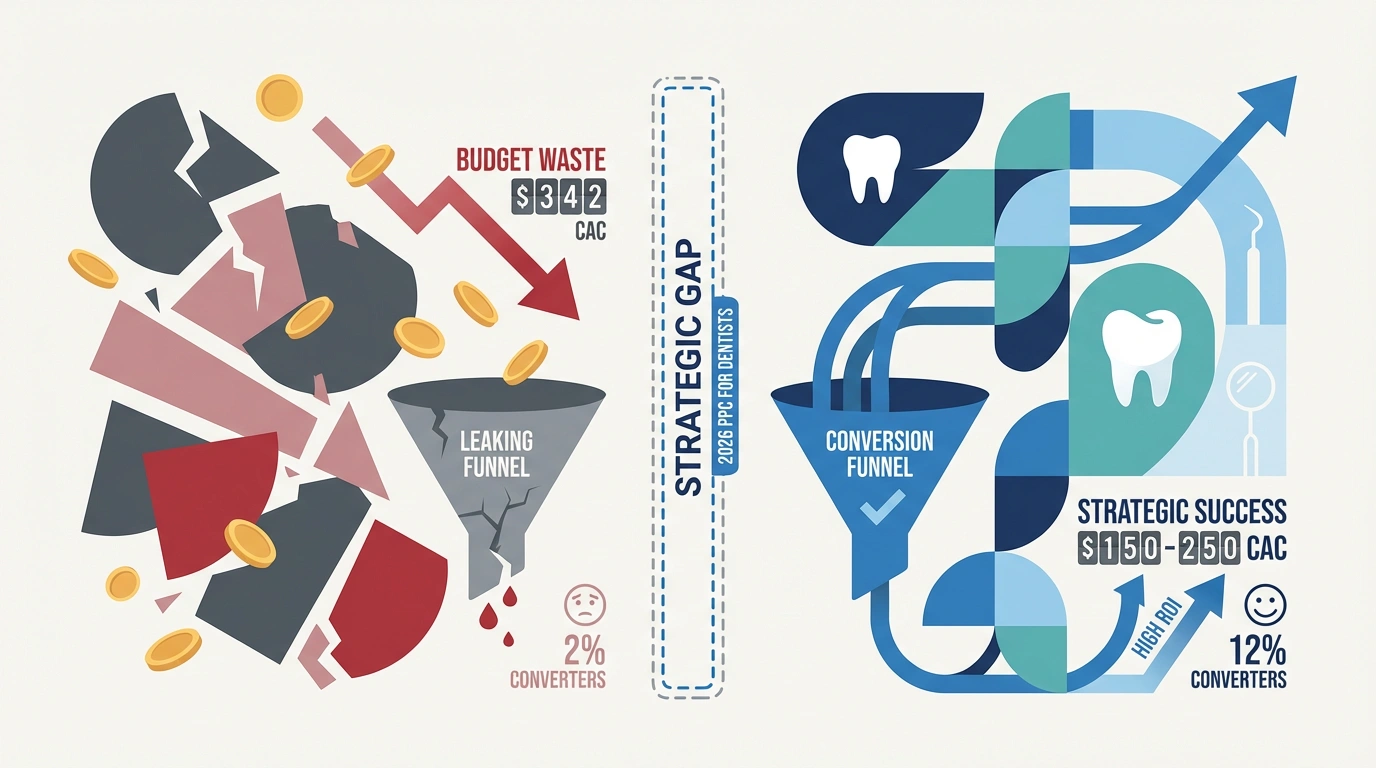
It’s that dental PPC has the highest patient acquisition cost of any marketing channel at $342 per patient, and practices converting 12% are targeting different intent than the 2% converters bleeding budget on volume.
What changed, what it’s costing you, and what winners are doing differently.
The $342 CAC Problem: Why PPC for Dentists Has the Highest Patient Acquisition Cost and How Winners Cut It in Half
Your competitor just booked three $25,000 implant cases from a $2,500 monthly Google Ads budget while you burned $3,200 and signed two cleanings worth $300 each.
PPC for dentists averages $342 per patient, the highest cost of all marketing channels, beating organic social ($289) and direct mail ($240) by a wide margin.
Most practices spend $3,200 monthly but struggle because leads don’t convert: prospects reject insurance terms or ghost after seeing prices.
The service-specific gap reveals the real story:
- General dentistry: $150-$250 CAC, $1,500-$3,000 lifetime value (6-12x ROI)
- Implants: $250-$500 CAC, $15,000-$30,000 lifetime value (30-60x ROI possible)

Case study: One practice structured $2,000 monthly ($1,200 implants/Invisalign, $800 general) and generated 50+ qualified leads.
Most practices spread budget evenly across all services, treating $300 cleanings and $25,000 implants identically.
If you’re paying $400 to acquire patients worth $1,500, overhead eats your margin before the second visit, but the practices cutting CAC in half aren’t buying cheaper clicks (they’re targeting different intent).
Intent Beats Volume: Emergency Keywords Convert 3x Better Than “Dentist Near Me”
Two practices bid on dental keywords at $7.85 per click, but one converts 12% while the other converts 2%, and it has nothing to do with their landing pages.
Generic broad keywords like “dentist near me” or “dental clinic” generate clicks but conversion rates stay stuck at 2-5%.
Emergency keywords like “toothache relief now,” “broken tooth emergency,” or “emergency dentist open Sunday” convert at 10-15% despite higher CPCs (weomedia).
The gap compounds fast:
- qualifying copy in ads that mentions pricing ranges
- insurance acceptance
- specific services pre-filters tire-kickers before they click.
Reddit practitioners report massive bounce rates when landing pages don’t immediately answer “Do you take my insurance?” and “How much does this cost?”.
Dental PPC conversion rates range 5-15% depending on keyword type and landing page quality, but most practices waste 40% of budget on broad research terms hoping volume becomes quality.
If your search terms report shows “dentist near me” eating 40% of budget while “emergency root canal tonight” sits at 5%, you’re paying $7.85 per click for researchers, not patients ready to book, and high-intent keywords don’t just convert better—they attract patients who accept pricing faster.
PPC for Dentists: Why 50% Bounce Before Reading Your Offer
Your $7.85 clicks are landing on pages built for desktop in 2019, and half your budget is evaporating before patients scroll past the hero image.
Successful dental campaigns hit 5-15% click-to-lead conversion and 40-60% lead-to-patient conversion.
Practices below 5% don’t have traffic problems; they have landing page problems.
Mobile-first is non-negotiable: 60%+ of dental searches happen on mobile, and slow load times kill conversions before patients read your offer.
The insurance and pricing question destroys campaigns silently.
Reddit data shows patients need immediate answers on insurance acceptance, payment plans, and ballpark pricing in the first screen or they bounce to the next result.
High-performing practices display:
- Insurance logos above the fold
- Transparent pricing ranges or “from $X” indicators
- Clear CTA with phone number and booking button
- Mobile load time under 3 seconds
Conversion rate jumps from 5% to 12% aren’t about redesigning your entire site; they’re about answering the two questions every $7.85 click is asking.
If your landing page forces patients to hunt for “Do you take my insurance?” while competitors answer it in the headline, you’re paying premium CPCs to send qualified traffic to practices with better mobile UX, and LSA vs Google Ads budget allocation can’t fix what broken landing pages are hemorrhaging.
LSA vs Google Ads: Why You Need Both
Analysis of 150 dental practices shows the average spends $3,200 monthly on Google Ads while leaving 30-50% of local search volume completely untapped.
Local Service Ads (LSA) offer:
- pay-per-lead pricing,
- top placement above traditional ads,
- and a Google-verified badge that builds instant trust
Traditional Google Ads offer:
- more control,
- better targeting for high-value services like implants and Invisalign,
- and broader reach beyond local-only searches.
The integration multiplier is where winners separate from budget bleeders: practices running both LSA for general dentistry volume plus Google Ads for high-value service targeting see compounding results.
Budget allocation strategy:
- General dentistry practices: 50% LSA, 50% Google Ads
- Specialty/cosmetic practices: 30% LSA, 70% Google Ads (high-value services need precise targeting)
Practices running Google Ads in isolation pay premium CPCs for baseline performance while competitors stacking LSA plus Google Ads capture both general dentistry volume and targeted implant leads.
If you’re spending $3,200 monthly on Google Ads alone while LSA sits dormant, you’re funding one channel at premium pricing when the winning playbook runs both.
And the weekly optimization discipline that keeps either channel profitable starts with knowing which clicks are bleeding budget into unqualified leads.
The Weekly Optimization Discipline (Why Last Quarter’s Winners Are This Quarter’s Budget Bleeders)
PPC costs jumped 12.88% in 2025, hitting an average of $5.26 per click, and dental services climbed to $7.85—what worked at $6.50 CPC doesn’t work at $7.85 without weekly optimization (WhatConverts).
Negative keyword management saves $500-$1,500 monthly when updated weekly:
- filter “free consultation”
- “dental jobs”
- “DIY dentistry”
- and competitor names you don’t want triggering ads.
Most practices check search terms reports monthly; winners audit weekly and kill wasteful triggers within 48 hours.
The conversion tracking gap kills silently: practices tracking form fills optimize toward tire-kickers who ghost after seeing prices.
Practices uploading offline conversions (booked appointments, completed treatments) teach Google’s AI what actually drives revenue.
Multi-channel integration compounds authority:
- Isolated PPC = premium CPCs for baseline results
- PPC + LSA + SEO + GMB + reviews = stacked signals, lower CPCs, higher Quality Score
Weekly audits separate 12% converters from 2% converters, and if your last optimization was 90 days ago while CPC rose 12.88%, you’re funding competitors who reallocate budget every seven days to what’s working.
Pro tip: Track every lead source to the exact campaign, keyword, and ad variation that generated it by using LeadSources.io. Then tie closed patients back to their origin so you know which $7.85 clicks are printing $25,000 implant cases and which are burning budget on tire-kickers—this revenue attribution lets you kill underperformers within one week, reallocate budget to campaigns with 10x+ ROI, and scale what’s working instead of guessing which keywords close deals.
PPC for Dentists: The $342 CAC Gap Comes Down to Intent
PPC for dentists in 2026 separates strategic CMOs from budget bleeders.
Target emergency and service-specific keywords over generic volume.
Fix landing pages to answer insurance and pricing in the first screen.
Run LSA plus Google Ads, not one or the other.
Audit search terms weekly and update negatives within 48 hours.
The difference between $150 CAC with 10x LTV ratios and $400 breakeven is whether you’re optimizing for intent or hoping volume becomes quality—it won’t.
