


b2b sem is no longer just about buying clicks; it is about owning the most intent-rich moments in your category before competitors even see them.
CMOs who treat paid search as a precision growth engine, not a media line item, are quietly reshaping their pipeline mix and sales velocity.
In this article, we will unpack how a modern b2b sem strategy can become your most accountable source of net-new, in-market demand, with examples drawn from leaders featured on (Think with Google).
Optimizing B2B SEM for Intent, Quality, and Funnel Stage
Performance B2B SEM now lives or dies on how precisely you align queries, journeys, and qualification standards. Volume is easy to buy, but compounding waste from low-intent clicks will quietly drain budget and confidence in paid search. CMOs need SEM that behaves like a revenue engine, not a traffic faucet.
That requires disciplined intent design, content that serves buyer self-education, and experiences that work flawlessly on mobile.
When those elements work together, you get fewer hand-raisers but more opportunities that reach pipeline and revenue. When they do not, SDRs are stuck chasing noise and finance starts questioning your entire media mix.
Precision in keyword intent and match strategy drives lead quality
Most B2B accounts can add spend in days, yet struggle for quarters to fix lead quality. In r/PPC threads, practitioners regularly point to broad match usage without guardrails and shallow negative lists as the culprits behind floods of irrelevant demo requests, student queries, and job seekers. The result is a widening gap between reported “conversions” and sales accepted opportunities that senior teams quickly notice.
That gap is not a creative problem, it is an intent problem.
High performing B2B SEM programs treat intent like tiers of eligibility, not just lists of keywords. They cluster queries into buying modes such as learning, problem identification, solution comparison, and ready to engage, then match each cluster with the right match types, bids, and exclusions. Structured this way, keyword strategy becomes a quality filter that protects SDR bandwidth instead of a volume dial that overwhelms it.
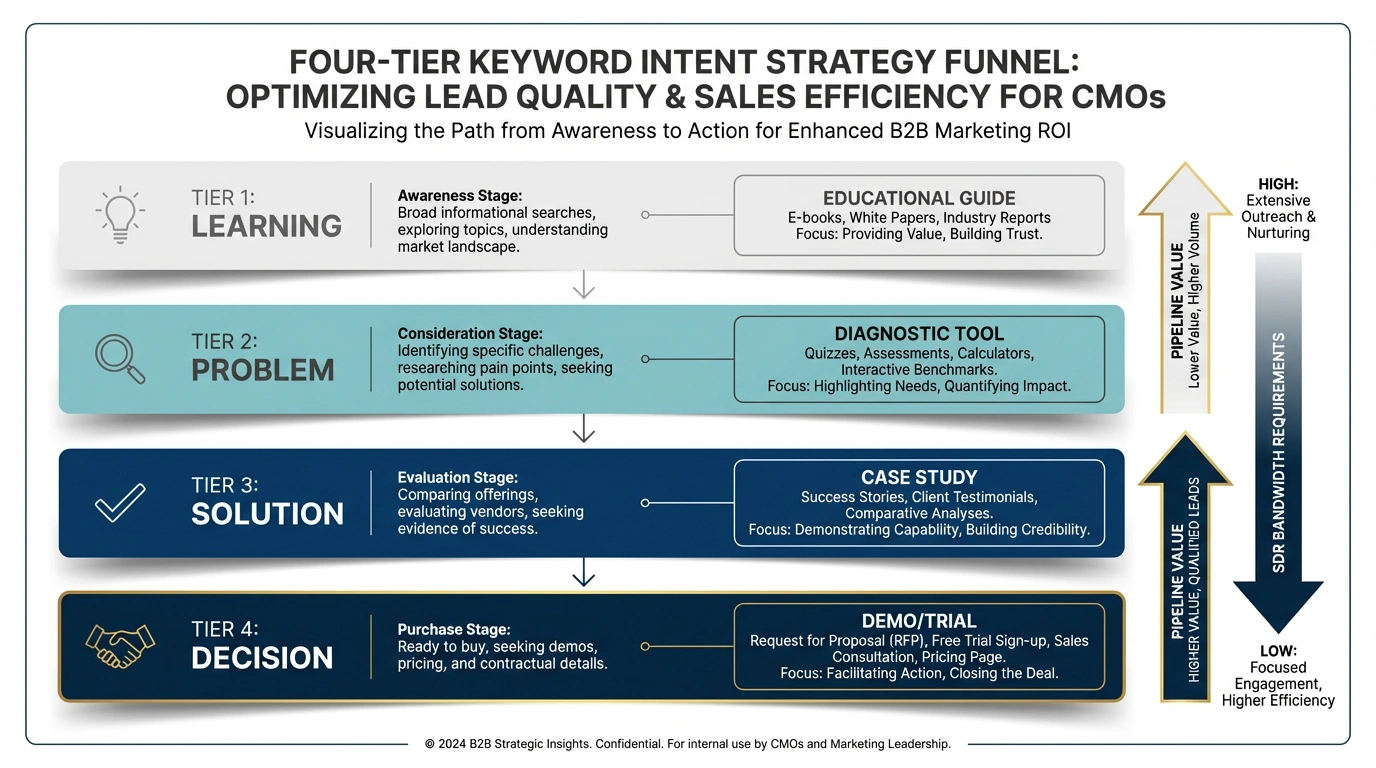
One cybersecurity vendor illustrates the impact. Their original account leaned on broad match across generic security terms, with minimal negatives and all funnel stages sent to a single “book a demo” page. After tightening negatives, shifting discovery to more controlled match types, and splitting campaigns by intent cluster, low quality form fills dropped while qualified pipeline rose. SDRs spent less time disqualifying poor fits and more time progressing real opportunities.
Landing pages and content must answer to buyer self-education
Today’s B2B buyers want to research on their own long before they talk to sales. Gartner reports that 75% of B2B buyers prefer to explore independently without sales involvement early in the journey ([Gartner]).
This flips SEM landing pages from simple lead capture to primary sales touchpoints.
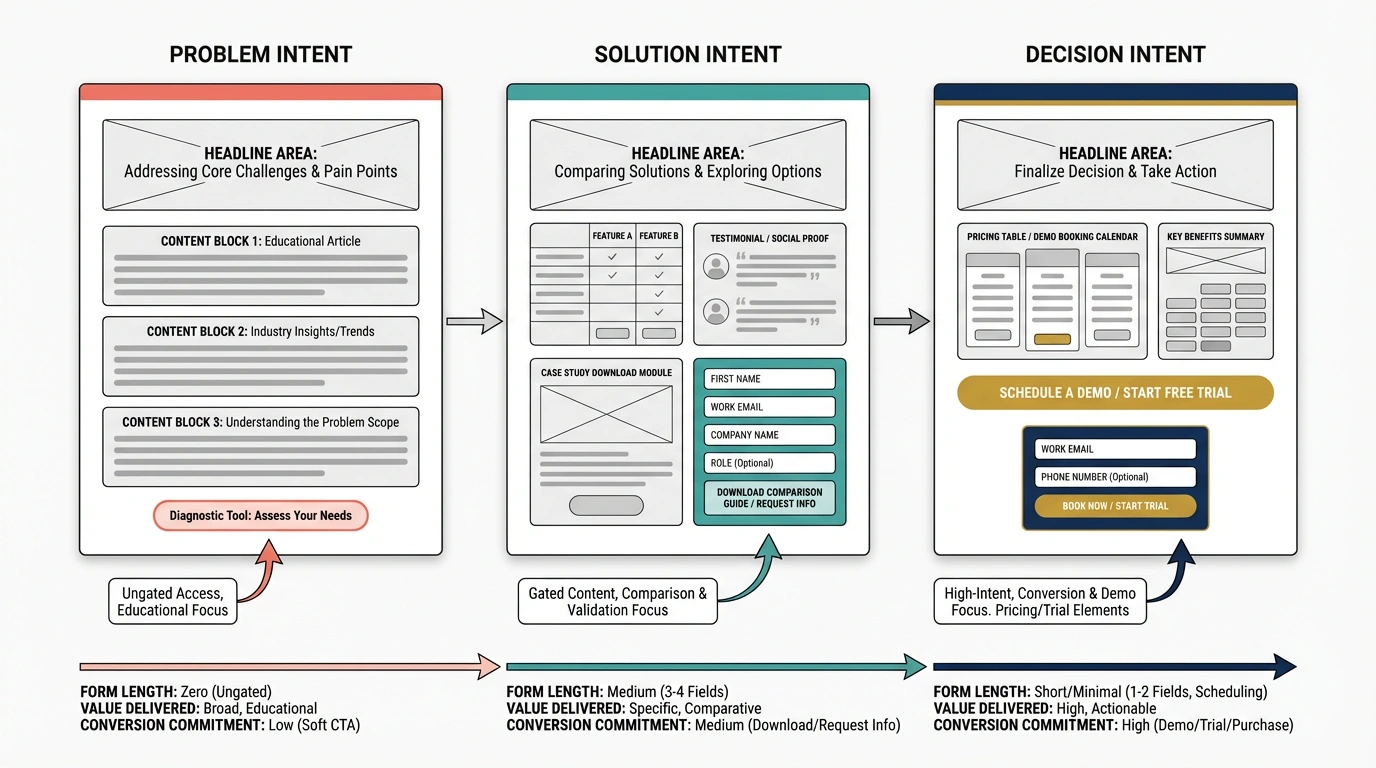
Pages that still lead with generic hero copy and a hard “talk to sales” CTA ignore what buyers are actually trying to accomplish. Instead, high intent strategies pair query clusters with tailored offers such as guides, ROI breakdowns, proof of value assets, or light-touch consultations. Forms stay focused on essential fields and clarify what the prospect receives, not what your SDR team needs.
In one services firm, separating landing pages for problem aware and solution aware keywords was the unlock. Problem oriented searches landed on educational pages that explained the stakes, shared benchmarks, and offered a diagnostic. Solution oriented searches landed on comparison and case-study heavy pages that positioned the firm against alternatives. Conversion rates improved, lead scores rose, and downstream funnel reports stopped treating all SEM leads as a single, noisy bucket.
Mobile experience is now non-negotiable in B2B SEM
Mobile accounts for more than half of Google searches, and that behavior carries into B2B research as executives scan results between meetings, on commutes, or during events. A slow, clunky, desktop first experience quietly suppresses conversion rates on your most common entry point. Practitioners routinely surface this in community forums as one of the hidden reasons “high intent” campaigns underperform on paper.
For CMOs, mobile optimization is not a UX side project, it is a lead quality and efficiency lever. Responsive layouts, tap friendly CTAs, short form content, and fast load times keep senior buyers on page long enough to understand your value. Simple mobile specific elements, such as clear call extensions for lower funnel campaigns or easy calendar booking from phones, reduce friction at critical handoff moments.
When you combine rigorous intent controls, self serve content, and mobile ready experiences, SEM becomes a predictable source of qualified, stage appropriate demand rather than an expensive experiment.
Measurement in B2B SEM: Closing the Loop for True ROI
B2B SEM only earns its seat at the leadership table when it can prove a direct line to pipeline and revenue, not just leads and clicks. Long consideration cycles, multiple stakeholders, and rising privacy constraints make that harder every quarter.
Yet these same realities also make rigorous measurement a strategic advantage for CMOs willing to close the loop between media, CRM, and revenue reporting.
To get there, measurement has to evolve beyond channel-centric dashboards and into revenue-based KPIs that your CFO and CRO recognize. That shift starts with rethinking attribution, then operationalizing offline conversion data, and finally aligning success metrics to pipeline stages instead of top-of-funnel volume.
Attribution must move beyond last click to revenue-based KPIs
Last click looks clean in a report, but in B2B it routinely misrepresents what actually drives deals. Long sales cycles, dark social, and privacy limits mean the final click is usually just the last touch in a much richer journey.
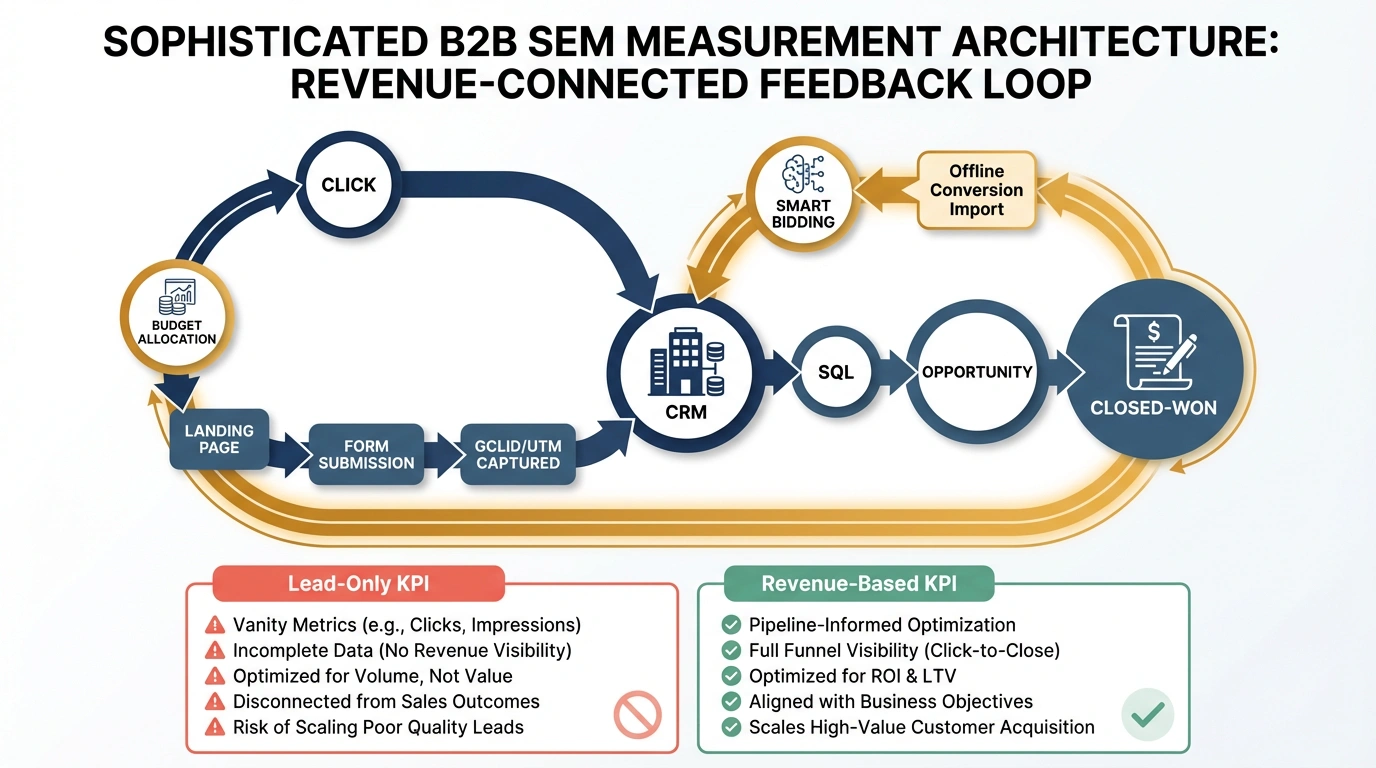
Reddit r/marketing practitioners consistently highlight a practical fix: capture GCLID and UTM parameters on lead forms, pass them into the CRM, and join that data to opportunities and revenue. That enables full-funnel reporting that ties spend to SQLs, opportunities, and closed-won, not just leads.
Without this CRM-connected feedback loop, bidding algorithms quietly optimize for the cheapest form fills. The result is inflated lead volume, low qualification rates, and internal skepticism about SEM. By contrast, a SaaS firm that imported “SQL” conversions from its CRM back into Google Ads saw pipeline quality improve while junk leads declined, because bidding finally prioritized the behaviors that predicted revenue.
Offline conversion imports power smarter bidding and reporting
Once CRM data is structured, the next unlock is sending offline outcomes back into the ad platform as conversions. Feeding opportunity creation, SQLs, or high-intent product-qualified stages into Google Ads or other platforms lets Smart Bidding optimize toward what actually matters.
Instead of chasing low CPL, the system learns which queries, audiences, and creative patterns correlate with high-value deals and adjusts bids accordingly.
This closes a persistent accountability gap that has dogged B2B SEM for years. Media teams gain a defensible story when they can show that campaigns with higher CPL are actually producing stronger opportunity creation rates and contribution to revenue. Practitioners in Reddit discussions report that offline conversion imports increased both opportunity volume and quality, giving finance leaders more confidence in sustained or increased SEM investment.
Define pipeline-driven success metrics, not just MQLs
Internal mistrust of SEM often starts with a single issue: the organization measures success on lead volume instead of revenue impact. When every form fill is treated as a win, teams are unintentionally rewarded for low-intent, low-conversion traffic.
To reset, CMOs need a clear taxonomy and reporting cadence that separates MQLs, SQLs, pipeline opportunities, and closed-won deals by channel and campaign.
Benchmarks that stop at “lead source” obscure which programs actually move prospects through the funnel. Marketers on Reddit frequently note that over-indexing on MQLs pushes teams toward cheap, unqualified tactics that erode sales trust. Aligning SEM reporting to revenue stages and pipeline contribution changes the internal conversation from “how many leads did we get?” to “how much qualified pipeline did we create?” and makes your SEM budget far more defensible in the next planning cycle.
For CMOs, the priority is to codify these expectations in your operating model: define the right conversion events, mandate CRM integration for all high-intent journeys, and ensure your dashboards mirror the way finance and sales evaluate growth. For a practical playbook on connecting ad data to revenue, see resources on (HubSpot).
Strategic SEM: What It Takes for CMOs to Win Long-Term
Winning with SEM in B2B now depends on running fewer, higher quality programs that are tightly aligned to revenue. Rising CPCs, longer buying cycles, and committee-based decisions punish activity for activity’s sake.
CMOs who succeed treat SEM as a portfolio asset, not a set of disconnected campaigns. They orchestrate intent coverage, conversion quality, and CRM visibility into a single operating system. The result is cleaner attribution, more predictable pipeline, and a clearer case to protect or expand budget.
Anchor SEM in Revenue, Not Clicks
SEM performance must roll up to pipeline and revenue or it will lose in budget conversations. Clicks, CTR, and even MQL volume are secondary signals.
Build your strategy around contribution to qualified opportunities and closed-won deals, so SEM can be compared fairly with other growth levers.
CMOs should push teams to reframe SEM objectives in terms of commercial outcomes, such as:
- Marketing sourced pipeline from high intent queries (brand, category, competitor, replacement)
- Influenced pipeline from mid-funnel queries that accelerate existing opportunities
- Customer expansion pipeline from queries related to add-ons, upgrades, and services
When the governing metric is pipeline, budget allocation decisions become clearer, and low-intent or vanity campaigns are easier to cut.
Map Campaigns to Buying Stages and Intent
Most wasted SEM spend in B2B comes from mismatched intent. A generic landing page for a high intent “software” query, or a hard demo CTA for an early stage “what is” query, quietly destroys ROI.
Winning programs segment keywords and creative by buying stage, then route traffic to experiences built for that specific level of intent.
At a minimum, your portfolio should distinguish between:
- Decision intent: branded, competitor, “vs”, pricing, and implementation queries that justify direct sales CTAs
- Problem and solution intent: “how to improve”, “best tools for”, or industry use cases that call for education-first offers
- Learning intent: definitions, frameworks, and trends that are best handled with ungated or lightly gated content
This structure enables you to tune bids, budgets, and creative to the actual business value of each intent band, not just traffic volume.
Close the Loop With CRM and Sales Reality
Without CRM integration, SEM looks better on a dashboard than it performs in the business. Form fills and conversions must be tied to accounts, opportunities, and revenue to understand true contribution.
CMOs should insist on end-to-end traceability from keyword to opportunity outcome. That means standardizing naming conventions, ensuring source data is reliable, and aligning with sales on qualification rules.
When SEM data is unified with CRM and sales feedback, you can:
- Shift budget toward queries and messages that produce high win-rate opportunities
- Identify patterns in markets, verticals, or use cases where SEM accelerates deal cycles
- Retire keywords and offers that generate noise for SDRs and AEs
Independent benchmarks already show that B2B buyers conduct extensive online research before engaging sales, with search as a primary input ([Gartner]).
CMOs who connect that early search behavior to the CRM are in the strongest position to prove marketing’s full revenue influence.
Strategic SEM: What It Takes for CMOs to Win Long-Term
To win with B2B SEM, CMOs need fewer, higher quality programs that are explicitly anchored in revenue. Rising CPCs and longer buying cycles make it risky to fund activity that cannot be mapped to pipeline or closed-won impact.
SEM must be managed as a portfolio asset, where every campaign’s job is clear, measurable, and defensible in a budget review.
That starts with reframing success around commercial outcomes. Clicks and MQLs are diagnostic, not directional.
Use metrics like marketing sourced pipeline from high intent queries and influenced pipeline from mid-funnel searches to compare B2B SEM objectively with other growth levers.
Next, align campaigns tightly to buying stage and search intent so you stop paying for mismatches. Decision intent queries should hit sales-ready offers, while problem and learning intent should route to education-first experiences that nurture and qualify interest.
This structure lets you tune bids and budgets to business value instead of raw traffic volume.
Finally, fully connect SEM to your CRM and sales reality. Trace performance from keyword to opportunity outcome, standardize tracking, and close the feedback loop with sales.
Given how extensively B2B buyers research via search before engaging a vendor ([Gartner]), CMOs who connect early intent signals to downstream revenue will protect their budgets and prove marketing’s true impact.