

TL;DR
- Carryover Effect describes how marketing impact persists after the initial exposure, causing conversions, pipeline, and revenue to appear later than the spend that triggered them.
- In attribution, it explains why channels with delayed influence often look weaker in short reporting windows and stronger in CRM revenue over time.
- Teams measure it best by combining journey-level lead tracking, lag analysis, and adstock-style modeling instead of relying on same-session or last-touch views.
What Is Carryover Effect?
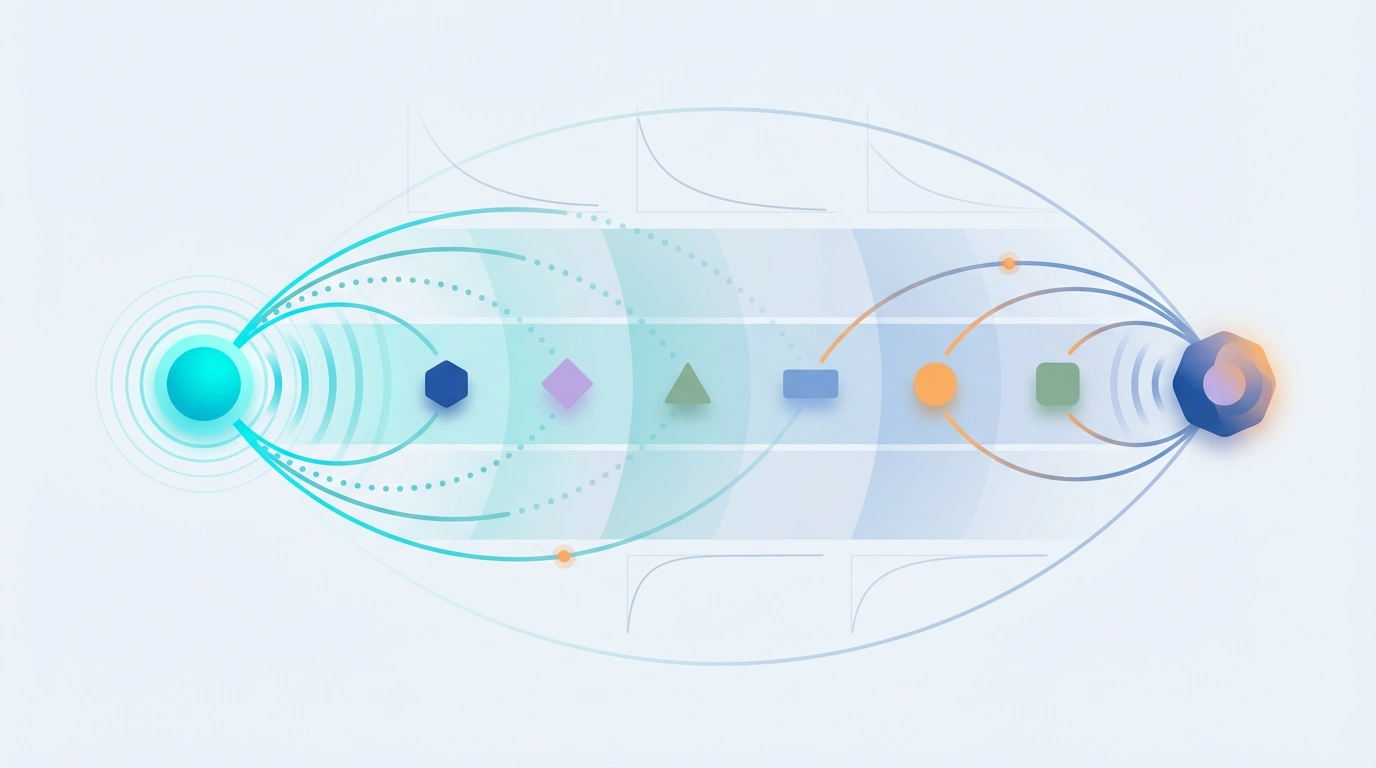
Carryover Effect is the delayed and persisting impact of a marketing activity after the original exposure period has ended.
In advanced measurement, it means a channel can continue influencing awareness, consideration, lead quality, and revenue across later days or weeks even when no new spend is added. This is why the term is closely tied to lagged effects and adstock in marketing mix modeling.
This is best classified as an advanced analytical concept rather than a tool or KPI. It is highly practical because it changes how CMOs read attribution, set lookback windows, evaluate CAC efficiency, and forecast pipeline from upper-funnel programs.
Its relationship to lead attribution is direct. If you only measure the final session, you under-credit the early touches whose effect carried forward into later form fills, SQL creation, and closed-won revenue.
Test LeadSources today. Enter your email below and receive a lead source report showing all the lead source data we track—exactly what you’d see for every lead tracked in your LeadSources account.
Why It Matters for Lead Attribution
Not all influence is immediate.
That is the core measurement problem.
Google’s attribution path reporting exists because customer journeys span multiple touchpoints before conversion. Google Meridian also models lagged media effects that taper over time, reinforcing that spend can affect KPI outcomes beyond the period in which the impression or click occurred.
That matters financially. A webinar, video campaign, category content push, or awareness program may create lift that shows up later in branded search, direct traffic, demo requests, and sales-qualified pipeline.
Forrester reported that 74% of business buyers conduct more than half of their research online before an offline purchase. In journeys like that, delayed influence is normal, not exceptional.
Gartner reported that only 52% of senior marketing leaders could prove marketing’s value and receive credit for business outcomes in 2024. Misreading delayed impact is one reason strong programs get undervalued in executive reviews.
Salesforce’s State of Marketing is based on insights from nearly 4,500 marketers worldwide, and related reporting shows only 26% are completely satisfied with their data unification. Without unified source and journey data, carryover gets buried under whatever channel happens to close the conversion.
How Carryover Effect Works
The effect unfolds over time.
A first touch creates memory, consideration, or demand. Later touches activate that demand and capture the conversion.
In measurement systems, this is often modeled with an adstock-style transformation that allows past media to retain a decaying share of influence into future periods.
A simplified geometric form is:
Adstock(t) = Spend(t) + λ × Adstock(t-1)
In this framework, λ is the decay rate. A higher value means impact persists longer into future periods.
Example: if a LinkedIn campaign generates thought-leadership reach this week, some of that influence may still affect branded search, direct visits, and demo conversions next week. Short-window attribution often misses that carryover and hands too much credit to the closing channel.
Common Patterns and Use Cases
| Scenario | Typical lag profile | Attribution risk |
|---|---|---|
| Brand or awareness media | Longer carryover | Under-credited in short reporting windows |
| Educational content and webinars | Moderate delayed lift | Credit shifts to later search or direct visits |
| Retargeting and branded search | Shorter lag, faster conversion | Over-credited as final touch |
| Partner and field marketing | Often uneven, cohort-dependent lag | Influence looks inconsistent without CRM linkage |
This is why the issue is not only statistical. It is also operational.
If campaign data, first touch, assist touch, and CRM outcomes are disconnected, delayed impact becomes invisible in planning cycles.
How to Measure It Better
- Extend reporting beyond same-session or last-click views and review conversion lag by channel.
- Store first touch, assist touches, landing page, session depth, and final touch at the lead level.
- Compare platform conversions with CRM outcomes such as SQL rate, pipeline created, and closed-won revenue.
- Use adstock or lag-aware MMM when evaluating upper-funnel channels and long sales cycles.
- Stress-test budget decisions with holdout experiments, time-based cohorts, or geo splits.
This is where LeadSources.io becomes operationally valuable.
Its customer journey tracking and richer source fields make it easier to connect the original source with later sessions and final conversion events. That reduces the chance that delayed influence is overwritten by the most recent visit.
Best Practices
- Judge channels on both immediate efficiency and delayed revenue contribution.
- Use longer lookback windows for programs with slower response curves, especially content, events, podcasts, and thought-leadership campaigns.
- Separate demand creation from demand capture in board reporting so closing channels do not absorb all the credit.
- Refresh decay assumptions regularly because lag patterns change by segment, market conditions, and creative quality.
- Translate lag findings into budget timing, not just attribution commentary.
The strategic edge is timing discipline.
Teams that understand delayed impact are less likely to cut high-value channels before their pipeline contribution fully appears.
Frequently Asked Questions
Is Carryover Effect the same as adstock?
Not exactly. Carryover Effect is the underlying phenomenon, while adstock is a common modeling method used to represent that delayed influence mathematically.
Why does this matter for B2B more than some B2C programs?
B2B journeys usually involve longer consideration cycles, more stakeholders, and more touchpoints. That increases the gap between initial exposure and recorded conversion.
Can last-touch attribution hide delayed influence?
Yes. Last-touch models often over-credit branded search, direct traffic, and retargeting because they close demand that earlier programs created.
What metric should executives watch first?
Start with conversion lag by channel, then compare attributed pipeline, SQL rate, and closed-won revenue across short and long reporting windows.
Does a longer lag always mean a better channel?
No. Longer lag only means influence persists or converts later. The channel still has to prove efficient contribution to pipeline and revenue.
What is the biggest implementation mistake?
Using platform-reported conversions without tying them back to CRM outcomes and journey data. That usually understates upper-funnel impact and overstates closing-channel efficiency.