


PPC cost estimator tools are quietly reshaping how CMOs forecast paid media, turning guesswork into board-ready numbers.
Used correctly, they help you pressure-test budgets, scenario-plan across channels, and align performance targets with real market costs.
Yet most leaders still treat them as rough calculators, not strategic instruments.
This article explores how a PPC cost estimator can evolve from a tactical widget into a core part of your growth and planning stack, on par with your CRM and analytics platforms like (Google).
Beyond CPC: How Advanced Estimators Connect to True Business Outcomes
Clicks are only the surface-level signal. Senior leaders care about what those clicks turn into across the full funnel, from qualified pipeline to revenue and profit.
To inform real investment decisions, PPC cost estimators must translate CPC into customer acquisition cost (CAC), payback period, and return on ad spend (ROAS).
That requires connecting media metrics to sales performance, margins, and cash flow impact, not simply projecting traffic volume.
In short, the estimator needs to function like a lightweight financial model, not a bid calculator.
PPC cost estimators must project complete funnel economics to be actionable
At the executive level, CPC is useful only if it is linked directly to economic outcomes.
Effective estimators start with projected impressions and clicks, then move through the funnel to lead, opportunity, and revenue projections that finance teams can interrogate.
They answer questions such as: At this CPC and conversion rate, what CAC should we expect, and how does that compare to our guardrails by segment or product line
In many organizations, under-forecasted CAC starts with optimistic assumptions between the click and the sale.
Teams underestimate drop-off at each stage, ignore non-opportunity disqualification rates, and neglect margin variability by product mix.
The result is a model that looks efficient on paper but fails when real-world leakage and margin erosion show up in the P&L.
A more rigorous approach explicitly maps every key conversion step and its economics.
That means wiring in click-through rate, lead conversion rates, sales cycle velocity, close rates, and gross margin so leaders can see how sensitive CAC and ROAS are to each assumption.
With this structure in place, CMOs can stress-test whether PPC will ever hit target payback periods at current bid levels or whether the strategy requires creative, offer, or funnel redesign instead of simply higher bids.
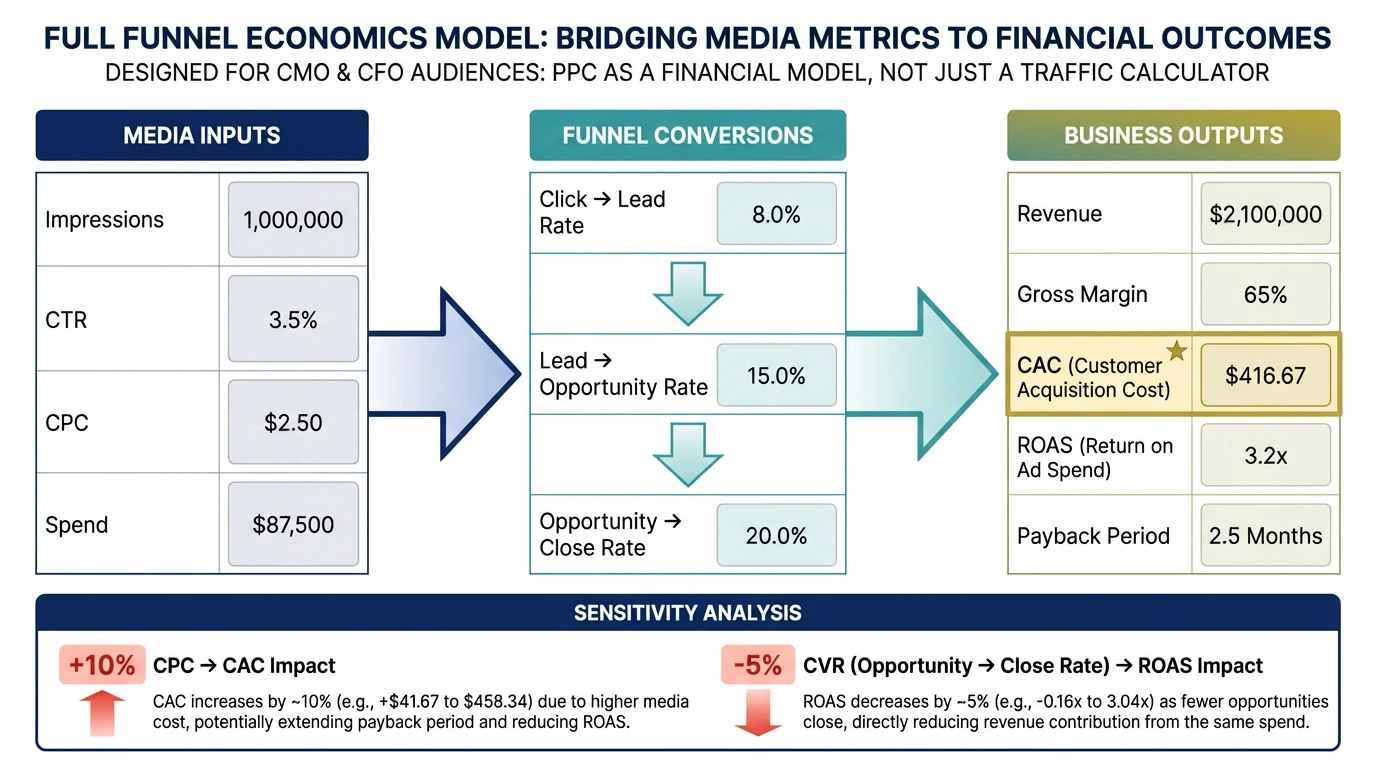
Consider an ecommerce brand that models advanced funnel economics into its estimator.
It uses average order value, contribution margin, and repeat purchase rate to calculate lifetime value and break-even ROAS.
The estimator continually evaluates whether rising CPCs are compressing ROAS below that break-even line, effectively flagging when to pull back spend, renegotiate with affiliates, or test higher-value bundles before profitability is compromised.
PPC cost estimation should enable scenario analysis and investment calibration
For a CMO, the primary value of a PPC estimator is not a single prediction, but a range of plausible outcomes.
High-quality tools allow teams to run structured scenarios so budget decisions can be framed in terms of risk, variance, and trade-offs across channels and markets.
Instead of asking whether a campaign will work, executives can ask what level of spend produces acceptable CAC and payback under conservative assumptions.
Scenario analysis typically centers on a few levers.
Teams model how shifts in CPC, conversion rate, and average deal size affect both CAC and ROAS, then identify where incremental budget begins to hit diminishing returns.
These ranges help CMOs avoid overcommitting to aggressive forecasts that assume perfect execution and ideal market conditions.
In practice, the most useful estimators make it simple to compare best, expected, and worst cases side by side.
When leadership can see that a particular keyword cluster delivers stable ROAS even in a downside scenario, it becomes a candidate for increased investment.
Conversely, segments that only work under aggressive performance assumptions can be capped, tested more cautiously, or funded from an experimental budget rather than the core plan.
One multi-location services company, for example, maintains separate regional models to reflect competitive intensity and local pricing power.
Marketing and finance review forecasts monthly, then reallocate spend toward regions where projected ROAS meaningfully exceeds the organization’s minimum thresholds.
This cadence turns PPC planning into an ongoing capital allocation exercise rather than an annual set-and-forget budget cycle.
Adoption accelerates when estimators integrate with live campaign data for ongoing calibration
Executive trust in any forecast depends on its ability to learn.
PPC estimators that stay static quickly lose credibility as auction dynamics, creative performance, and buyer behavior shift.
To remain actionable, models need to ingest first-party campaign data on a regular cadence, reconcile forecast variances, and adjust assumptions so each new planning cycle starts closer to reality.
Market benchmarks, such as those regularly published by [WordStream](https://www.wordstream.com/blog/ws/google-ads-benchmarks), highlight how quickly CPCs and conversion rates evolve across verticals.
Relying on last year’s assumptions in this environment creates forecasting whiplash when actual performance diverges sharply from planned results.
By contrast, estimators that automatically pull in live platform metrics, CRM outcomes, and margin data can re-baseline expected CAC and ROAS every few weeks.
For CMOs, this closed-loop calibration is what turns PPC estimates into a strategic management tool.
When actuals feed back into the model, each forecast becomes a testable hypothesis rather than a static commitment.
The organization learns which assumptions consistently hold, which channels or segments display volatility, and where additional data or experimentation is required before scaling spend.
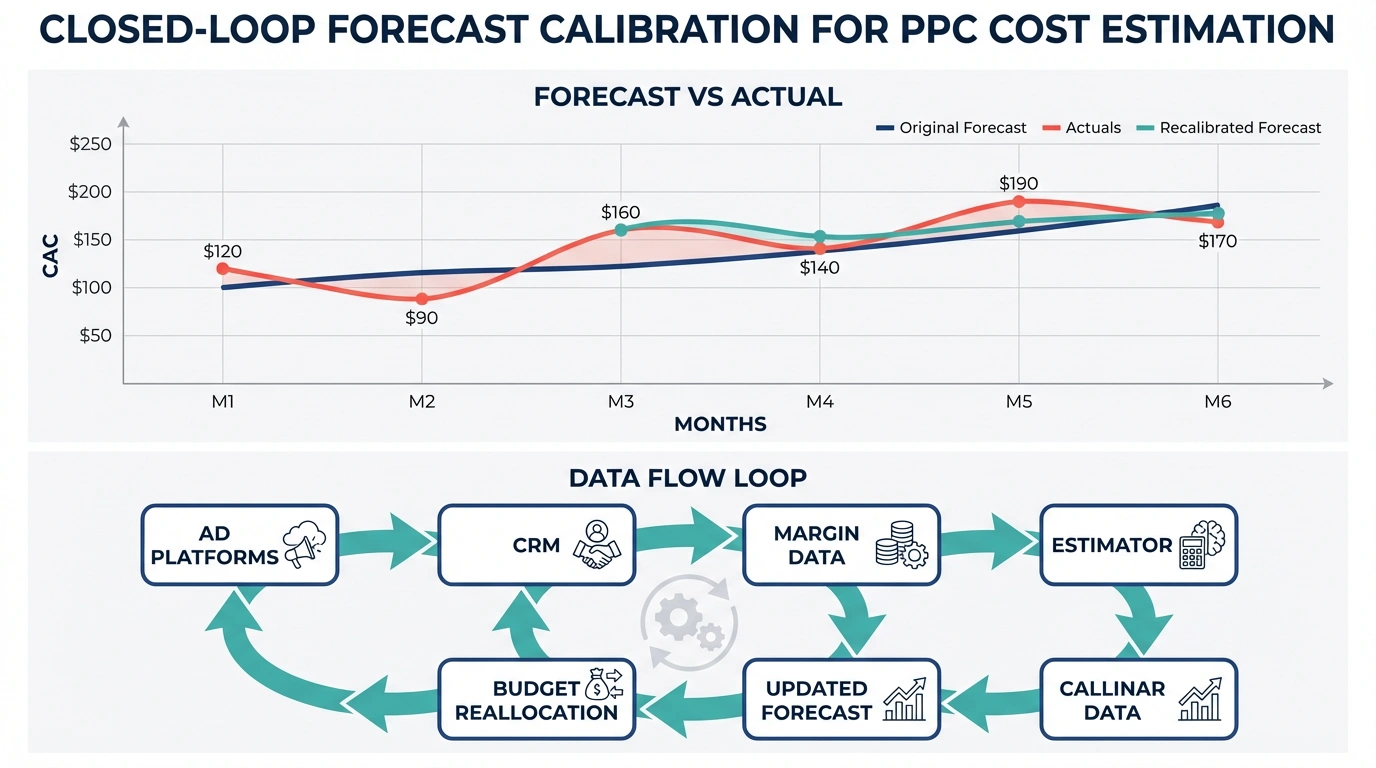
Over time, this feedback loop materially improves both planning accuracy and internal confidence.
Finance teams see that marketing is continuously reconciling plan versus actuals, adjusting forecasts when conditions change, and retiring outdated assumptions.
That transparency makes it easier to defend PPC budgets, greenlight new experiments, and position paid media as a disciplined investment lever instead of a discretionary expense.
Positioning a Best-in-Class PPC Cost Estimator for CMO Success
For CMOs, a PPC cost estimator is not a toy calculator but a forecasting asset that must stand up in the boardroom.
To be credible, it has to mirror how real auctions behave, how performance can drift, and how financial risk actually shows up in the P&L.
The strongest tools go beyond “traffic and leads” to support scenario planning, capital allocation, and accountability conversations with finance.
In practice, that comes down to three things: transparent uncertainty, clear performance levers, and tight calibration to your vertical and first-party data.
Transparency and uncertainty bands are key to executive-level trust
Traditional PPC calculators that promise single-number projections rarely survive contact with a skeptical CFO.
CMOs need estimators that explicitly show uncertainty bands so leadership can understand not just the most likely outcome, but also the realistic upside and downside.
This allows you to frame paid search not as a gamble, but as a managed risk with defined probability ranges and clear triggers for intervention.
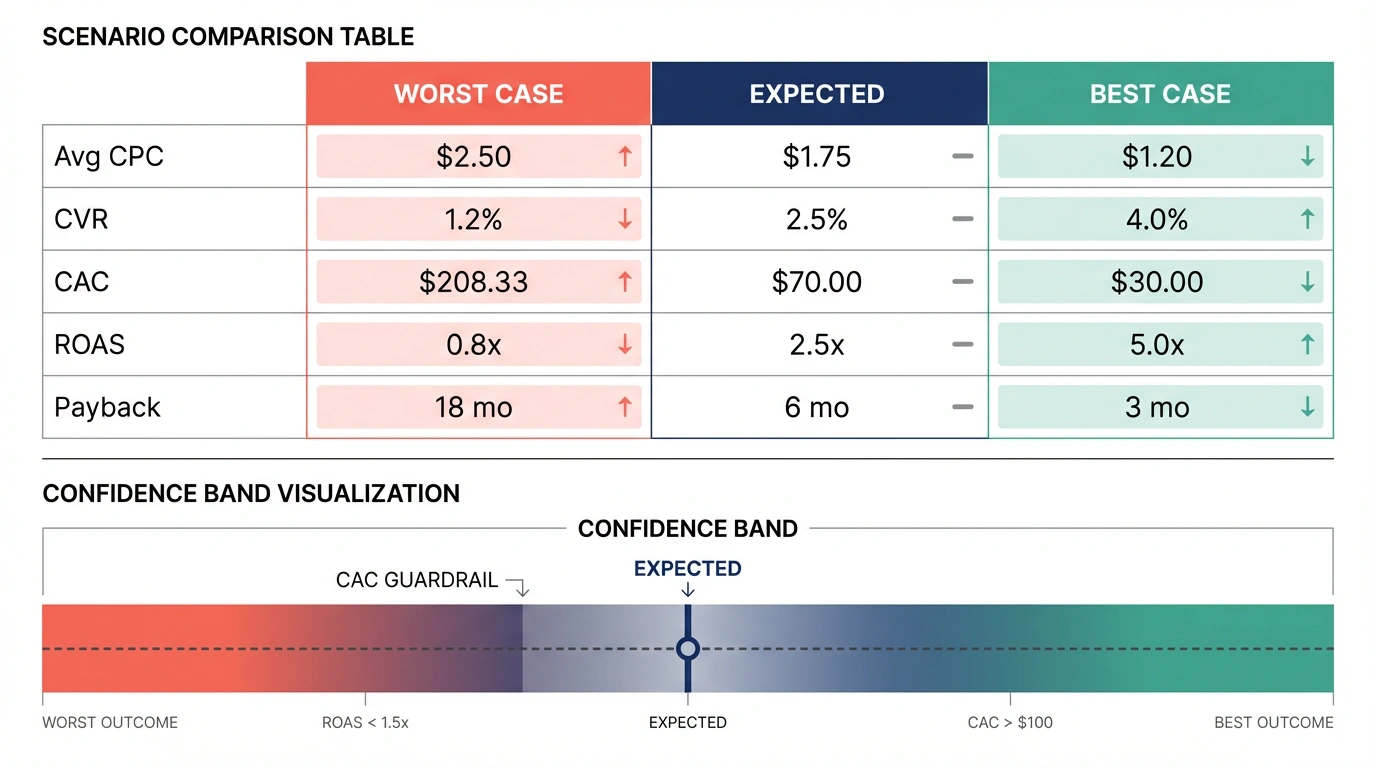
By surfacing confidence intervals for metrics like CPC, CPA, and pipeline, the estimator becomes a decision support tool instead of a vanity model.
It reinforces that auction dynamics, competitor moves, and macro shifts introduce volatility that no responsible leader should hide.
Executives quickly learn to ask, “What would have to be true to move us from expected to best or worst case?” which sharpens budget and channel mix conversations.
In practice, this makes scenario planning faster and more defensible.
CMOs can walk boards through best, base, and stretch pipeline views tied to paid search, complete with cash payback timelines.
When outcomes land inside the predicted band, trust in both the marketing plan and the finance partnership strengthens over time.
Customizability and clarity on levers drive real business value
A best-in-class PPC estimator does not treat costs as a black box.
Instead, it lets leaders manipulate the specific drivers that marketing teams can actually influence, such as Quality Score, conversion rate, average order value, and audience refinement.
By tying each lever to clear financial impact, the tool connects creative and experience decisions directly to CAC, LTV, and pipeline coverage.
For example, modeling how a 20 percent lift in landing page conversion rate or a one-point Quality Score improvement affects blended CAC turns abstract optimization work into tangible value creation.
This allows CMOs to prioritize initiatives that move the economics, not just vanity metrics.
It also sharpens internal accountability, since channel owners can see exactly how their optimization roadmaps translate to budget efficiency.
Teams learn faster when they see these sensitivities visualized.
Over time, they internalize which levers deliver step-change versus incremental gains, and the estimator becomes a shared language for trade-offs across creative, product marketing, and demand generation.
The result is a more focused testing agenda and quicker convergence on scalable campaign configurations.
Vertical calibration and first-party data integration differentiate market leaders
Generic PPC benchmarks are rarely sufficient for enterprise-level forecasting.
CMOs need estimators that reflect both the structural realities of their vertical and the specific economics of their own funnels.
That starts with vertical-specific CPC and conversion rate baselines, then layers on company-level modifiers for factors like sales cycle length, lead quality, and deal size.
A modern estimator should prompt users to upload or connect first-party performance data on a recurring cadence.
With each import, the model tightens the gap between external benchmarks and lived results, improving forecasting accuracy quarter after quarter.
In effect, the tool evolves into a marketing data product that compounds in value, rather than a static spreadsheet that quickly goes stale.
The payoff is better capital deployment and cleaner executive reporting.
For instance, a brand operating across multiple regions can tune geo-specific bid and budget strategies by feeding localized CPC and CVR data into the estimator.
This enables CMOs to reallocate spend from structurally inefficient markets to higher-yield geographies with confidence, supported by a forecast their board recognizes as disciplined and data-driven.
Used this way, the estimator becomes a durable advantage in planning, not just a pre-campaign calculator.
PPC cost estimators are a CMO’s essential ally for strategic, data-driven planning
PPC cost estimators have evolved from simple CPC widgets into boardroom-grade planning tools.
Used correctly, they give CMOs a fast, defensible view of what it really costs to buy revenue in paid search.
Instead of debating channel budgets on opinion, you can walk in with ranges, guardrails, and tradeoffs tied to numbers.
That turns paid search from a black box into a controllable investment that you can scale up or dial back with confidence.
As auction dynamics, privacy changes, and generative AI reshape search, this kind of disciplined forecasting is what separates reactive spenders from CMOs who stay in control.
From click calculator to strategic forecast engine
The modern PPC cost estimator is no longer a tactical calculator for your performance team.
It is a forecasting layer that connects market conditions, your historical data, and your revenue model into one coherent view of paid search economics.
The most useful tools let you combine three critical inputs.
First, vertical benchmarks for CPCs, click-through rates, and conversion rates, ideally segmented by intent and device.
Second, your first-party performance data from analytics and CRM.
Third, your true unit economics, such as qualified lead rate, opportunity close rate, and average contract value.
When those inputs are modeled together, the estimator becomes a strategic console for CMOs.
You can quickly see whether a proposed budget will deliver enough pipeline, how sensitive outcomes are to conversion shifts, and where diminishing returns start to kick in.
Managing risk and volatility in paid search
Auction volatility is now a constant.
Seasonality, competitor moves, and algorithm updates can move CPCs by double digits in weeks, not months.
CMOs need a structured way to turn that volatility into quantified risk instead of surprise overspend.
Scenario planning within PPC cost estimators is the most practical way to do this.
By toggling ranges for CPC, conversion rate, and sales conversion, you can stress-test your plans before committing budget.
- What happens to CAC if CPC rises 20% but conversion holds steady
- How much pipeline you lose if you cap spend at a lower ceiling
- Which mix of branded, non-branded, and competitor terms preserves ROAS under pressure
This turns conversations with finance from “we think the market is hot” into “here are three modeled outcomes with explicit assumptions and risks.”
It also helps you pre-negotiate contingency plans, so you can shift spend quickly without re-opening the entire annual budget.
Strengthening budget narratives with clear conversion math
In the C-suite, paid search only earns trust when you connect impressions and clicks to revenue in simple, transparent math.
PPC cost estimators help you cement that connection by standardizing how you translate media metrics into commercial outcomes.
A best-practice approach is to anchor forecasts around a few stable, easily understood metrics.
Cost per opportunity, pipeline per dollar, and projected CAC by segment give non-marketers a clear line of sight to business impact.
With a consistent model, you can show how incremental spend translates into incremental opportunities and revenue, not just more clicks.
Used this way, estimators also support portfolio decisions across channels.
You can compare marginal CAC in paid search with the marginal CAC in paid social, partner programs, or field marketing.
That comparison is crucial when CFOs are benchmarking marketing efficiency against industry data from sources such as the paid search benchmarks on (WordStream).
Most importantly, the discipline of using a PPC cost estimator forces your team to keep assumptions current.
As new data comes in, you refine conversion rates, lead quality factors, and win rates.
Over time, the model becomes a living asset that gives you faster, sharper decisions in an increasingly volatile auction environment.
PPC cost estimators are a CMO’s essential ally for strategic, data-driven planning
The modern PPC cost estimator is now a core part of the CMO toolkit, giving you a clear, defensible view of what it really costs to buy revenue in paid search.
Used rigorously, it turns debates about “more budget” into concrete conversations about CAC, pipeline, and revenue tradeoffs.
By combining vertical benchmarks, first-party performance data, and real unit economics, PPC cost estimators move you from channel guessing to scenario-led planning.
You can quantify how shifts in CPC, conversion rate, or win rate change your commercial outcomes, before you commit dollars.
This transforms auction volatility into managed risk.
Scenario planning lets you pre-model contingencies, set guardrails with finance, and decide when to scale or pull back without re-opening the annual plan.
Equally important, a PPC cost estimator sharpens your narrative in the boardroom.
Standardized metrics like cost per opportunity, pipeline per dollar, and marginal CAC make it easy for non-marketers to see the direct link from media spend to revenue, and to compare paid search efficiency with benchmarks such as the paid search data on (WordStream).
For CMOs, the signal is clear.
Treat your PPC cost estimator as a living forecasting engine, keep its assumptions current, and use it to anchor every major paid search decision in transparent, conversion-led math.