


A saas ppc agency
Not more leads, but cleaner, CRM-verified opportunities that map directly to revenue and sales capacity.
The real test is whether they can wire Google Ads to your CRM, enforce ruthless ICP filters, and own landing pages and sales follow-up as core levers.
Anything less belongs on your ([PPC budget review]) agenda, not your growth roadmap.
What Defines an Elite SaaS PPC Agency: Turning CAC into Pipeline Control
For a growth-minded CMO, a SaaS PPC agency is not a traffic vendor. It is a control system for CAC and pipeline quality.
Elite partners connect ad spend directly to revenue, so you can dial pipeline up or down with intention, not guesswork.
That means trading cheap leads for qualified opportunities, and requiring CRM visibility on every dollar invested.
If an agency cannot prove how it improves opportunity volume, win rates, and payback, it belongs in your cost-cutting plan, not your growth strategy.
CRM Integration and Offline Conversion Tracking Are Mandatory
The best SaaS PPC agencies optimize to closed-won revenue, not form fills. They wire your ad platforms into your CRM and push back offline conversions such as SQOs, opportunities, and revenue.
This closes the loop between click and pipeline, so bidding engines learn from the deals that actually close, not the leads that only look good on paper.
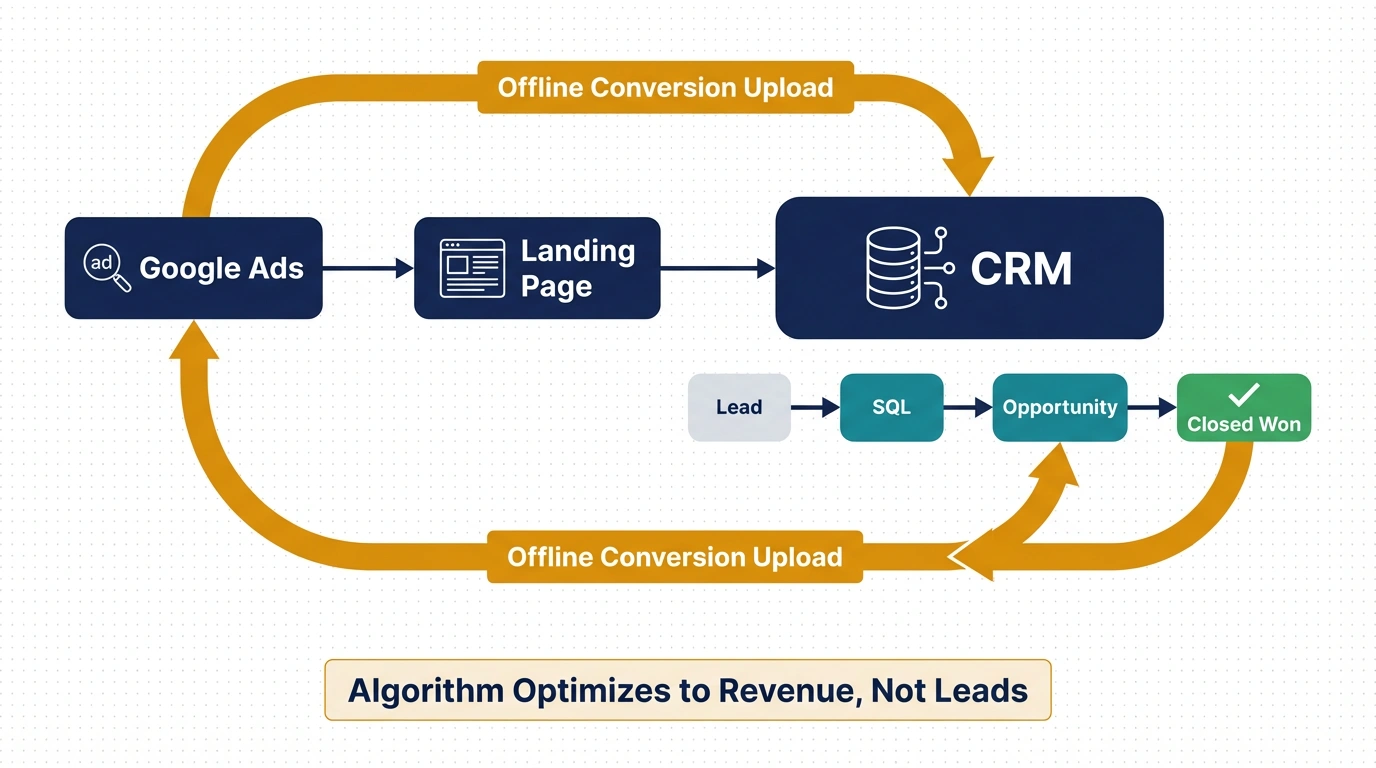
In B2B SaaS, Google’s market power and long sales cycles make disconnected reporting a critical risk. Without CRM back-feeds, paid search quickly degrades into a cost center, because algorithms are rewarded for low-cost leads instead of in-ICP buyers.
Elite agencies insist on technical foundation early: clean UTM discipline, lead-to-opportunity mapping, and offline conversion uploads as a non-negotiable launch requirement.
Consider a product-led SaaS that imported SQL and opportunity data from its CRM to retrain automated bidding. By cutting off optimization to low-velocity, non-ICP signups, the program eliminated spend on cheap but unqualified leads and doubled pipeline quality in a single quarter.
That is what modern PPC looks like when CRM data drives every major decision.
Value-Based and Lifecycle-Aware Bidding Outperforms Volume-Based Tactics
Volume-centric strategies that target MQL counts or CPL ceilings ignore the reality of B2B SaaS economics. Elite agencies structure bidding and budgeting around expected LTV, pipeline value, and payback periods.
They treat an opportunity from a strategic enterprise account very differently from a free-plan tire kicker, even if the initial click costs are similar.
Practitioners in r/SaaS and other operator communities report that shifting to pipeline-based bidding, powered by offline CRM data, improves both win rates and CAC efficiency.
By optimizing to late-funnel events like SQLs, opportunities, and closed-won deals, agencies align media to revenue, not vanity metrics.
In one SaaS case study, lead cost went up after the shift to CRM-driven bid strategies. Yet opportunity creation tripled, and CAC improved because sales teams spent time with accounts that matched ICP and progressed through the funnel.
For CMOs, that trade is rational: fewer leads, more revenue, and higher confidence in every incremental dollar of spend.
Continuous Landing Page and CRO Testing Are Non-Negotiable
With typical B2B landing page conversion rates hovering around 2 to 3 percent, every page is a performance asset that demands ongoing testing.
Elite SaaS PPC agencies treat landing pages, sales follow-up speed, and qualification criteria as extensions of the media plan, not separate initiatives.
Small conversion rate optimizations compound. Improvements in page speed, message match, and clarity can prevent large bounce rate spikes as load times increase, as shown in benchmarks from (Think with Google).
This turns marginal design tweaks into meaningful CAC improvements.
Operators on r/PPC report that dedicated landing experiences by intent and ad group, combined with systematic headline and offer testing, consistently yield better-qualified leads.
The most effective agencies connect those on-page experiments to sales-side data, using fast feedback from SDRs and AEs to refine value props, objections handling, and CTAs in near real time.
For CMOs, the signal to look for is simple: a partner that treats conversion rate optimization as an always-on discipline tied to pipeline metrics, not a one-time website project.
Pitfalls to Avoid When Hiring a SaaS PPC Agency
Most SaaS PPC agencies talk about “scale,” but very few can show you firm, pipeline-level control.
The real risk is not overspending on ads; it is funding an engine that optimizes for the wrong outcomes and buries bad economics inside pretty dashboards.
To turn paid search into a reliable growth lever, you need an agency that behaves like an extension of revenue operations, not a media vendor.
If they cannot integrate with your CRM, enforce ICP filters, and shape sales follow-up, they are just another CAC line item.
Use the pitfalls below as disqualifiers, not suggestions.
If an agency hits one of these, it belongs in your cost-cutting plan, not in your pipeline strategy.
Agencies That Focus on Impressions, Clicks, or MQL Volume Miss the Point
When an agency leads with impressions, CTR, or “record MQL volume,” they are optimizing for optics, not revenue.
That mindset rewards cheap, low-intent traffic instead of opportunities that convert into ARR.
Marketing leaders on r/marketing repeatedly complain that “lead quality is terrible” even when volume looks strong.
The thread is consistent: agencies chase low-cost form fills that have no fit with your ICP and never progress in the CRM.
The only meaningful SaaS PPC KPI framework starts at SQL and opportunity, and extends through to opportunity value and closed-won revenue.
Your agency should be comfortable bidding toward offline conversion events, like qualified opportunities, synced directly from your CRM.
Ask for live examples of campaigns where they turned off high-MQL, low-opportunity segments in favor of fewer, higher value leads.
If they cannot show that trade off in data, they are not ready to manage your pipeline.
Lack of Sales Collaboration and Slow Lead Response Time Kill Win Rates
Even perfect targeting fails if sales does not follow up with speed and structure.
Research in (HBR) shows that responding within 5 minutes can make you several times more likely to convert online leads, yet most PPC programs ignore what happens after the form submit.
Agencies that treat “lead delivered” as success, without owning time-to-first-touch and follow-up quality, leave a large share of pipeline value on the table.
In r/SaaS and r/PPC discussions, the highest performing teams wire PPC directly into CRM workflows, sales alerts, and routing rules.
Your SaaS PPC partner should insist on collaboration with sales leadership, clear contact SLAs, and auditable lead handling.
If they avoid conversations about sales ops, they are not serious about revenue outcomes.
Weak Negative Keyword and Audience Frameworks Waste Budget
As search auctions get more competitive, unqualified clicks become a hidden tax on your CAC.
Without disciplined negative keywords and audience controls, your budget bleeds into job seekers, students, and non-SaaS researchers.
CMOs on Reddit often outperform “set and forget” agencies simply by tightening search terms weekly and pruning irrelevant segments.
Those in-house teams treat negative keyword expansion and audience exclusions as ongoing revenue operations, not quarterly hygiene.
Your agency should present a clear framework for:
- Systematic negative keyword management tied to search term reports and CRM feedback.
- Audience segmentation and exclusions based on ICP, deal size, and win-rate patterns.
If an agency cannot walk you through how they protect your spend from irrelevant queries and audiences, they are not ready to run a value-based, pipeline-led PPC program.
Making the SaaS PPC Agency a True Driver of Sustainable Pipeline Growth
For a SaaS CMO, paid search should operate like a pipeline control system, not a disconnected acquisition channel.
Your agency’s job is to convert every marginal dollar of spend into higher-quality, CRM-verified opportunities, not more “leads.”
That requires ruthless ICP discipline, deep sales integration, and full ownership of the journey from query to opportunity creation.
If an agency cannot show how it impacts opportunity volume, win rate, and payback, it is adding noise, not growth.
The objective is simple: shift from buying traffic to buying validated opportunities.
Your guardrails, metrics, and governance model need to enforce that shift every week, not once a quarter.
Turn PPC From CAC Line Item Into a Pipeline Control System
Most agencies optimize to cheap form fills and inflated MQL counts.
You need a system that optimizes to opportunity value inside your CRM.
This means every critical PPC event must be captured, synced, and used to guide bids and budgets.
At a minimum, require your agency to design and maintain a value-based bidding framework that reflects your pipeline math.
For example, a demo request from a 1,000-seat ICP account should be “worth” more to the algorithm than a trial signup from a 10-seat non-ICP account.
The agency’s media plan, creative testing, and recommendations should map back to that value model.
- Define conversion hierarchies tied to real sales stages, not just form submissions.
- Assign monetary values to key milestones such as SQL, opportunity created, and opportunity won.
- Use these values to guide bidding and budget allocation, not surface-level CPA targets.
Enforce Ruthless ICP and Sales Integration
Sustainable pipeline growth hinges on strict ICP enforcement.
Your agency should help you translate ICP criteria into targeting, negative filters, and qualification rules inside your campaigns and landing flows.
This includes explicit disqualification paths, not just broader reach.
Equally important is sales integration.
The agency must design for speed to lead, routing accuracy, and follow-up quality as core levers of PPC performance.
Review performance together with sales leadership, not in a marketing silo.
Weekly reviews should cover opportunity quality, sales feedback on fit, and reasons for loss at the opportunity level.
Make Offline Conversion and Pipeline Reporting Non-Negotiable
A capable SaaS PPC agency proves its impact with CRM-sourced numbers.
Insist on offline conversion tracking that pushes actual opportunity and revenue data back into your ad platforms.
This is the only way your bidding can favor the keywords, audiences, and messages that drive real deals, not just top-of-funnel noise.
Your standard reporting pack should highlight:
- Opportunities created, pipeline value, and revenue tied to PPC.
- Stage-by-stage conversion rates from click through to opportunity and close.
- Payback period and CAC by segment, channel, and campaign.
If an agency cannot walk you through how its setup aligns with this kind of feedback loop, treat its fees as a discretionary cost, not a growth lever.
Independent research from sources like (HubSpot) shows that pipeline-centric reporting consistently correlates with higher marketing ROI, because it forces teams to focus on revenue outcomes, not activity volume.
Making the SaaS PPC Agency a True Driver of Sustainable Pipeline Growth
Your saas ppc agency should operate as a pipeline control system, not a traffic vendor.
The mandate is clear: every incremental dollar must be traceable to qualified, CRM-verified opportunities that fit your ICP.
If the agency cannot show impact on opportunity volume, win rate, and payback, it belongs in your cost review, not your growth strategy.
Set explicit expectations that the agency optimizes to opportunity value inside your CRM, not to form fills or MQL counts.
Require value-based bidding built on your actual pipeline math, with clear conversion hierarchies tied to SQL, opportunity created, and opportunity won.
Guardrails, targets, and budgets should all roll up to this value model.
Enforce ruthless ICP discipline in targeting, negatives, and landing flows, with built-in disqualification paths to protect sales focus.
Integrate sales tightly, treating speed to lead, routing accuracy, and follow-up quality as core performance levers.
Review results together with sales leadership at least weekly.
Finally, make offline conversion tracking and pipeline-level reporting non-negotiable.
Your agency should prove impact with CRM-sourced data on opportunities, pipeline value, revenue, and CAC by segment and campaign.
Independent research from sources like (HubSpot) reinforces that pipeline-centric reporting drives stronger ROI by aligning media decisions with revenue outcomes.
