


Sem tracking
Yet most teams still rely on fragmented reports, unclear attribution, and lagging insights that hide what is actually working.
This article shows how a modern, unified approach to sem tracking
We will focus on pragmatic moves you can implement quickly, not theory from (Backlinko).
Essential Pillars for Modern SEM Tracking
SEM performance is now limited less by media budgets and more by signal quality. Privacy regulation, browser restrictions, and shrinking third-party cookies have turned “good enough” tracking into a liability for growth-focused brands.
To keep automated bidding honest and accurate, CMOs need a tracking stack that is resilient, privacy-aware, and tightly aligned to revenue. The priority is not more data, but better data that your platforms can reliably act on.
Three pillars now define modern SEM tracking: smart consent and conversion recovery, server-side infrastructure, and rigorous offline conversion integration. Together, they protect performance as the data landscape fragments and consent rates decline.
Consent Mode and Enhanced Conversions Restore Lost Signal
As consent rates drop, standard browser tags undercount conversions and starve algorithms of signal. That leads to underbidding on high-value audiences and volatile CPAs.
Implementing Google Consent Mode and Enhanced Conversions helps restore this missing signal by modeling conversions when consent is limited and improving identity resolution when it is granted. Advertisers using Consent Mode with modeling have recovered a larger share of conversions than those relying on consent-only tagging, according to (Google Ads Help).
The impact for CMOs is pragmatic: more complete conversion data feeds into Smart Bidding, so budgets are optimized against a truer view of performance instead of distorted opt-in data. You regain a cleaner feedback loop between spend and real outcomes.
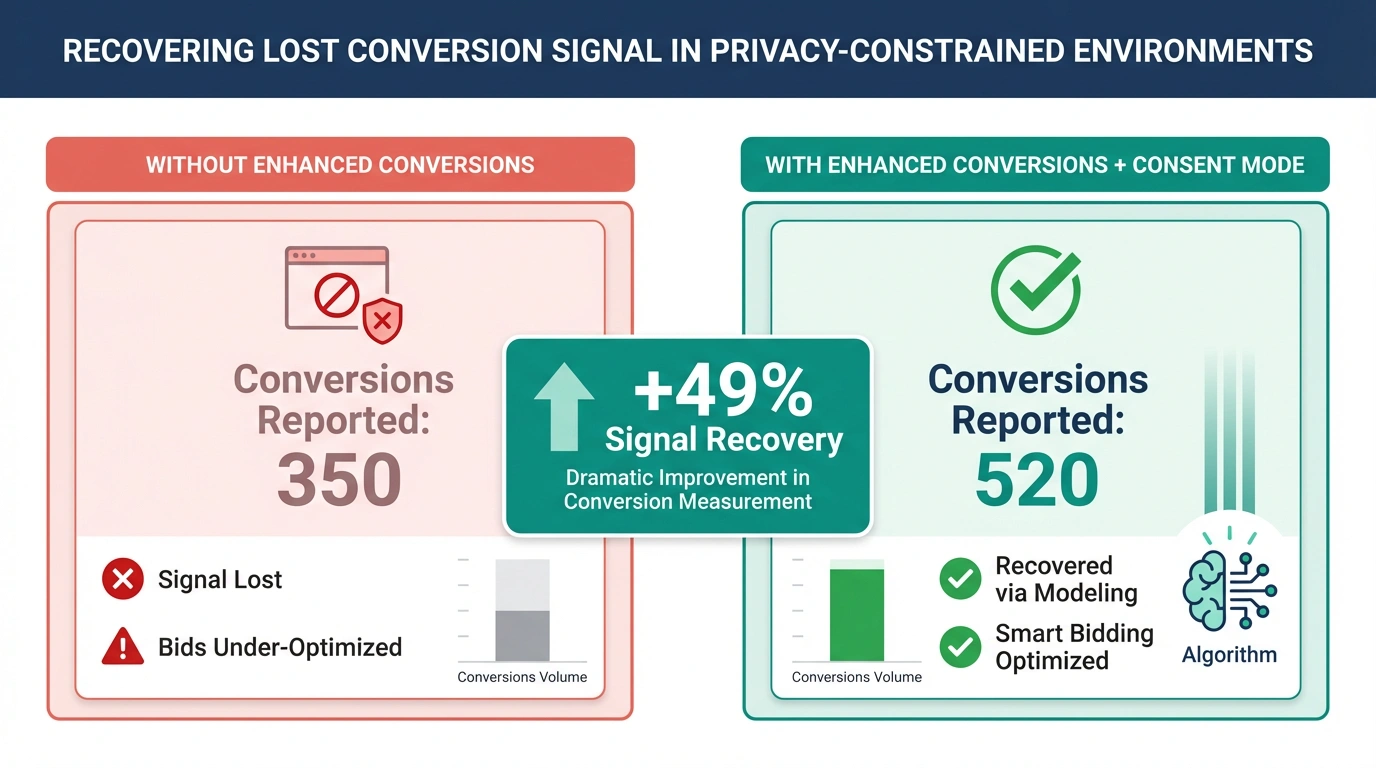
Practitioners in communities like r/marketing report higher conversion matching ratios when they pair Enhanced Conversions with robust first-party data and clear consent frameworks.
In practice, this means aligning legal, analytics, and CRM teams on data fields, consent language, and identity keys so that Enhanced Conversions can safely and accurately reconcile ad clicks with downstream actions.
Server-Side Tagging Drives Data Quality and Control
Client-side tags are increasingly blocked, throttled, or stripped by browsers and privacy tools. As a result, even well-designed measurement strategies can underdeliver because the underlying collection method is fragile.
Server-side Google Tag Manager adoption is growing because it shifts tracking logic from the browser to a controlled server environment. This improves data quality, reduces exposure to ad blockers, and supports faster page performance.
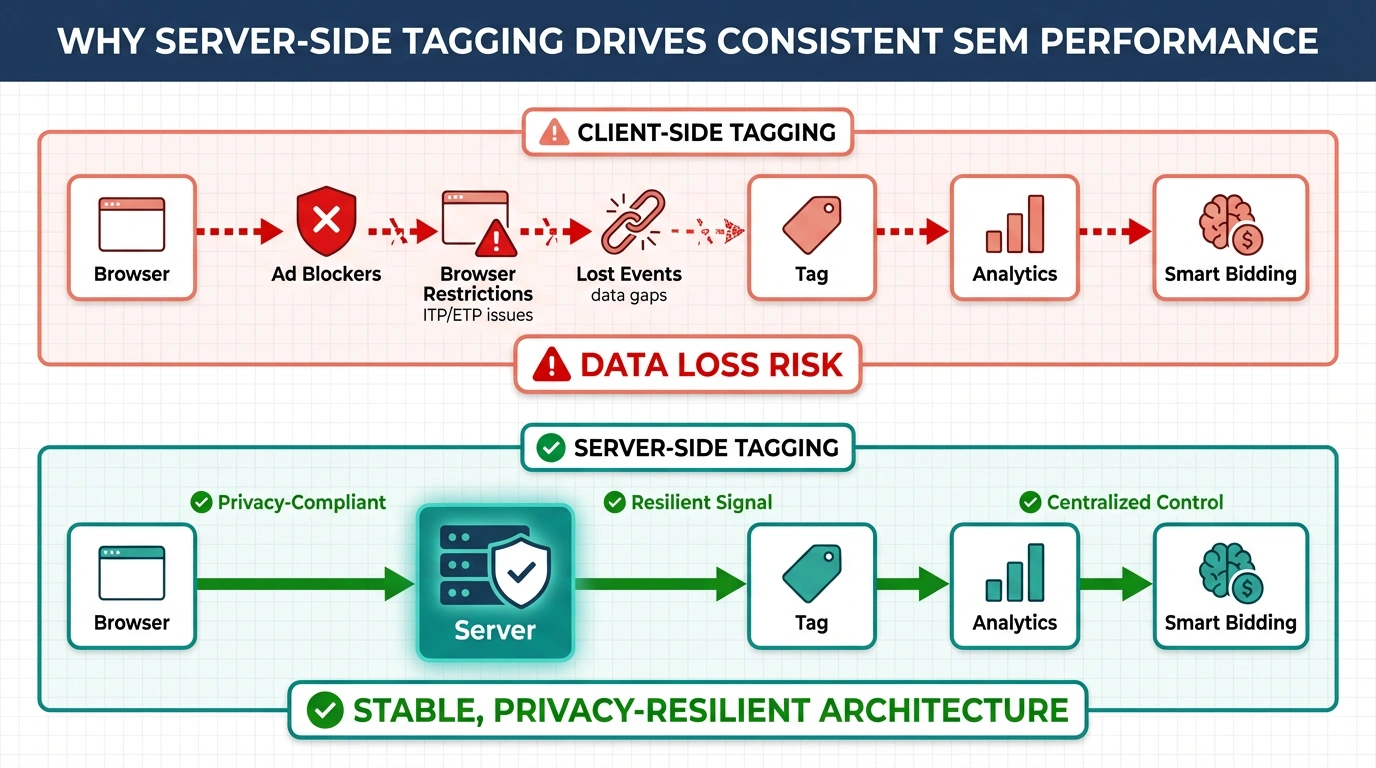
Research from industry bodies and discussions in r/analytics highlight a steady migration to server-side setups despite higher upfront cost and technical complexity.
For CMOs, the benefit is strategic control: you can standardize data flows, manage privacy policies centrally, and maintain more consistent measurement across markets and channels. Several practitioners report that detailed server-side configurations helped them recover data lost to ITP and ETP changes, restoring continuity that client-side tags could not maintain.
Offline Conversion Integration Is Now Mandatory
In B2B and considered purchases, most of the value is created after the initial click. Yet many SEM programs still optimize to shallow events such as “lead” or “form fill.”
This inflates perceived efficiency while masking true customer acquisition cost and lifetime value. The result is a bidding strategy that overvalues low-intent leads and undervalues accounts that actually convert to revenue.
Modern SEM tracking requires systematic import of offline conversions from your CRM or sales systems. When GCLID and GBRAID parameters are captured and mapped into opportunity stages, you can feed “Qualified Lead,” “SQL,” or even “Closed Won” signals back into Google Ads.
One B2B implementation that mapped these identifiers into the CRM and imported qualified stages enabled Smart Bidding to prioritize higher quality opportunities. The outcome was tighter alignment between SEM investment and pipeline value, with budgets shifting toward queries and audiences that reliably produced revenue rather than vanity lead volume.
Validation and Incrementality: The Future of SEM Tracking
As attribution signals erode, CMOs can no longer treat SEM reporting as a precise science built on user-level paths. The strategic question is shifting from “What channel gets credit?” to “What spend actually drives incremental revenue?”
To answer that, leading teams are hardening their approach on three fronts: disciplined holdout testing, clean conversion architecture, and first party identity frameworks. Together, these pillars separate real performance from noisy dashboards and create SEM programs that can withstand continued privacy and platform change.
Holdout Testing Proves True Incremental Impact
Incrementality testing with holdout groups is emerging as the executive safeguard against increasingly noisy attribution models. As tracking becomes more privacy centric and user journeys fragment across devices, traditional multi touch attribution has turned into a directional signal rather than a financial truth source.
Holdout tests go back to fundamentals: create comparable audiences or geos, expose one to SEM and keep the other dark, then measure the difference in outcomes. That lift is the incremental impact you can defend in budget reviews and board conversations.
Analytics leaders and platforms such as (Google Analytics) increasingly recommend these methods in recognition that modeled conversions and overlapping touchpoints can overstate channel value. Instead of debating fractional credit, your team can quantify the real revenue and lead lift attributable to SEM.
For example, a multi location services brand implemented geo based holdouts across matched markets. By systematically toggling paid search spend in and out, they isolated the incremental contribution on booked appointments and revenue. The result was more credible SEM ROI reporting, faster reallocation away from low lift segments, and the confidence to increase investment where lift was consistently strong.
Clean Conversion Architecture Reduces Data Disputes
Holdout testing only works if your conversion data is trustworthy. Many enterprises still suffer from fragmented event naming, channel specific “pet metrics,” and competing definitions of what counts as a high value action. The outcome is predictable: weekly arguments over whose numbers are right instead of focused discussions on where to scale or cut.
A clean conversion architecture starts with a single, unambiguous hierarchy of events that maps to the customer journey, then propagates that structure into GA4 and Google Ads. Modern teams harmonize event parameters, define one primary bidding conversion for core performance goals, and reserve secondary events for diagnostics rather than optimization.
One ecommerce retailer improved both reporting accuracy and bidding efficiency by consolidating overlapping sign up and purchase events, then eliminating double counting through enhanced conversions and consent mode. Once finance, analytics, and media teams rallied around the same conversion source of truth, Google Ads could optimize on higher quality signals and leadership finally saw one coherent SEM performance number.
First-Party Identity Frameworks Ensure Future Resilience
Even with clean events and sound testing, SEM tracking will weaken over time if your identity strategy remains cookie dependent. The ongoing shift toward browser level restrictions, ad platform privacy controls, and customer expectations of transparency is steadily eroding third party identifiers.
To future proof measurement, high performing organizations are engineering first party identity frameworks into their SEM and broader performance stack. That means capturing permissioned, hashed identifiers such as email and phone, standardizing consent states, and feeding those signals into ad platforms via solutions like enhanced conversions.
Industry discussions on Enhanced Conversions, including practitioner threads in communities like Reddit’s r/marketing, underscore the gap that is emerging. Brands with robust CRM and consent processes see a tangible improvement in conversion attribution quality and bid model stability. Those that lack durable first party identity struggle to maintain tracking fidelity as cookies decline, and gradually lose the ability to prove the value of their SEM budgets.
Strategic Priorities for SEM Tracking Leaders
CMOs cannot afford guesswork in paid search. The brands winning in SEM are the ones that treat tracking as a strategic asset, not a hygiene task.
In an environment of fragmented journeys, signal loss, and tightening privacy, the priority is to build a measurement spine that is consistent, privacy-resilient, and tied directly to revenue outcomes.
The following five priorities focus on what materially improves accountability and ROI, rather than incremental tweaks to bidding or creative.
Each is practical to implement in phases, yet together they form a durable operating system for SEM measurement.
1. Enforce Strict, Unified Conversion Definitions
Most SEM underperforms not because of weak media, but because platforms are optimizing to noisy or inconsistent conversions.
Your first task is to define one source of truth for what counts as a “conversion” across Google Ads, Microsoft Ads, analytics, and CRM.
Align your performance, analytics, and sales teams on a concise conversion taxonomy that distinguishes between micro actions and true revenue drivers.
Then ruthlessly remove legacy and vanity conversions from bidding and reporting to keep algorithms focused on outcomes that the business actually values.
- One primary revenue conversion for optimization (e.g., qualified opportunity, first order).
- A short, standardized set of assist conversions for diagnostics, not bidding.
Codify this in a governance document and require every new campaign, agency, or market to adhere before launch.
2. Maximize First Party, Consented Data with Enhanced Conversions and Consent Mode
Third party signals are shrinking, but users still willingly share data when they see value and transparency.
Your SEM program should be architected to capture that consented first party data and translate it into better measurement.
Deploy enhanced conversions so hashed customer identifiers from your site or app can recover conversions that cookie loss would otherwise hide.
Pair this with Consent Mode to respect user choices while still allowing modeled conversions where appropriate and legally compliant.
The CMO’s role is to align legal, product, and media teams on a clear consent strategy that balances privacy, user experience, and performance.
3. Build Robust Offline Conversion Bridges to Paid Media Platforms
For many B2B and higher value B2C journeys, the decisive revenue event happens offline in CRM or POS systems.
If that data never flows back into your SEM platforms, you are training algorithms on proxies instead of profit.
Stand up a repeatable offline conversion pipeline that pushes closed won deals, qualified opportunities, or in store transactions into your ad accounts with the right matching keys and timestamps.
Slice these uploads by high value segments, such as product line, deal size, and retention propensity, so your bidding models can prioritize customers that matter most, not just cheap clicks.
4. Invest in Server Side Tagging for Reliable Signal Capture
Client side tags are increasingly fragile under browser restrictions and ad blocking.
Server side tagging routes key conversion and event data through your own infrastructure, giving you more control, resilience, and transparency.
Move your most important SEM events to server side collection first, then expand to broader site behaviors as you harden the architecture.
This shift reduces data leakage, improves page performance, and creates a more stable signal layer for smart bidding over time.
5. Layer in Incrementality Testing to Validate True Lift
Even with excellent tracking, attribution models can still misread what SEM is actually adding to the business.
Incrementality testing through geo or audience holdouts reveals the true lift from your paid search investments compared to an organic or baseline scenario.
Build a lightweight, recurring test agenda that evaluates branded keywords, key non brand clusters, and major launches.
Use results to adjust budget allocation and inform where automation is over or under valuing certain tactics.
Independent analyses from sources like [Think with Google](https://www.thinkwithgoogle.com) show that brands who systematically connect first party data, offline signals, and incrementality testing achieve more efficient growth in paid media.
For CMOs, institutionalizing these five priorities turns SEM tracking from a compliance chore into a compounding strategic advantage.
Strategic Priorities for SEM Tracking Leaders
CMOs who treat sem tracking as a strategic asset create a durable edge in paid search performance.
This starts with a single, enforced definition of “conversion” across platforms, teams, and markets so every optimization is tied to real revenue outcomes.
Next, maximize consented first party data with Enhanced Conversions and Consent Mode to recover signals that cookies can no longer reliably provide.
In parallel, connect offline revenue events from CRM or POS back into ad platforms so SEM algorithms optimize toward actual profit, not surface level proxies.
Server side tagging then becomes your control layer for resilient, privacy aware signal capture that can withstand browser changes and ad blocking.
As this foundation matures, layer on structured incrementality testing with holdouts to validate true lift and recalibrate budget toward the channels, keywords, and audiences that move the needle.
These five priorities work best as a coordinated roadmap, not isolated projects.
They answer the core executive questions: What is SEM really contributing, where is it leaking value, and how confidently can we invest the next dollar?
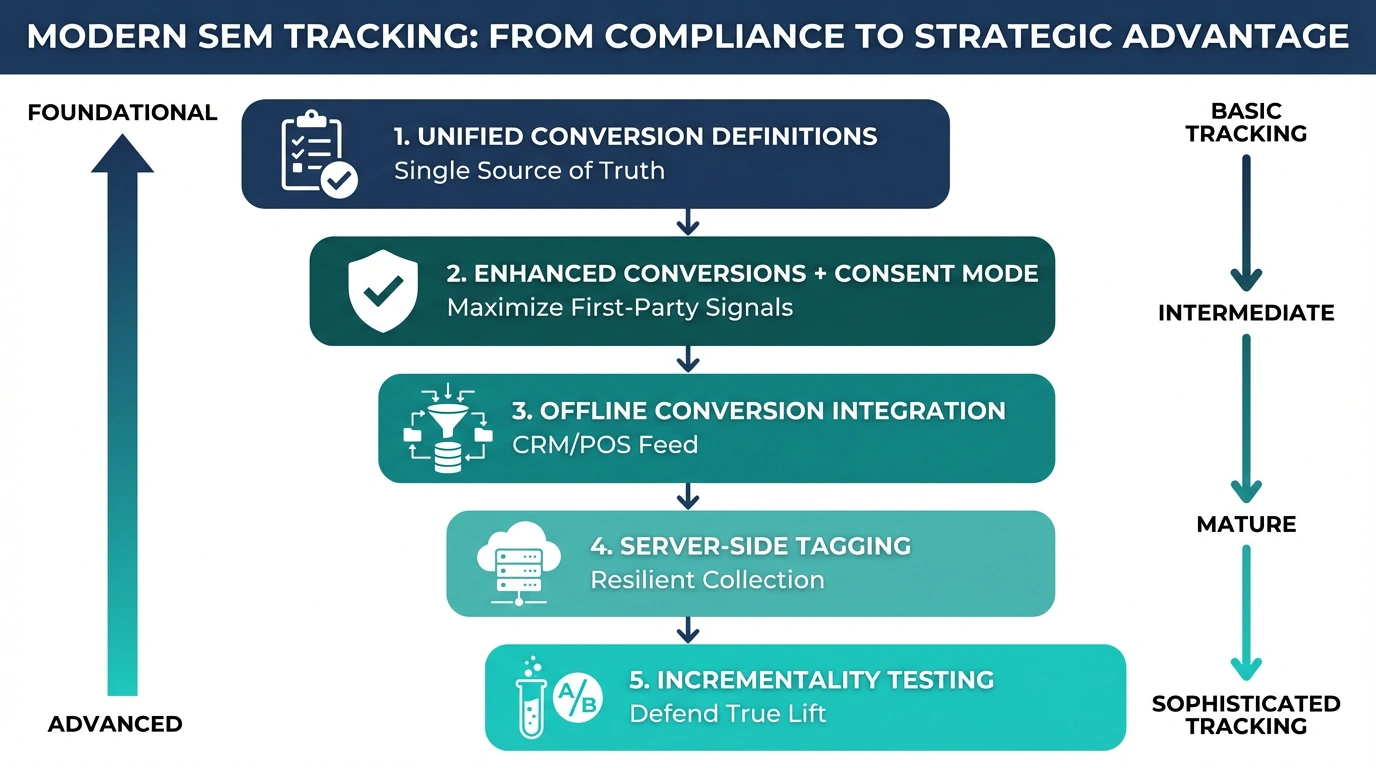
For CMOs, institutionalizing this approach transforms sem tracking into an operating system for growth, enabling faster decisions, smarter automation, and more defensible SEM budgets in a volatile market.
