

TL;DR
- Data visualization transforms raw lead attribution data—channel performance, CPL, pipeline contribution—into visual formats that compress time-to-insight and eliminate reporting ambiguity at the executive level.
- The strategic value isn’t in making data look better; it’s in making attribution decisions faster and with higher confidence—directly impacting CAC efficiency and ROAS across channels.
- Visualization fails when it’s disconnected from contact-level attribution data. Aggregate charts built on incomplete source data produce directionally wrong conclusions that compound over time.
What Is Data Visualization?
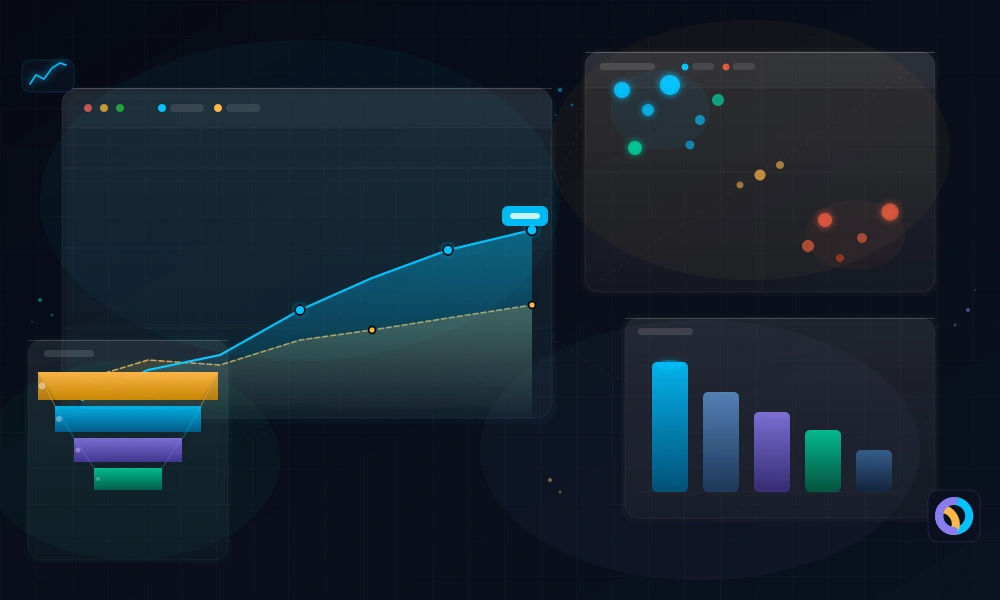
Data visualization is the graphical representation of quantitative information—converting datasets from CRM records, ad platforms, web analytics, and attribution systems into charts, graphs, maps, and dashboards that human cognition can process in seconds rather than hours.
In a marketing attribution context, visualization is the interface between raw lead source data and the budget decisions that data should drive. It answers questions like: which channels produced the most pipeline last quarter, where is CPL rising faster than MQL quality justifies, and what does the full customer journey look like across touchpoints.
The technical complexity is intermediate-to-advanced. Building a pie chart is trivial; building a visualization layer that accurately reflects multi-touch attribution across 9 data dimensions per lead—and connects that to closed-won revenue—requires deliberate data infrastructure decisions upstream.
Test LeadSources today. Enter your email below and receive a lead source report showing all the lead source data we track—exactly what you’d see for every lead tracked in your LeadSources account.
Why Visualization Is a Strategic Attribution Asset
Raw attribution data without visualization is operationally inert. A CRM export showing 4,000 lead records across 12 source channels tells you nothing until it’s structured into a comparative view.
The strategic implication: CMOs who rely on tabular reports for attribution decisions operate with a significant latency disadvantage. Visualization compresses the analytical cycle from days to minutes, enabling same-week budget reallocation rather than same-quarter.
According to Forrester, organizations with mature visual analytics capabilities make budget reallocation decisions measurably faster than those relying on static reporting—and the competitive impact compounds over time as winning channels receive budget sooner.
Three specific attribution decisions that visualization accelerates:
- Channel mix optimization: Side-by-side CPL and MQL-to-SQL conversion rates by channel reveal which sources produce revenue, not just volume. Without visualization, this comparison requires manual cross-referencing across multiple reports.
- Funnel velocity analysis: Time-to-MQL and time-to-close heat maps expose where specific lead sources stall. A channel producing 30% of leads but only 8% of closed-won revenue is invisible in aggregate—obvious in a properly structured visual.
- Spend efficiency benchmarking: ROAS trend lines across rolling 90-day periods catch degrading channel performance before it becomes a budget problem.
Core Visualization Types for Lead Attribution
Not all chart types serve attribution analysis equally. Selecting the wrong format creates visual noise rather than insight.
Time-Series Line Charts
The primary format for tracking CPL, lead volume, and conversion rate trends over time. Use dual-axis configurations to overlay spend against lead quality metrics—this combination surfaces the inflection points where increased spend stops producing proportional return.
Rolling 28-day or 90-day windows reduce noise from weekly volatility without masking real trend shifts.
Waterfall and Funnel Charts
Purpose-built for attribution. A funnel chart by lead source—showing impressions to clicks to form completions to MQLs to SQLs to closed-won—makes conversion drop-off points immediately visible. When layered by channel, it reveals which sources have structural funnel problems versus which simply need volume.
Waterfall charts are the correct format for multi-touch attribution contribution: showing how first-touch, mid-funnel, and last-touch interactions each contributed incremental pipeline value.
Scatter Plots for Channel Efficiency
Plot CPL on one axis and MQL-to-SQL conversion rate on the other. Every channel becomes a point in a quadrant. The upper-left quadrant (low CPL, high conversion) is where budget should concentrate. The lower-right (high CPL, low conversion) is where budget should exit. This visualization type is underused in attribution analysis and delivers disproportionate strategic clarity.
Cohort Heatmaps
Essential for LTV-by-source analysis. Group leads by acquisition month and channel, then track their conversion and revenue contribution across subsequent periods. This format reveals whether certain channels produce faster-converting or higher-value customers—a dimension that CPL-only analysis systematically misses.
Implementation Architecture: Visualization That Actually Reflects Attribution
The most common implementation failure: building visually polished dashboards on top of corrupted or incomplete attribution data. The chart looks authoritative; the underlying source field is populated with “direct / none” for 40% of leads because UTM tagging was inconsistent.
A visualization layer is only as reliable as its data foundation. That foundation requires three things:
- Contact-level source capture: Attribution must be recorded at the individual lead level—not aggregated at the session or campaign level—so visualization can slice by any dimension without losing fidelity.
- CRM field integrity: Lead source data must flow from the form submission into consistent, queryable CRM fields. If source data lives in free-text notes rather than structured fields, it cannot be visualized accurately at scale.
- Cross-system data joining: Revenue outcomes from the CRM must be joinable to the marketing attribution record. Without this join, visualization can show lead volume and CPL but cannot connect those metrics to actual pipeline or closed-won revenue.
Once the data foundation is sound, visualization tool selection is secondary. Looker, Tableau, Power BI, and even well-configured CRM dashboards can produce executive-grade attribution visuals from clean underlying data.
Common Visualization Failures in Attribution Reporting
Aggregate-only views: Showing total lead volume without source breakdown obscures which channels are working. Total is always less actionable than segmented.
Last-click-only charts: Visualizations built on last-touch attribution systematically underrepresent top-of-funnel channels. When a CMO reviews a channel performance chart built on last-click, they’re seeing a structurally distorted picture—and potentially defunding channels that drive significant first-touch influence.
Vanity metric dominance: Dashboards populated with impressions, sessions, and raw lead counts without connecting those to pipeline outcomes create false confidence. Visuals should always terminate in a revenue or pipeline metric, not a volume metric.
Static reporting cadence: Weekly or monthly static reports visualized in slides cannot support in-cycle budget decisions. High-performing marketing operations teams run visualization on live or near-live data with automated refresh, not manual exports.
Missing data freshness indicators: A visualization without a last-updated timestamp is operationally dangerous. Decisions made on a dashboard that hasn’t refreshed in 72 hours—without the viewer knowing—compound attribution errors into budget misallocation.
Frequently Asked Questions
What is the difference between data visualization and a marketing dashboard?
A dashboard is a specific application of data visualization—a curated, multi-panel interface designed for ongoing monitoring of a defined set of KPIs. Data visualization is the broader discipline: it includes dashboards, one-off analytical charts, cohort maps, funnel diagrams, and any other graphical representation of quantitative data. All dashboards use data visualization; not all data visualization lives in a dashboard.
Which data visualization format is most useful for multi-touch attribution?
Waterfall charts and Sankey diagrams are best suited for multi-touch attribution because they visually represent the proportional contribution of each touchpoint to a final outcome. Sankey diagrams in particular are excellent for visualizing customer journey paths—showing which sequences of channel interactions most frequently result in conversion. They require clean, event-level attribution data to render accurately.
How does data visualization impact marketing ROI measurement?
Visualization accelerates the insight-to-action cycle. When channel performance data is visually accessible and updated in near-real time, budget reallocation decisions can happen within days rather than quarters. The compounding effect over 12 months—consistently moving budget toward efficient channels faster—typically produces measurable improvements in blended CAC and ROAS without requiring additional spend.
Can data visualization replace a dedicated attribution platform?
No. Visualization tools render data; they do not capture or attribute it. A chart built in Tableau or Looker is only as accurate as the attribution data feeding it. If lead source data is missing, inconsistent, or captured only at the session level rather than the contact level, the visualizations will confidently display incorrect information. The attribution infrastructure must be solved before visualization produces reliable output.
What is the minimum data infrastructure required for effective attribution visualization?
At minimum: consistent UTM tagging across all campaigns, contact-level source capture at the form submission event, clean CRM field mapping for lead source data, and a mechanism to join marketing attribution records to CRM pipeline and revenue outcomes. Without the revenue join specifically, visualization can show channel efficiency in terms of CPL but cannot validate whether those channels produce revenue—which is the only metric that ultimately justifies spend.
How often should attribution visualizations be refreshed?
Operational channel performance dashboards used for active campaign management should refresh every few hours to daily. Executive attribution dashboards—those used for strategic budget reviews—typically refresh daily or weekly. The critical rule: whatever the refresh cadence, it must be visible on the dashboard itself. A stale visualization used as the basis for a budget decision is worse than no visualization, because it carries false authority.
What is the biggest mistake CMOs make with marketing data visualization?
Building visually sophisticated dashboards before solving the attribution data problem upstream. A beautifully designed visualization layer on top of incomplete or last-click-only attribution data produces confident, directionally wrong conclusions. The correct sequence is: fix the attribution data foundation first, then invest in visualization tooling and design. Reversing that order is the most expensive mistake in marketing analytics.