
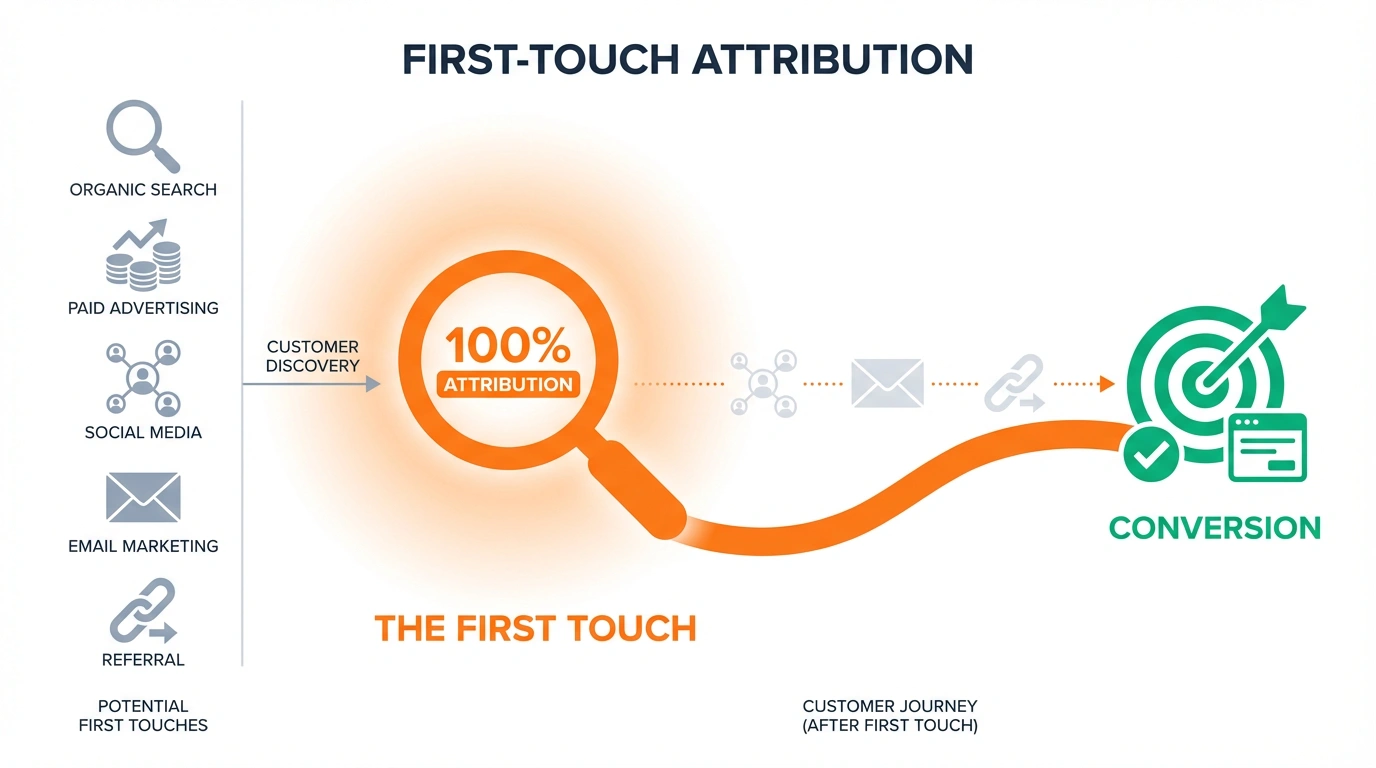

First-touch attribution answers a critical question for every marketer: which marketing channels successfully introduce prospects to your brand? While most attribution discussions focus on what closes deals, understanding how customers discover you reveals which awareness strategies actually work. This model credits 100% of a conversion’s value to the very first touchpoint, providing clear visibility into top-of-funnel performance.
What Is First-Touch Attribution?
First-touch attribution is a single-touch attribution model that assigns 100% of the credit for a conversion to the first marketing touchpoint where a prospect initially interacted with your brand. Whether they clicked a Facebook ad, found you through organic search, or discovered you via a referral link, that initial interaction receives full attribution for any eventual conversion.
Think of first-touch attribution as identifying the front door prospects use to enter your marketing ecosystem. When someone becomes a customer three months later, this model ignores all subsequent interactions—the email campaigns they opened, the webinars they attended, the sales calls they took—and credits only that original discovery moment.
This model operates on a straightforward principle: without that first interaction, the customer journey never begins. If someone never clicks your ad or finds your content, they never enter your funnel regardless of how excellent your nurturing might be. First-touch attribution reveals which channels excel at generating brand awareness and initiating customer relationships.
LeadSources is a first-touch attribution software that tracks where your leads come from and links them to the first interaction that started the conversion journey.
Test LeadSources today. Enter your email below and receive a lead source report showing all the lead source data we track—exactly what you’d see for every lead tracked in your LeadSources account.
Why First-Touch Attribution Matters for Lead Tracking
Understanding first-touch performance provides strategic advantages that other attribution models miss.
Optimize Awareness Investments
First-touch data shows which channels successfully introduce new prospects to your brand. If organic search drives 40% of first touches but only receives 15% of your budget, you’ve identified a growth opportunity.
Identify Your Discovery Channels
Not all marketing channels work well for brand awareness. First-touch attribution reveals which channels prospects actually use to discover you versus which ones only work for remarketing or nurturing existing awareness.
Measure Brand Building Impact
Brand awareness campaigns are notoriously difficult to measure. First-touch attribution connects awareness efforts directly to pipeline, showing concrete ROI for upper-funnel activities.
Understand Audience Acquisition Patterns
First-touch data reveals where your target audience hangs out online. If LinkedIn consistently drives first touches while Twitter doesn’t, you know where to focus social media efforts.
Guide New Market Entry
When expanding to new markets or launching new products, first-touch attribution identifies which channels work best for initial awareness in unfamiliar territories.
How First-Touch Attribution Works
First-touch attribution relies on capturing and preserving the original source data for every lead throughout their entire customer journey.
Capture the First Interaction
When someone first lands on your website, tracking technology records their source—whether they came from paid search, organic search, social media, referral, direct traffic, or another channel. This typically involves cookies, UTM parameters, and tracking pixels that identify the origin.
Preserve First-Touch Data
As prospects return to your site multiple times over weeks or months, the system must maintain that original source data. Even if they come back via email, direct visits, or other channels, the first-touch information remains attached to their profile.
Connect to Conversions
When the prospect eventually converts—submitting a form, making a purchase, requesting a demo—the system attributes that conversion back to the original first-touch source, regardless of how many interactions occurred in between.
Aggregate for Reporting
Individual first-touch data rolls up into channel performance reports showing: “Organic search generated 150 first touches this month that led to 45 conversions” or “LinkedIn ads drove 80 new prospects who eventually generated $50,000 in revenue.”
Inform Strategy
Armed with first-touch insights, you can allocate more budget to high-performing discovery channels, improve underperforming awareness campaigns, or cut channels that don’t effectively introduce new prospects.
First-Touch Attribution vs. Other Models
Understanding how first-touch differs from alternative attribution approaches helps you choose the right model for your goals.
First-Touch vs. Last-Touch
Last-touch attribution credits the final interaction before conversion. While first-touch reveals discovery channels, last-touch identifies closing mechanisms. A prospect might discover you via organic search (first-touch) but convert after clicking a remarketing ad (last-touch). Neither model tells the complete story alone.
First-Touch vs. Multi-Touch
Multi-touch attribution distributes credit across all interactions in the customer journey. First-touch is simpler to implement and understand but ignores nurturing efforts. Multi-touch provides fuller journey visibility but requires more sophisticated tracking and analysis.
First-Touch vs. Linear
Linear attribution gives equal credit to every touchpoint. If a customer had five interactions, each gets 20% credit. First-touch is more decisive—100% to the first interaction—making it clearer for evaluating discovery channel performance.
When First-Touch Makes Sense
This model works best when you’re specifically optimizing awareness and discovery. It’s ideal for:
- Evaluating brand awareness campaign effectiveness
- Identifying which channels introduce new audiences
- Short sales cycles where first touch strongly influences conversion
- Top-of-funnel budget allocation decisions
- Content marketing performance measurement
How to Implement First-Touch Attribution
Successfully tracking first-touch attribution requires proper technical setup and data management.
Set Up Source Tracking
Implement UTM parameters: Tag all campaign URLs with consistent UTM codes identifying source, medium, campaign, term, and content. This ensures accurate first-touch capture for all marketing activities.
Install tracking pixels: Place tracking code on all website pages to capture visitor source information immediately upon arrival.
Configure cookie persistence: Set cookies with appropriate expiration periods (typically 30-90 days) to maintain first-touch data across multiple sessions.
Preserve First-Touch Data
Use hidden form fields: When prospects submit forms, include hidden fields that automatically populate with first-touch source data, ensuring it flows into your CRM.
Establish data persistence rules: Configure your tracking so first-touch data doesn’t get overwritten by subsequent visits from different sources.
Set up proper attribution windows: Define how long first-touch data remains valid. Most businesses use 30-90 day windows depending on their typical sales cycle.
Connect to Your CRM
Map data fields: Ensure first-touch source information from your tracking system properly maps to corresponding CRM fields.
Validate data flow: Test that first-touch data successfully transfers from website visits through form submissions into CRM records.
Create reporting views: Build CRM reports that show conversions, pipeline, and revenue segmented by first-touch source.
Build Attribution Reports
Create dashboards showing:
- Lead volume by first-touch source
- Conversion rate by first-touch channel
- Customer acquisition cost per first-touch source
- Revenue generated by first-touch channel
- Time to conversion by first-touch source
Common Challenges and Solutions
First-touch attribution implementation faces several predictable obstacles.
Challenge: Dark Social and Direct Traffic
Many prospects discover you through untrackable channels—private messages, email links without UTM parameters, or typing your URL directly. These appear as “direct” traffic, obscuring true first-touch sources.
Solution: Minimize dark social by consistently using UTM parameters in all shared links, implement email link tracking, and analyze direct traffic patterns to identify likely actual sources. Accept that some first-touch attribution will remain unknown.
Challenge: Cookie Blocking and Privacy
Privacy tools, browser settings, and regulations limit cookie-based tracking, causing gaps in first-touch data.
Solution: Implement server-side tracking where possible, use first-party cookies rather than third-party, and rely on authenticated user tracking after login for more reliable attribution.
Challenge: Cross-Device Journeys
Prospects often discover you on mobile but convert on desktop, breaking first-touch tracking across devices.
Solution: Use probabilistic device matching, encourage account creation for deterministic tracking, or accept that cross-device attribution will have gaps and make decisions based on available data.
Challenge: Offline First Touches
Prospects might first hear about you at a conference, through word-of-mouth, or via offline advertising before visiting your website.
Solution: Create unique landing pages or URLs for offline campaigns, use vanity URLs or promo codes tied to specific campaigns, and train sales teams to ask and log how prospects first heard about you.
Challenge: Overemphasis on Discovery
First-touch attribution can lead to underinvestment in nurturing if you only reward discovery channels.
Solution: Use first-touch alongside other attribution models. Evaluate discovery channels with first-touch while assessing nurturing effectiveness through multi-touch or last-touch models.
First-Touch Attribution Best Practices
Maximize the value of first-touch data with these strategic approaches.
Use Alongside Other Models
First-touch shows discovery performance; last-touch shows closing effectiveness; multi-touch reveals the full journey. Don’t rely on first-touch alone. Compare insights across models to make balanced decisions.
Segment by Customer Quality
Track not just first-touch volume but quality. A channel generating 100 first-touch leads with 2% conversion is less valuable than one generating 50 with 10% conversion. Measure first-touch attribution through to revenue, not just lead creation.
Account for Sales Cycle Length
In B2B with 90-day sales cycles, don’t judge first-touch channel performance after 30 days. Wait for sufficient conversion time before optimizing based on first-touch data.
Differentiate New vs. Returning Visitors
True first-touch only applies to genuinely new prospects. Separate reporting for visitors whose first touch was months ago versus truly new discoverers to avoid skewed data.
Validate with Other Metrics
Cross-reference first-touch attribution with brand awareness surveys, direct traffic increases, and branded search volume growth to validate your discovery channel effectiveness.
Maintain Consistent Tagging Standards
Inconsistent UTM parameters corrupt first-touch data. Establish and enforce strict naming conventions for all campaigns across your marketing team.
Review Attribution Windows Regularly
If your 30-day first-touch window consistently shows prospects taking 45 days to convert, extend your attribution window to capture complete data.
Key Metrics to Track
Monitor these KPIs to maximize first-touch attribution value.
First-Touch Lead Volume by Channel
Track how many new prospects each channel introduces to your brand. This raw volume indicates discovery reach but must be evaluated alongside quality metrics.
First-Touch Conversion Rate
Calculate what percentage of first-touch leads from each channel eventually convert. High volume with low conversion indicates awareness without fit; low volume with high conversion suggests strong targeting.
Cost Per First-Touch Lead
Divide channel investment by first-touch leads generated. This shows discovery efficiency before considering conversion quality.
First-Touch Customer Acquisition Cost
Calculate total channel cost divided by customers acquired via that first-touch source. This connects discovery investment directly to revenue outcomes.
Revenue Per First-Touch Channel
Track total revenue generated from customers whose first touch came from each channel. This shows long-term value of discovery channels beyond immediate conversions.
Time from First-Touch to Conversion
Measure how long prospects take to convert after first discovering you via each channel. Faster-converting channels may deserve priority even with lower volume.
First-Touch Channel Mix Trends
Monitor how your first-touch channel distribution changes over time. Declining organic first touches might signal SEO issues; growing paid first touches indicate successful awareness campaigns.
First-Touch Attribution Limitations
Understanding what first-touch attribution can’t tell you prevents over-reliance on this single metric.
Ignores Nurturing Value
First-touch gives zero credit to all subsequent interactions. Email nurturing campaigns, remarketing ads, sales outreach, and content that moved prospects toward conversion receive no recognition. This can lead to underinvestment in mid-funnel activities.
Overlooks Journey Complexity
B2B buyers typically interact with 10+ touchpoints before converting. First-touch attribution completely ignores these interactions, potentially misrepresenting true channel contribution to conversions.
Can Skew Budget Allocation
Optimizing solely for first-touch performance may starve remarketing, nurturing, and closing tactics of budget. Discovery without conversion wastes resources.
Tracking Gaps Create Blind Spots
Dark social, cross-device journeys, offline touches, and privacy tools create attribution gaps. Your first-touch data is always incomplete, so don’t treat it as absolute truth.
Doesn’t Prove Causation
A channel receiving first-touch credit may not have actually caused awareness. Prospects might have heard about you elsewhere but happened to visit your site via that channel first.
Frequently Asked Questions
When should I use first-touch attribution instead of multi-touch?
Use first-touch attribution when your primary goal is optimizing awareness and discovery channels. It’s particularly valuable for brand awareness campaigns, content marketing effectiveness, and top-of-funnel budget allocation. However, don’t use it as your only attribution model. Combine first-touch insights with last-touch or multi-touch models to understand the full customer journey. If you have short sales cycles where first interaction heavily influences conversion, first-touch provides clearer insights than complex multi-touch models.
How long should my first-touch attribution window be?
Set your first-touch attribution window based on your typical sales cycle length. For e-commerce with same-day conversions, 30 days suffices. For B2B SaaS with 60-90 day sales cycles, use 90-180 day windows. Analyze your actual time-to-conversion data to determine appropriate windows. If 80% of conversions happen within 60 days of first touch, a 90-day window captures most attribution while keeping data fresh. Too short windows miss conversions; too long windows may attribute to channels prospects forgot about.
Why does my first-touch data show high direct traffic?
High direct traffic in first-touch attribution usually indicates dark social and tracking gaps, not genuine direct visits. Prospects discover you through untracked channels—private messages, email links without UTM parameters, mobile apps—then type your URL directly. To reduce false direct attribution, implement consistent UTM tagging on all shared links, use email link tracking, add tracking to social share buttons, and create unique landing pages for offline campaigns. Accept that some direct traffic is legitimate (returning visitors, existing customers) but investigate sudden spikes.
Should I optimize budget purely based on first-touch attribution?
No, never optimize budget based solely on first-touch attribution. While it reveals discovery channel performance, it ignores nurturing and closing effectiveness. A channel generating many first touches with poor conversion wastes money. Balance first-touch insights with conversion rate, customer acquisition cost, and revenue data. Use first-touch to identify strong awareness channels, then validate quality with downstream metrics. Maintain investment in remarketing and nurturing even if they receive zero first-touch credit—these channels convert prospects that discovery channels introduce.
How does first-touch attribution handle returning visitors?
First-touch attribution should only apply to a prospect’s genuine first interaction with your brand, not every visit. Once captured, first-touch source data persists throughout the customer relationship. If someone discovered you via organic search in January, that remains their first-touch source even if they return via email in March and convert via paid search in May. Proper implementation uses cookies or authenticated tracking to maintain original first-touch data across multiple sessions. New attribution only applies when a completely new visitor arrives at your site.
Can first-touch attribution track offline marketing effectiveness?
Yes, but it requires manual processes. Create unique landing pages or vanity URLs for each offline campaign—different URLs for radio ads, print materials, trade shows, direct mail. When prospects visit these URLs, they’re tagged with the appropriate first-touch source. Use promo codes tied to specific campaigns that prospects enter when converting. Train sales teams to ask “How did you first hear about us?” and manually log offline first touches in your CRM. While less precise than digital tracking, these methods provide reasonable offline first-touch attribution.
What’s the difference between first-touch attribution and lead source tracking?
These terms are often used interchangeably, but there’s a subtle distinction. Lead source tracking simply records where a lead came from—the source field in your CRM. First-touch attribution is the analytical methodology that assigns conversion credit to that source. Lead source tracking is the data collection; first-touch attribution is how you use that data for marketing optimization. You need accurate lead source tracking to implement first-touch attribution, but simply capturing sources without attribution analysis doesn’t optimize your marketing strategy.
