

TL;DR:
- Lead Enrichment drives 25% conversion rate improvements and 15% CPL reductions through data-quality optimization. Companies generating 50% more sales-ready leads at 33% lower cost leverage enrichment for qualification accuracy.
- B2B contact data decays at 25-30% annually. Real-time enrichment achieves 90% match rates versus 35-40% for batch processing, preventing $32,000 annual productivity loss per sales rep from working with incomplete data.
- Enterprise enrichment platforms (ZoomInfo, Clearbit, Cognism) maintain 95-98% accuracy through triple-verification. Each sales rep loses 550 hours yearly to bad data; enrichment automation recovers this productivity drain.
What Is Lead Enrichment?
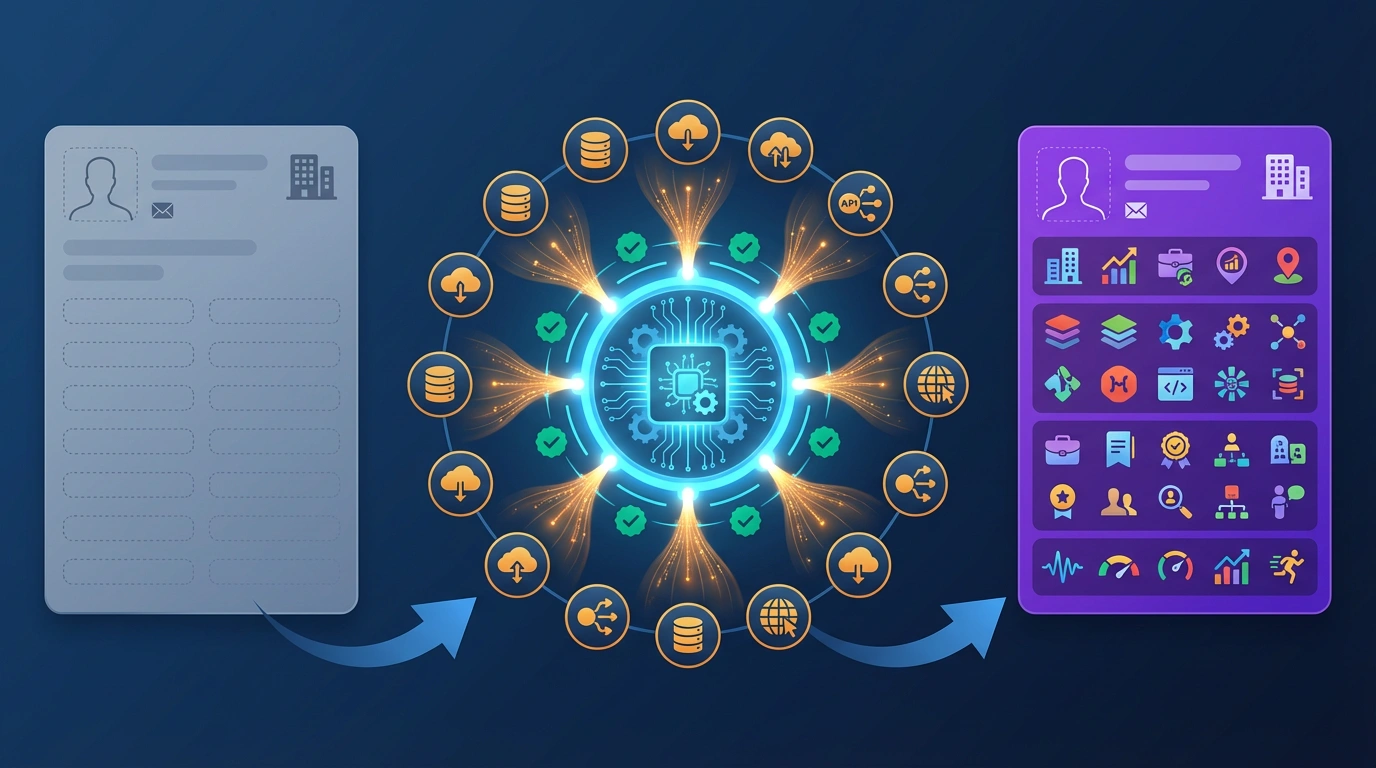
Lead Enrichment is the automated process of appending firmographic, technographic, and behavioral data to existing lead records, transforming minimal contact information into comprehensive profiles that enable accurate attribution, lead scoring, and sales qualification.
It’s the bridge between form submissions capturing name and email versus complete records containing company size, revenue, industry, technology stack, intent signals, and organizational structure.
In attribution systems, enrichment populates the firmographic and demographic dimensions required for segmented CPL analysis, channel performance by ICP fit, and attribution modeling that accounts for account-level buying complexity.
Without enrichment, leads lack the contextual data necessary to calculate accurate LTV, segment conversion rates by company size, or route leads to appropriate sales resources based on deal complexity.
The average lead enrichment implementation increases conversion rates 25% while reducing CAC by 15% through better qualification and prioritization.
Platforms like LeadSources.io capture 9 comprehensive data points per form submission, creating enriched attribution profiles without requiring external data provider integration or manual research.
Test LeadSources today. Enter your email below and receive a lead source report showing all the lead source data we track—exactly what you’d see for every lead tracked in your LeadSources account.
How Lead Enrichment Works
Data Source Identification begins with matching lead contact information (email domain, company name, LinkedIn profile) against proprietary databases maintained by enrichment providers.
Enterprise platforms aggregate data from 50-100+ sources including public filings, web scraping, user-contributed updates, partnerships, and crowdsourced verification networks.
Automated Appending adds 15-30 data fields to each lead record: company size, revenue band, industry classification, headquarters location, technology stack, funding stage, employee count, and organizational hierarchy.
API-based enrichment triggers when leads enter CRM, populating custom fields within 5-30 seconds for real-time processing or 24-48 hours for batch operations.
Verification and Validation uses triple-verification combining AI matching algorithms, human quality assurance teams, and crowdsourced updates to maintain 95-98% accuracy for enterprise providers.
Match rates vary by company size: 90-95% for enterprises with public records, 70-85% for mid-market firms, 50-70% for startups lacking established digital footprints.
Real-Time vs. Batch Enrichment
Real-time enrichment processes leads individually at form submission or CRM entry, delivering enriched data within 5-30 seconds for immediate qualification and routing.
This approach achieves 25% higher sales productivity through instant lead prioritization but costs $5,000-$50,000 monthly versus $500-$5,000 for batch processing.
Batch enrichment processes leads in scheduled intervals (daily, weekly), reducing API costs 10x but introducing qualification delays that lose 15-20% of hot leads to competitor response time advantages.
Lead Enrichment for Attribution Accuracy
Attribution segmentation requires firmographic data to analyze channel performance by account type, revealing that CPL, MQL-to-SQL rates, and deal sizes vary 3-5x across company size brackets and industry verticals.
Firmographic Segmentation enables attribution reporting by company attributes: enterprise accounts ($100M+ revenue) generate 3-5x higher LTV but require 40-60% longer sales cycles than SMB segments ($1M-$10M).
Without enrichment, blended attribution metrics obscure that paid search delivers 2-3x ROI for SaaS companies versus manufacturing, or that enterprise accounts source 60% via organic while SMB sources 60% via paid.
Lead Scoring Integration weights enriched firmographic data alongside behavioral signals, preventing high-activity leads from low-fit accounts consuming sales resources meant for qualified prospects.
Companies implementing enrichment-powered scoring achieve 138% ROI on lead generation versus 78% without, according to lead management benchmarks.
Account-Based Attribution requires enriched company hierarchies to aggregate subsidiary, division, and regional office activities under parent organizations for unified account-level measurement.
Enrichment prevents attribution fragmentation that understates account engagement by 40-60% when buying signals scatter across multiple entity records.
Benefits of Lead Enrichment
Conversion Rate Improvement increases qualified lead identification by 50% through accurate ICP matching, enabling sales teams to prioritize accounts with structural buying capacity.
Enriched leads convert 25-30% faster than non-enriched counterparts due to better qualification, personalized outreach, and appropriate sales resource allocation.
Sales Productivity Gains recover the 550 hours ($32,000) each sales rep loses annually to researching incomplete contact data, validating company information, and pursuing dead-end accounts.
Automated enrichment eliminates 60-70% of manual prospect research, redirecting rep time toward actual selling activities rather than data hygiene.
CPL and CAC Reduction decreases cost per lead 15% by eliminating marketing spend on accounts outside serviceable segments (too small, wrong industry, incompatible geography).
Customer acquisition costs drop 15-33% when enrichment-powered qualification prevents sales resources from working leads structurally incapable of converting.
Personalization Enablement provides the contextual data (company size, industry, technology stack, recent funding) required for relevant outreach that achieves 3-4x higher reply rates than generic messaging.
Implementing Lead Enrichment Systems
Step 1: Define Enrichment Requirements by listing firmographic, technographic, and behavioral data points necessary for lead scoring, routing, attribution segmentation, and sales qualification.
Minimum enrichment fields: company name, industry, employee count, revenue range, headquarters location. Enhanced packages add technology stack, funding stage, growth signals, and buying committee identification.
Step 2: Select Enrichment Provider based on match rates (90%+ for target segments), data accuracy (95%+ verification), API performance (sub-5-second response), and CRM integration capabilities.
Enterprise providers (ZoomInfo, Clearbit, Cognism) maintain 95-98% accuracy through triple-verification; mid-market alternatives (Apollo, Lusha) achieve 85-90% at lower price points.
Step 3: Configure CRM Field Mapping to route enriched data into appropriate custom fields, ensuring company size populates “Employee Count,” revenue range maps to “Annual Revenue,” and industry classification feeds “Vertical” fields.
Validate mapping by enriching 50-100 test records and confirming 95%+ data accuracy and completeness before production deployment.
Step 4: Establish Enrichment Workflows triggering on form submission, lead import, or scheduled batch processing based on volume, budget, and speed requirements.
High-velocity sales teams (100+ leads daily) require real-time enrichment; lower-volume operations (10-50 leads daily) optimize costs through batch processing.
Step 5: Implement Data Decay Management by scheduling quarterly re-enrichment for active opportunities and annual refreshes for entire database, addressing 25-30% annual contact data decay.
Automated decay detection flags records older than 6-12 months without enrichment updates, preventing attribution decisions based on outdated firmographic classifications.
Step 6: Build Enrichment-Powered Reports segmenting attribution, conversion rates, and pipeline metrics by enriched firmographic dimensions (company size, industry, revenue, location).
Calculate segment-specific CPL, MQL-to-SQL rates, and LTV to identify highest-performing account profiles and reallocate budget toward proven ICP segments.
Common Enrichment Implementation Failures
Neglecting Data Decay Management allows 25-30% of firmographic data to become outdated annually as companies grow, relocate, rebrand, or restructure.
Attribution analysis based on 18-24 month old enrichment data misallocates budget toward account segments that have since evolved beyond serviceable thresholds.
Over-Relying on Single Provider limits match rates to 70-85% as no provider maintains complete coverage across all company sizes, industries, and geographies.
Waterfall enrichment querying multiple providers sequentially achieves 90-95% match rates by filling gaps from primary provider failures.
Skipping Field Mapping Validation allows 30-40% of enriched data to populate wrong CRM fields or fail to sync entirely, creating attribution black holes where lead source data exists but firmographic context is missing.
Each unmapped enrichment field represents lost segmentation capability worth 15-25% CPL optimization opportunity.
Batch Processing High-Priority Leads introduces 24-48 hour qualification delays that lose 15-20% of hot leads to competitors responding within minutes using real-time enrichment.
Cost optimization through batch processing sacrifices conversion velocity on time-sensitive inbound leads requiring immediate sales follow-up.
Best Practices for Lead Enrichment
Enrich at Capture, Not Post-Conversion: Trigger enrichment immediately when leads enter CRM to prevent sales teams from contacting prospects before firmographic data arrives.
Real-time enrichment enables instant qualification and routing; delayed enrichment forces reps to research manually, negating productivity gains.
Implement Waterfall Strategy for Critical Fields: Query multiple enrichment providers sequentially for high-priority data points (company size, industry, revenue) to maximize match rates above 90%.
Single-provider reliance caps match rates at 70-85%; waterfall architectures achieve 90-95% by leveraging complementary provider strengths.
Segregate Real-Time and Batch Workflows: Enrich inbound form submissions real-time for immediate qualification while batch-processing imported lists overnight to optimize API costs.
This hybrid approach balances conversion velocity ($5K-$50K monthly real-time costs) with budget efficiency ($500-$5K batch processing).
Automate Decay Detection and Re-Enrichment: Flag records stale beyond 6-12 months and schedule automated re-enrichment before making attribution or routing decisions.
Quarterly re-enrichment for active opportunities, annual for dormant leads maintains 95%+ data accuracy despite 25-30% annual natural decay.
Validate Accuracy Through Spot Checks: Manually verify 50-100 enriched records monthly against public sources (company websites, LinkedIn, Crunchbase) to confirm 95%+ provider accuracy.
Accuracy below 85% indicates provider data quality issues requiring vendor evaluation or waterfall fallback configuration.
Build Enrichment-Specific Attribution Reports: Analyze CPL, conversion rates, and pipeline value segmented by enriched firmographic dimensions rather than aggregated channel metrics.
Enrichment-powered segmentation reveals 3-5x performance variance across company sizes and industries that blended reporting obscures.
Frequently Asked Questions
What is the difference between lead enrichment and lead validation?
Lead validation confirms existing data accuracy (email deliverability, phone number connectivity, company domain verification) while lead enrichment appends new data points (firmographics, technographics, behavioral signals) to incomplete records.
Validation prevents bad data entry; enrichment transforms minimal contact information into comprehensive profiles enabling qualification and attribution segmentation.
How accurate are lead enrichment providers?
Enterprise providers (ZoomInfo, Clearbit, Cognism) maintain 95-98% accuracy through triple-verification combining AI, human QA, and crowdsourced updates.
Match rates vary by company size: 90-95% for enterprises with public records, 70-85% for mid-market firms, 50-70% for startups lacking established digital presence.
Should B2B companies use real-time or batch lead enrichment?
Real-time enrichment ($5K-$50K monthly) delivers 25% higher sales productivity through instant qualification but costs 10x more than batch processing ($500-$5K).
Hybrid strategies enrich inbound form submissions real-time for velocity while batch-processing imported lists overnight to optimize API costs.
How does lead enrichment improve marketing attribution accuracy?
Enrichment populates firmographic dimensions enabling attribution segmentation by company size, industry, and revenue, revealing that CPL and conversion rates vary 3-5x across account profiles.
Without enrichment, blended metrics obscure that paid search delivers 2-3x ROI for enterprise SaaS versus SMB manufacturing, preventing budget optimization toward highest-performing segments.
What lead enrichment data points matter most for attribution?
Company size (employee count), annual revenue, industry vertical, and headquarters location constitute critical dimensions for attribution segmentation and ICP matching.
These four attributes determine budget capacity, buying authority structure, sales cycle complexity, and channel responsiveness patterns that drive 3-5x performance variance.
How often should B2B contact data be re-enriched?
B2B contact data decays at 25-30% annually due to role changes, company relocations, and organizational restructuring, requiring quarterly re-enrichment for active opportunities and annual refresh for full database.
Automated decay detection flags records stale beyond 6-12 months, triggering re-enrichment before attribution or qualification decisions rely on outdated firmographic classifications.
Can lead enrichment reduce cost per lead and CAC?
Yes—companies implementing enrichment see 15% CPL reductions by eliminating marketing spend on accounts outside serviceable segments, plus 15-33% CAC decreases when enrichment-powered qualification prevents sales resources from pursuing unqualified prospects.
Organizations generating 50% more sales-ready leads at 33% lower cost leverage enrichment to focus acquisition efforts exclusively on high-fit accounts matching ideal customer profiles.
