
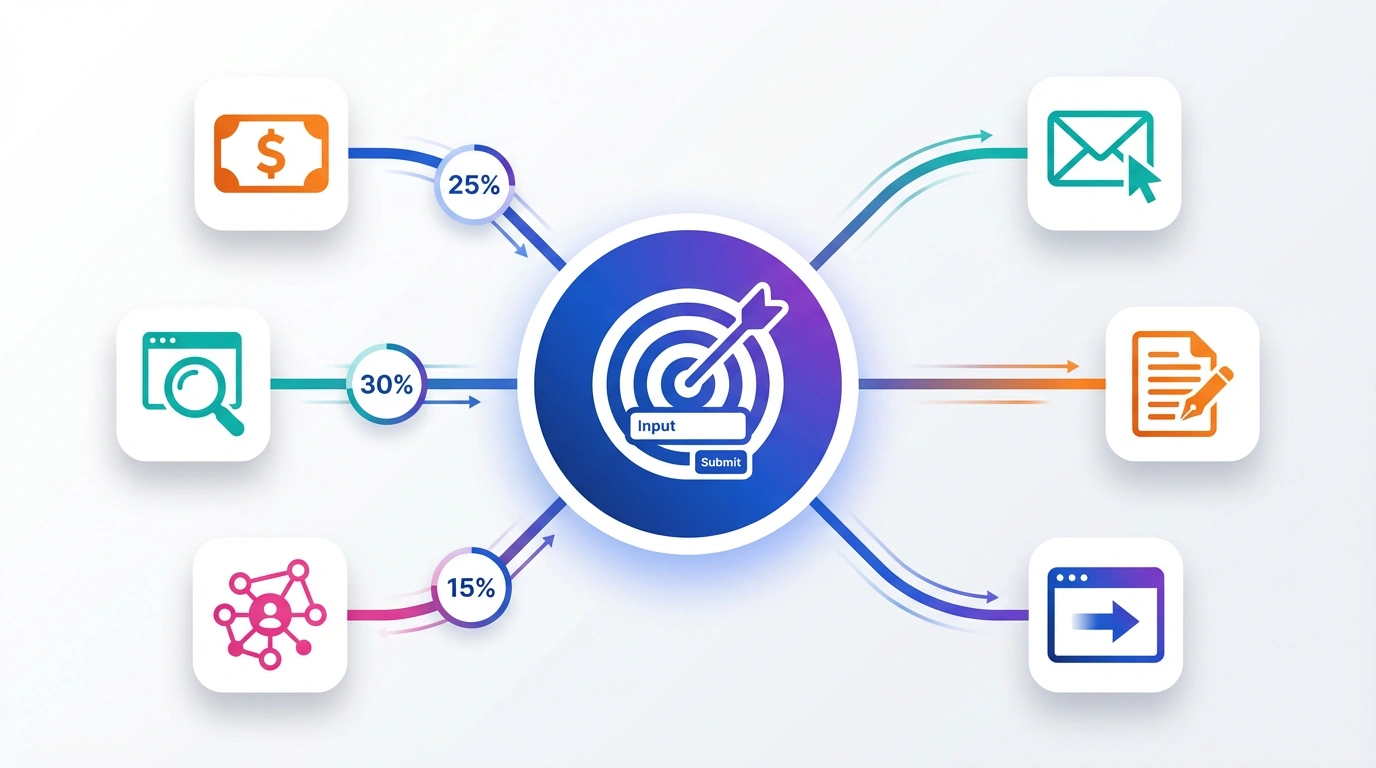

Marketing attribution answers the fundamental question every marketer struggles with: which campaigns and channels actually generate results? Without clear attribution, you’re investing marketing budget blindly, unable to identify what works and what wastes money. Attribution transforms scattered touchpoint data into actionable insights that optimize spend and prove ROI.
What Is Marketing Attribution?
Marketing attribution is the analytical method of identifying which marketing touchpoints influence a prospect’s decision to convert. It tracks every interaction—from initial ad clicks to email opens to website visits—and assigns credit to each touchpoint based on its contribution to the final conversion.
Think of attribution as detective work for your marketing funnel. When someone fills out your contact form, attribution reveals their complete journey: Did they discover you through a Google search? Did they click a LinkedIn ad three weeks ago? Did they download a whitepaper before requesting a demo? Attribution connects these dots, showing exactly how prospects move from awareness to conversion.
Modern buyers interact with brands across multiple channels before making decisions. B2B buyers might engage with 10+ touchpoints over several months. Attribution captures this complexity, providing visibility into the customer journey that simple analytics miss.
LeadSources is a marketing attribution software that tracks where your leads come from and links them to the first interaction that started the conversion journey.
Test LeadSources today. Enter your email below and receive a lead source report showing all the lead source data we track—exactly what you’d see for every lead tracked in your LeadSources account.
Why Marketing Attribution Matters for Lead Tracking
Attribution isn’t just about collecting data—it’s about making smarter marketing decisions that directly impact revenue.
Eliminate Wasted Marketing Spend
Attribution shows which campaigns generate qualified leads versus those that burn budget without results. You can confidently cut underperforming channels and reinvest in proven winners.
Understand Multi-Touch Customer Journeys
Single touchpoints rarely convert prospects. Attribution reveals the complete path—how awareness-stage content leads to consideration-stage webinars that ultimately drive demo requests. This visibility helps you optimize every funnel stage.
Prove Marketing’s Revenue Contribution
Executives care about pipeline and revenue, not vanity metrics. Attribution directly connects marketing activities to closed deals, demonstrating concrete ROI that justifies budget requests.
Optimize Lead Quality Over Quantity
High lead volume means nothing if leads don’t convert. Attribution tracks which sources generate leads that actually become customers, helping you focus on quality channels.
Align Marketing and Sales Teams
When both teams see which marketing touchpoints produce the best leads, coordination improves. Sales understands lead context, while marketing receives feedback on what closes deals.
How Marketing Attribution Works
Attribution relies on tracking infrastructure that monitors prospect behavior across all marketing touchpoints. Here’s how the process functions:
Capture Every Touchpoint
Tracking mechanisms record each prospect interaction—ad clicks, website visits, email engagement, content downloads, form submissions. This requires implementing UTM parameters on campaign URLs, tracking pixels on website pages, and form capture technology that preserves source data.
Connect Interactions to Individuals
The attribution system links all touchpoints to specific prospects. When someone converts, the technology captures not just that action but their complete interaction history—which campaigns they engaged with, which pages they visited, how many sessions occurred before conversion.
Apply Attribution Model
An attribution model determines credit distribution across touchpoints. Should the first interaction receive more weight? The last one? Should all touchpoints share equally? The chosen model assigns percentage credit accordingly.
Aggregate for Analysis
Individual lead data aggregates into channel and campaign performance reports. You can analyze patterns like: “Organic search drove 200 leads last month with 30% converting to opportunities” or “Webinar registrations assisted in 45% of closed deals.”
Optimize Marketing Strategy
Armed with attribution insights, you make data-driven decisions—increase investment in high-performing channels, refine messaging on underperforming campaigns, eliminate tactics that don’t contribute to conversions.
Types of Marketing Attribution Models
Different attribution models distribute credit differently across the customer journey. Selecting the right model depends on your sales cycle length, business type, and marketing objectives.
Single-Touch Models
First-Touch Attribution
Assigns 100% credit to the initial touchpoint where prospects discover your brand. This model emphasizes top-of-funnel channel effectiveness and brand awareness efforts. However, it completely ignores nurturing activities that moved prospects toward conversion.
Last-Touch Attribution
Credits the final touchpoint before conversion with 100% of the value. Useful for identifying closing mechanisms but overlooks all awareness and consideration-stage interactions that made the conversion possible.
Multi-Touch Attribution Models
Linear Attribution
Distributes credit equally across all touchpoints. If a prospect had six interactions before converting, each receives approximately 17% credit. This provides balanced visibility but doesn’t account for varying touchpoint importance.
Time-Decay Attribution
Weights recent touchpoints more heavily than earlier ones. Interactions closer to conversion receive more credit. This model works well when you believe later-stage activities have greater influence on purchase decisions.
U-Shaped (Position-Based) Attribution
Allocates 40% credit to first touch, 40% to last touch, and distributes the remaining 20% among middle touchpoints. This emphasizes both awareness and conversion moments while acknowledging the nurturing journey between them.
W-Shaped Attribution
Expands on U-shaped by adding a third milestone—typically lead qualification or opportunity creation. It assigns 30% credit to first touch, 30% to lead creation, 30% to opportunity creation, and 10% to remaining touchpoints. Ideal for B2B companies with defined sales stages.
Data-Driven Attribution
Uses machine learning algorithms to analyze conversion patterns and assign credit based on statistical impact. This requires substantial data volume but provides the most accurate picture of touchpoint influence.
How to Implement Marketing Attribution
Successfully implementing attribution requires strategic planning and proper technical execution.
Define Clear Attribution Goals
Start by identifying what questions you need answered. Are you optimizing channel ROI? Improving campaign performance? Proving marketing’s revenue impact? Clear objectives guide your implementation approach and model selection.
Map Your Complete Customer Journey
Document every potential touchpoint where prospects interact with your brand—paid advertising, organic search, social media, email campaigns, webinars, sales calls, events. Understanding typical journey length and complexity informs model choice.
Build Tracking Infrastructure
Implement UTM parameters: Create consistent tagging standards for all campaign URLs to identify traffic sources accurately.
Install tracking pixels: Place tracking code on key website pages to monitor visitor behavior and conversions.
Enable form tracking: Deploy technology that captures complete lead source data when prospects submit forms and automatically passes it to your CRM.
Integrate marketing tools: Connect advertising platforms, website analytics, email systems, and CRM to create unified data flow across your stack.
Select Your Attribution Model
Begin with straightforward models if you’re new to attribution—first-touch or last-touch provides immediate value. As your attribution maturity grows, implement multi-touch models that reflect your sales cycle complexity. Many organizations use multiple models simultaneously to gain different analytical perspectives.
Create Performance Dashboards
Build visualizations that make attribution insights accessible to stakeholders. Essential reports include:
- Lead volume and quality by channel
- Cost per lead and customer acquisition cost by source
- Conversion rates at each funnel stage by channel
- Revenue influenced or generated by marketing programs
Test, Learn, and Optimize Continuously
Attribution isn’t a one-time implementation. Regularly review data, test hypotheses, and refine your marketing mix based on insights. Run controlled experiments to validate attribution findings—if data suggests email nurturing is highly influential, test increased email frequency to measure impact.
Common Challenges and Solutions
Attribution implementation faces predictable obstacles. Here’s how to address them:
Challenge: Cross-Device Tracking Gaps
Prospects research on mobile devices but often convert on desktop computers, breaking the attribution trail.
Solution: Implement platforms with probabilistic matching capabilities, or use authenticated tracking when users log into your system.
Challenge: Privacy Regulations Limiting Tracking
GDPR, CCPA, and cookie deprecation restrict tracking capabilities and data collection.
Solution: Prioritize first-party data collection through owned channels. Implement privacy-compliant tracking methods and focus on data you control directly.
Challenge: Attributing Offline Conversions
Phone calls, in-person meetings, trade show interactions, and direct mail responses are difficult to connect to digital touchpoints.
Solution: Use call tracking with campaign-specific phone numbers, create unique URLs or QR codes for offline materials, implement event registration tracking, and manually log offline leads in your CRM with proper source attribution.
Challenge: Inconsistent Data Quality
Broken integrations, inconsistent UTM tagging, and missing form fields corrupt attribution data.
Solution: Establish strict naming conventions and tagging standards. Conduct regular tracking audits. Implement CRM validation rules that enforce required source fields.
Challenge: Selecting Inappropriate Attribution Models
Using first-touch attribution for long B2B sales cycles over-credits awareness activities while ignoring crucial nurturing efforts.
Solution: Match attribution models to your actual sales cycle characteristics. B2B companies with 60-90 day cycles need multi-touch models; e-commerce businesses with same-day conversions can use simpler single-touch approaches.
Marketing Attribution Best Practices
Follow these principles to maximize attribution effectiveness:
Prioritize Data Quality Over Quantity
Attribution accuracy depends entirely on data quality. Establish UTM parameter standards, enforce consistent tagging across teams, audit tracking implementation regularly, and fix issues immediately when discovered.
Use Multiple Attribution Models
Each model reveals different insights. View first-touch for awareness effectiveness, last-touch for conversion drivers, and multi-touch for comprehensive journey understanding. Triangulating across models provides balanced perspective.
Track Attribution Through to Revenue
Measuring attribution only to lead generation misses the complete picture. Track through opportunity creation and closed revenue to understand which channels generate leads that actually become customers.
Account for Sales Cycle Time Lag
Don’t evaluate channel performance based on insufficient time windows. If your sales cycle averages 60 days, wait for adequate conversion windows before making optimization decisions.
Educate Stakeholders on Limitations
Attribution demonstrates correlation, not causation. A touchpoint receiving credit in your model doesn’t prove it caused the conversion—it simply was present in the journey. For causal validation, supplement attribution with incrementality testing.
Make Data Accessible
Create dashboards that enable self-service access to attribution insights. When marketers can independently explore data, they make better daily decisions without waiting for analyst support.
Review and Refine Continuously
Attribution insights evolve as your marketing mix changes. Schedule regular reviews to assess model performance, validate data accuracy, and adjust strategy based on emerging patterns.
Key Metrics to Track
Monitor these essential KPIs to measure attribution effectiveness:
Leads by Channel
Track lead volume generated by each marketing channel—organic search, paid advertising, social media, email, referral traffic, direct visits. This reveals which channels reach your target audience most effectively.
Cost Per Lead by Source
Calculate channel investment divided by leads generated to understand acquisition efficiency. Channels producing high volume at low cost deserve increased budget allocation.
Lead-to-Customer Conversion Rate by Channel
High lead volume is meaningless if those leads don’t convert. Track the percentage of leads from each source that become paying customers to identify quality differences.
Customer Acquisition Cost by Channel
Calculate total marketing and sales expenses divided by customers acquired from each source. This reveals your most cost-effective channels for sustainable growth.
Revenue Influenced by Channel
Track total pipeline and closed revenue where each channel appeared anywhere in the attribution path. This identifies channels that may not receive last-touch credit but play important supporting roles.
Average Touchpoints to Conversion
Measure how many interactions prospects have before converting. This informs expectations about journey complexity and nurturing requirements.
Time to Conversion by Channel
Track how long leads from different sources take to become customers. Faster-converting channels may deserve priority even if they generate lower total volume.
Frequently Asked Questions
What’s the difference between marketing attribution and lead source tracking?
Lead source tracking identifies where a lead originally discovered your brand—the first touchpoint only. Marketing attribution is comprehensive, analyzing all touchpoints throughout the customer journey and determining how much credit each deserves for the conversion. Lead source answers “how did they find us?” while attribution answers “what combination of marketing efforts led to this conversion and what’s each worth?”
How long does it take to see meaningful attribution insights?
You’ll see basic data immediately after implementing tracking, but statistically significant insights require time and volume. For meaningful analysis, you need at least 100 tracked conversions. Timeline depends on your conversion volume—businesses generating 10 leads weekly need roughly 10 weeks, while those generating 100 leads weekly can draw conclusions in two weeks. Additionally, factor in your sales cycle length when measuring revenue attribution.
Which attribution model works best for B2B companies?
B2B companies with extended sales cycles benefit most from multi-touch attribution models. W-shaped attribution works particularly well because it credits three pivotal moments: initial discovery, lead qualification, and opportunity creation. This reflects typical B2B journeys where awareness, engagement, and sales-readiness all play distinct critical roles. Avoid relying exclusively on last-touch attribution in B2B, as it ignores weeks or months of nurturing that enabled the conversion.
Can attribution track phone calls and offline conversions?
Yes, tracking offline conversions is possible with proper setup. For phone calls, implement dynamic number insertion or campaign-specific tracking numbers that connect calls back to their originating digital touchpoint. For events and trade shows, create unique landing page URLs or registration forms that capture the offline source. When sales representatives manually enter leads from offline channels, enforce source tracking fields in your CRM to maintain attribution continuity. While offline attribution requires more manual processes than digital tracking, proper procedures preserve the attribution trail.
How accurate is marketing attribution data?
Attribution accuracy depends on your tracking infrastructure quality. With proper implementation—consistent UTM tagging, reliable tracking pixels, and form capture technology—digital attribution typically captures 75-90% of trackable touchpoints. However, some gaps are unavoidable: cross-device journeys, privacy-blocking tools, walled garden platform limitations, and offline interactions create blind spots. The key is understanding these limitations and treating attribution data as strong directional guidance rather than absolute truth. Combine attribution with incrementality testing for causal validation.
Does attribution work for small businesses with limited traffic?
Absolutely. Small businesses benefit significantly from attribution because every marketing dollar carries more weight. Even with limited traffic, attribution reveals patterns—perhaps your email newsletter consistently generates the highest-quality leads, or LinkedIn outperforms Facebook despite lower volume. Start with simple first-touch or last-touch models, which provide value even with smaller datasets. As you grow, evolve to more sophisticated multi-touch approaches. The critical step is tracking every lead’s source from day one, building historical data as you scale.
What’s the difference between attribution and web analytics?
Web analytics platforms track aggregate website traffic and behavior patterns—total visitors, page views, bounce rates, and overall conversion rates. Marketing attribution focuses specifically on lead-level tracking—connecting individual conversions back to the exact marketing touchpoints that influenced them. Analytics tells you what happened across your site; attribution tells you which marketing efforts drove specific conversions. Both provide value, but attribution delivers the lead-source visibility that directly impacts marketing budget allocation and optimization decisions.