
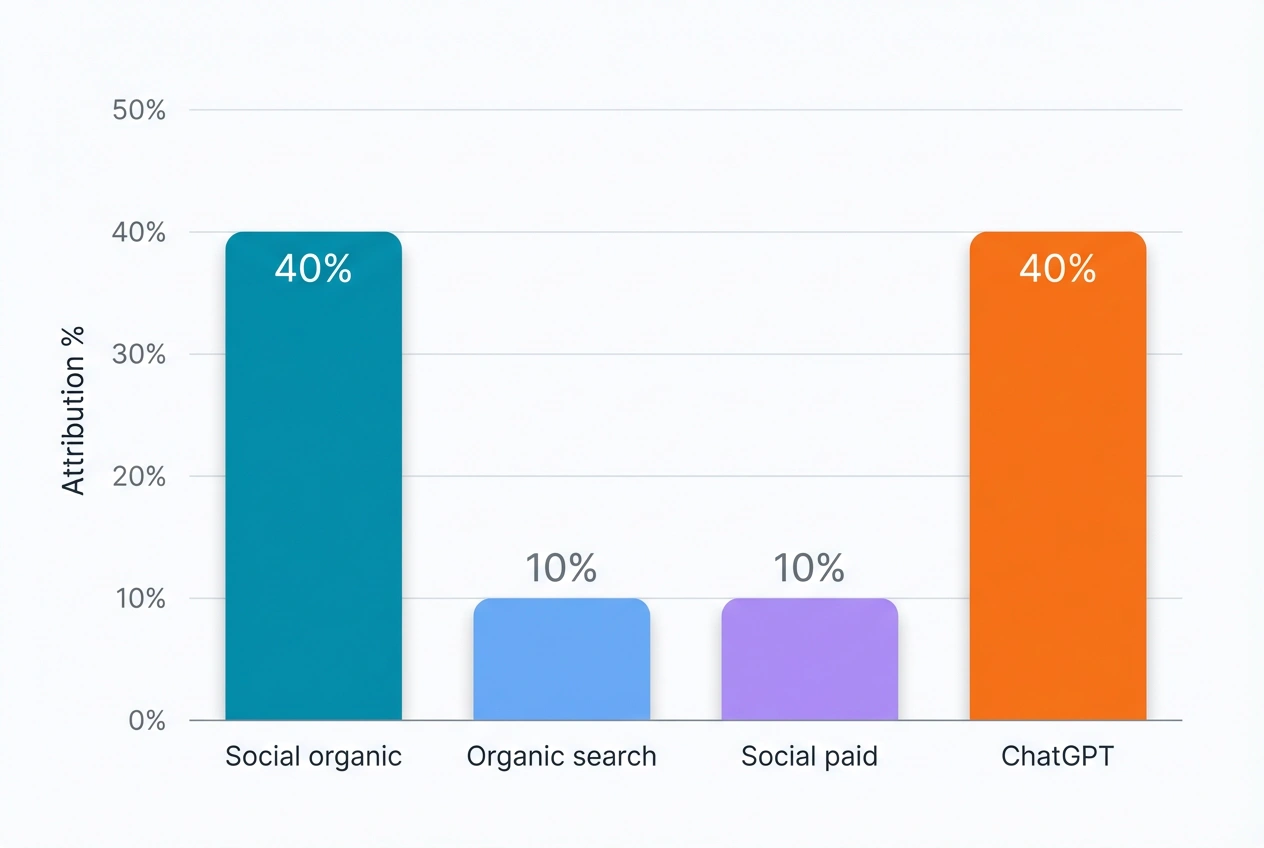

Marketing teams constantly grapple with determining which channels and campaigns deserve credit for conversions. When prospects interact with your brand multiple times before converting—clicking ads, reading blog posts, attending webinars—how do you fairly assess each touchpoint’s contribution? U-Shaped Attribution offers a balanced approach that recognizes both the critical moment of discovery and the final push toward conversion, while acknowledging the nurturing journey between them.
What Is U-Shaped Attribution?
U-Shaped Attribution is a multi-touch marketing attribution model that assigns 40% of conversion credit to the first touchpoint where prospects discover your brand, 40% to the last touchpoint before conversion, and distributes the remaining 20% evenly among all middle interactions in the customer journey.
Also called Position-Based Attribution, this model recognizes that two pivotal moments significantly influence purchasing decisions: initial awareness and final conversion. The first touchpoint introduces prospects to your solution, establishing brand recognition and sparking interest. The last touchpoint provides the decisive nudge that converts consideration into action. Middle touchpoints—while valuable for nurturing and education—receive proportionally less credit under this framework.
Consider a prospect’s journey: They discover your company through a paid LinkedIn ad (first touch), read three blog articles over two weeks (middle touches), attend a webinar (middle touch), and finally request a demo after receiving an email campaign (last touch). U-Shaped Attribution assigns 40% credit to the LinkedIn ad, 40% to the email campaign, and splits the remaining 20% among the three blog visits and webinar—approximately 5% to each middle interaction.
LeadSources automatically applies U-Shaped Attribution models to your lead data, revealing which channels drive initial awareness and which close conversions effectively, enabling precise optimization of your marketing mix.
Test LeadSources today. Enter your email below and receive a lead source report showing all the lead source data we track—exactly what you’d see for every lead tracked in your LeadSources account.
How U-Shaped Attribution Works
U-Shaped Attribution operates on the principle that customer journeys have defining moments that disproportionately influence outcomes. The model’s distinctive credit distribution reflects this reality.
First Touchpoint: 40% Credit
The initial interaction receives substantial credit because it determines whether prospects enter your funnel at all. Without successful awareness generation, no subsequent nurturing or conversion can occur. Channels that excel at driving discovery—paid search, social media advertising, content marketing—receive recognition for their top-of-funnel effectiveness.
Last Touchpoint: 40% Credit
The final interaction before conversion receives equal weight because it represents the decisive moment when prospects choose to act. This touchpoint overcomes final objections, provides necessary information, or creates urgency that transforms interest into commitment. Channels that drive conversions—email campaigns, retargeting ads, sales outreach—receive credit for their bottom-of-funnel impact.
Middle Touchpoints: 20% Credit Distributed Equally
All interactions between first and last share the remaining credit equally. If three middle touchpoints exist, each receives approximately 6.7%. If ten middle touchpoints exist, each receives 2%. This acknowledges that nurturing activities contribute to conversions but carry less individual weight than awareness and conversion moments.
The model requires comprehensive tracking infrastructure that captures every prospect interaction throughout their journey. Implementation involves tagging all marketing campaigns with tracking parameters, deploying tracking pixels across digital properties, and integrating data across advertising platforms, website analytics, email systems, and CRM databases.
When to Use U-Shaped Attribution
U-Shaped Attribution proves most valuable in specific business contexts where both awareness generation and conversion tactics play critical roles.
Moderate-Length Sales Cycles
Companies with sales cycles spanning 30-90 days benefit significantly from U-Shaped models. These journeys typically involve enough touchpoints—usually 5-12 interactions—to make multi-touch attribution meaningful, while remaining short enough that first-touch awareness retains clear influence on final outcomes.
High Investment in Top and Bottom Funnel
Organizations allocating substantial budget to both awareness campaigns and conversion optimization need attribution models that reflect both investment areas. If you’re running brand awareness campaigns alongside aggressive retargeting and email conversion tactics, U-Shaped Attribution reveals performance across both strategies.
Distinct Awareness and Conversion Channels
When different channels serve different funnel stages—social media for awareness, email for conversion—U-Shaped Attribution provides clearer performance visibility than models that weight all touchpoints equally. You can identify which channels excel at generating interest versus closing deals.
B2B Marketing and SaaS Growth
B2B companies and SaaS businesses typically exhibit customer journeys where initial discovery and final conversion represent clearly defined stages. Prospects often discover solutions through content or paid advertising, engage with educational materials, and ultimately convert through targeted campaigns or sales interactions. U-Shaped Attribution aligns naturally with these journey patterns.
Benefits of U-Shaped Attribution
U-Shaped Attribution delivers strategic advantages over simpler attribution approaches by providing balanced visibility across critical funnel stages.
Balanced Credit Distribution
Unlike First-Touch models that ignore conversion effectiveness or Last-Touch models that overlook awareness channels, U-Shaped Attribution recognizes both ends of the funnel. This balanced perspective prevents underinvestment in awareness or conversion optimization.
Strategic Budget Allocation
The model reveals which channels generate valuable first touches and which drive conversions, enabling sophisticated budget decisions. You might discover that LinkedIn ads excel at awareness while email campaigns close conversions, justifying continued investment in both channels despite different funnel positions.
Awareness Campaign Justification
Brand awareness efforts often struggle for budget allocation because their impact isn’t immediately visible in Last-Touch analysis. U-Shaped Attribution quantifies awareness value, demonstrating ROI for channels that initiate customer journeys even if they don’t drive immediate conversions.
Conversion Optimization Insights
By emphasizing last-touch interactions, the model identifies which tactics effectively convert prospects who are already aware and engaged. This insight guides optimization of bottom-funnel activities—email sequences, retargeting campaigns, sales follow-up—that close deals.
Realistic Journey Recognition
The model acknowledges that customer journeys have pivotal moments while avoiding the oversimplification of single-touch attribution. This realistic framework better reflects actual buyer behavior than models that either focus exclusively on one touchpoint or distribute credit identically across all interactions.
Challenges and Limitations
Despite its advantages, U-Shaped Attribution carries limitations that marketers must understand when interpreting results.
Arbitrary Weight Distribution
The 40-40-20 split, while logical, remains somewhat arbitrary. Different businesses might justify different distributions—perhaps 50-30-20 or 35-35-30—depending on their specific customer journey characteristics. The standard distribution may not perfectly match your unique conversion dynamics.
Undervaluing Nurturing Activities
Middle touchpoints receive minimal individual credit under U-Shaped models, potentially undervaluing crucial nurturing activities. If your webinars, case studies, or educational content play vital roles in moving prospects toward conversion, the 20% middle-touch allocation may not reflect their true impact.
Short Journey Limitations
When prospects have only 2-3 touchpoints, U-Shaped Attribution provides minimal advantage over simpler models. The framework’s value emerges with longer, more complex journeys where first-touch, nurturing, and last-touch stages are clearly differentiated.
Implementation Complexity
Multi-touch attribution requires comprehensive tracking infrastructure and data integration across multiple systems. Organizations lacking mature marketing operations may struggle with technical implementation, data quality issues, or attribution platform costs.
Cross-Device and Offline Gaps
Like all digital attribution models, U-Shaped Attribution faces challenges tracking prospects who switch between devices or engage through offline channels. These tracking limitations can distort attribution results if significant portions of customer journeys occur outside trackable environments.
Best Practices for Implementation
Maximizing U-Shaped Attribution value requires thoughtful implementation and ongoing optimization.
Establish Comprehensive Tracking
Implement tracking mechanisms across all marketing channels—UTM parameters for campaigns, pixels for website behavior, form capture for lead generation. Attribution accuracy depends entirely on data quality, so invest in robust tracking infrastructure before relying on attribution insights.
Define Clear Conversion Events
Specify exactly what constitutes a conversion for attribution purposes—demo requests, trial signups, sales meetings, closed deals. Different conversion definitions yield different attribution results, so maintain consistency in measurement criteria.
Compare Multiple Attribution Models
Analyze performance using U-Shaped, First-Touch, Last-Touch, and Linear models simultaneously. Comparing results reveals which channels perform differently under various frameworks, providing richer strategic intelligence than any single model delivers.
Adjust for Sales Cycle Characteristics
If your sales cycle is particularly short or long, consider whether U-Shaped Attribution’s standard distribution matches your journey dynamics. Some attribution platforms allow custom weight configurations that better reflect your specific conversion patterns.
Account for Data Quality Issues
Monitor attribution data for tracking gaps, implement processes to capture offline interactions manually, and acknowledge attribution limitations when making strategic decisions. Treat attribution insights as directional guidance rather than absolute truth.
Regular Review and Optimization
Schedule quarterly attribution reviews to assess model performance, validate data accuracy, and refine marketing strategy based on emerging patterns. Attribution insights evolve as your marketing mix changes, requiring continuous evaluation.
U-Shaped Attribution vs. Other Models
Understanding how U-Shaped Attribution compares to alternative frameworks helps determine when each approach provides the most value.
U-Shaped vs. Linear Attribution
Linear Attribution distributes credit equally across all touchpoints, treating awareness, nurturing, and conversion identically. U-Shaped Attribution prioritizes first and last touches, providing clearer insight into awareness and conversion effectiveness but potentially undervaluing middle activities.
U-Shaped vs. W-Shaped Attribution
W-Shaped Attribution adds a third milestone—typically lead qualification or opportunity creation—creating a 30-30-30-10 distribution across first touch, middle milestone, last touch, and remaining interactions. Organizations with clearly defined sales stages and longer cycles may benefit from W-Shaped’s additional granularity.
U-Shaped vs. Time-Decay Attribution
Time-Decay Attribution weights recent touchpoints more heavily than earlier ones, operating on the assumption that proximity to conversion indicates greater influence. U-Shaped Attribution emphasizes position (first and last) rather than recency, making it more suitable when initial awareness carries long-term influence.
U-Shaped vs. Data-Driven Attribution
Data-Driven Attribution uses machine learning algorithms to calculate credit distribution based on statistical analysis of conversion patterns. While more sophisticated, it requires substantial data volume and technical capability. U-Shaped Attribution provides a simpler, more interpretable alternative that works effectively with moderate data volumes.
Frequently Asked Questions
How does U-Shaped Attribution differ from Linear Attribution?
Linear Attribution distributes credit equally across all touchpoints, giving each the same weight regardless of position. U-Shaped Attribution prioritizes the first and last touchpoints with 40% credit each, acknowledging that awareness and conversion moments carry greater influence than middle interactions. If a prospect has five touchpoints, Linear gives each 20%, while U-Shaped gives the first and last 40% each and splits 20% among the three middle touchpoints (approximately 6.7% each).
What types of businesses benefit most from U-Shaped Attribution?
B2B companies with moderate sales cycles (30-90 days) benefit significantly from U-Shaped Attribution because it recognizes both the importance of initial brand discovery and final conversion actions. SaaS businesses with free trials or demo request funnels find this model particularly useful, as it credits both the awareness campaign that drove discovery and the conversion tactic that pushed prospects to sign up. Companies investing heavily in both top-of-funnel brand awareness and bottom-of-funnel conversion optimization see the clearest value.
Can U-Shaped Attribution work with short sales cycles?
U-Shaped Attribution can work with shorter sales cycles but becomes less distinctive when prospects have only 2-3 touchpoints. With minimal interactions, the model behaves similarly to simpler attribution approaches. For e-commerce businesses where conversions happen within hours or days with few touchpoints, First-Touch or Last-Touch Attribution often provides sufficient insight without the complexity of multi-touch models.
How should I distribute credit if a prospect has only two touchpoints?
When only two touchpoints exist, U-Shaped Attribution assigns 50% credit to each interaction, since they are simultaneously the first and last touchpoints. This scenario effectively mirrors Last-Touch or First-Touch Attribution. The model’s value emerges when customer journeys include three or more touchpoints, allowing meaningful differentiation between awareness, nurturing, and conversion stages.
Should I use U-Shaped Attribution exclusively or combine it with other models?
Most sophisticated marketing teams analyze performance using multiple attribution models simultaneously. U-Shaped Attribution provides valuable insights into awareness and conversion effectiveness, but comparing it with First-Touch, Last-Touch, and Linear models reveals different perspectives on channel performance. For example, a channel might show strong results in U-Shaped but weak in Last-Touch, indicating it excels at generating awareness but struggles to close conversions. This multi-model approach delivers more comprehensive strategic intelligence than relying on any single framework.