

Why Your Attribution System Probably Doesn’t Match Your Business
Here’s the uncomfortable truth about the challenges of marketing attribution: most companies are solving the wrong problem.
You’re spending $50K a month across six channels. You’ve implemented the recommended tools, maybe hired a consultant. But when the CEO asks “Which channels are actually working?” you still hesitate.
The data says one thing. Your sales team says another. And your $2K/month attribution dashboard still doesn’t answer: Where should I spend more, and where should I cut?
Here’s why: You’re using an attribution solution designed for a completely different business model than yours.
Want to know what marketing attribution software fits your business? Take the quiz below:
The Attribution Challenge No One Talks About
The biggest challenges of marketing attribution aren’t technical. It’s that everyone assumes attribution complexity scales with budget.
Consider two companies, both spending $50K/month:
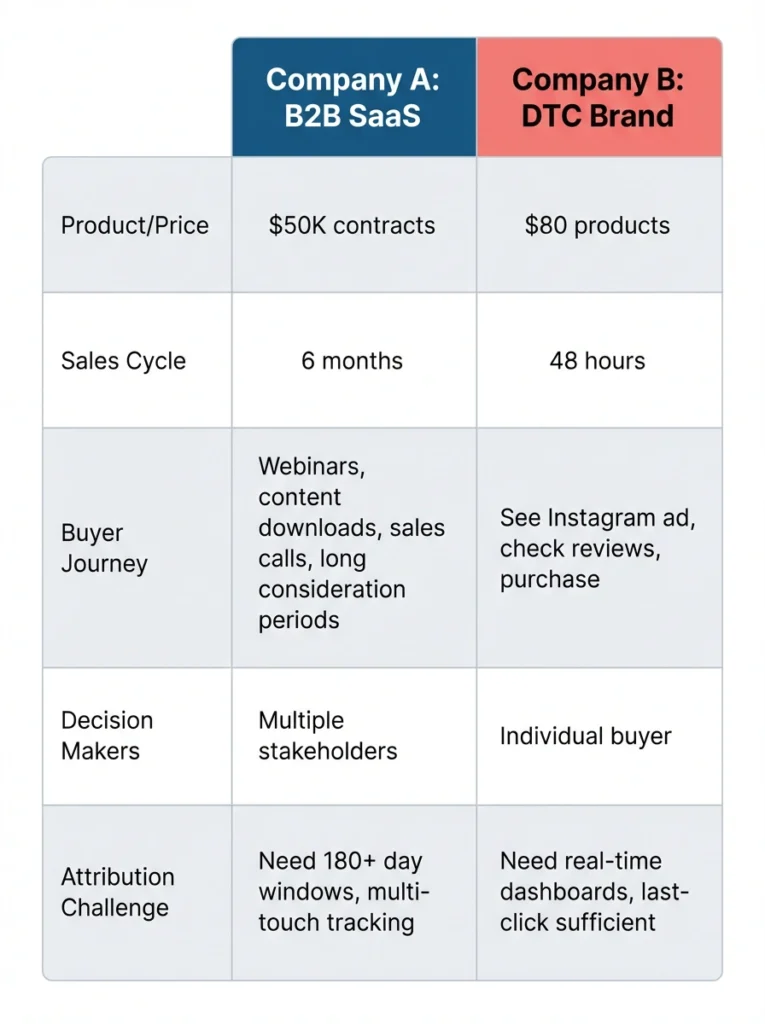
Same budget. Completely different attribution challenges.
Company A’s challenge? Their attribution tracks 30 days, but their sales cycle is 180 days. They need to connect that January webinar to the July deal close—but their system credits everything to the last Google search.
Company B’s challenge? They’re drowning in multi-touch attribution data when 70% of purchases happen within 24 hours. They don’t need 12 touchpoints tracked. They need to know right now: which ad drives highest lifetime value?
This is the attribution challenge no one’s talking about: you’re solving for the wrong business model.
When Perfect Attribution Kills Good Marketing
The other day, a friend of mine told me the story of their SaaS marketing director who launched a thought leadership campaign: LinkedIn content, community building, educational resources. No forms, no hard CTAs.
Results after three months:
- $2.3M in pipeline
- 34% drop in CAC
- 67% revenue increase
Sales loved it. Prospects arrived educated and closed faster.
The problem wasn’t marketing, it was a marketing attribution challenge: Last-touch attribution completely missed the channels that seeded this success.
Their attribution system showed zero conversions.
Why? Last-touch attribution only. Customers discovered them on LinkedIn, consumed content for weeks, then months later searched the company name and filled a demo form.
Attribution credited: “Organic search.”
Finance saw $80K spent with “no measurable ROI.” She was fired two weeks later.
The marketing worked. The measurement system couldn’t see it.
Why One-Size-Fits-All Advice Fails
Every marketing conference says: “Use multi-touch attribution.” “Implement a CDP.” “You need MMM.”
That advice isn’t wrong. It’s dangerously incomplete.
The CMO of a B2B company reads a Shopify case study and invests $30K in an e-commerce platform. Six months later, it can’t handle their 90-day sales cycles or connect touchpoints to closed revenue.
Or a DTC brand builds complex 12-touchpoint scoring when most customers buy within 24 hours and their real problem is form tools that stop at submission.
So how do you figure out what attribution approach actually fits? By applying this framework: Mapping six attribution dimensions that determine your real attribution challenges and the capabilities you need to solve them.
Dimension 1: Sales Cycle Length
Your sales cycle determines everything about what attribution can—and can’t—tell you.
Here’s the problem: Most attribution tools default to 7-30 day tracking windows. But if your actual sales cycle is 90 days? You’re only seeing a third of the story, which is one of the most common challenges of marketing attribution.
The Three Attribution Realities
0-7 Days: Speed Is Everything
If your customers buy within a week, you’re lucky. Last-click attribution might actually work here. You need real-time dashboards that answer: “What’s converting right now?”
That Instagram ad from Tuesday? If it’s driving sales by Friday, you can see it, optimize it, and scale it before the weekend. Your attribution challenge isn’t tracking complexity—it’s decision speed.
30-90 Days: The Invisible Middle
This is where most B2B companies live—and where attribution starts breaking down.
Your prospects don’t convert on first touch. They download a guide, attend a webinar, get retargeted, read three blog posts, then finally request a demo 60 days later.
If your attribution window is set to 30 days? That first webinar that actually started the journey gets zero credit. You’ll think retargeting is your hero channel when it’s really just catching people already interested.
You need extended windows and assist tracking. Not because it’s sophisticated—because it’s accurate.
180+ Days: Attribution Hell
Welcome to enterprise B2B, where deals take 6+ months and involve multiple stakeholders.
One $5M ARR SaaS company discovered their buyers averaged 11.3 touchpoints before closing. Not one. Not three. Eleven.
Their attribution was set to 30 days. Guess how many touchpoints they were tracking? About 2.
The result? Marketing reported channels as “underperforming” that were actually seeding every deal that closed six months later. Sales said marketing wasn’t delivering quality. Marketing said sales wasn’t following up fast enough.
Nobody was wrong. The attribution window was just too short to see reality.
The bottom line: Match your attribution window to your actual sales cycle. Anything shorter, and you’re just measuring random noise instead of what’s really driving revenue.
Dimension 2: Journey Complexity (Number of Touchpoints)
Here’s a question that reveals everything about your attribution challenges: How many times does someone interact with you before they buy?
If the answer is “once”—you click an ad, you buy—congratulations. Basic UTM tracking and last-click attribution will serve you fine.
But if the answer is “I don’t know”? You’ve got a problem.
The Touchpoint Reality Check
Single Touchpoint = Simple Attribution
Some businesses actually have linear journeys. Customer sees ad. Customer clicks. Customer buys. Done.
If that’s you, don’t overcomplicate it. GA4 with proper UTM parameters tells you everything you need. Your attribution challenge isn’t tracking complexity—it’s creative testing and offer optimization.
3-5 Touchpoints = The Interplay Problem
Most B2B and considered-purchase brands live here.
A prospect sees your LinkedIn ad (doesn’t click). Gets retargeted on Facebook (clicks, reads one blog post). Receives a nurture email (opens, doesn’t click). Sees another ad (clicks). Finally fills out a demo form.
Last-click attribution says: “Display retargeting drove this lead.”
Reality: Four different channels worked together. Understanding this complexity is one of the trickiest challenges of marketing attribution. And without multi-touch visibility, you’ll over-invest in retargeting and under-invest in the LinkedIn ads that started the whole journey.
This is where the challenges of marketing attribution get real: you need to see how channels influence each other, not just who got the last click.
10+ Touchpoints = Identity Crisis
Enterprise B2B? High-consideration purchases? You’re dealing with double-digit touchpoints—and that’s where attribution completely breaks.
Case study
One consulting firm analyzed their $5M ARR client’s closed deals and found buyers averaged 11.3 touchpoints before converting:
- Email opens
- Page visits
- Content downloads
- Ad clicks
- Webinar attendance
- Demo requests
Their attribution system? Last-touch only. Crediting 100% to whatever happened right before the demo form.
The result: They thought organic search was their top channel. Actually, it was just the final step in a journey that started with paid LinkedIn ads three months earlier.
But here’s where it gets worse: half those touchpoints happened across different devices. Prospect researched on mobile during their commute. Read whitepapers on a tablet at home. Filled out the demo form on their work laptop.
Without identity resolution and cross-device tracking, their attribution saw three different people—not one buyer on a 90-day journey.
Dimension 3: Stakeholder Count in the Buying Process
Here’s where B2B attribution gets messy: you’re not tracking one buyer. You’re tracking a committee.
And if your attribution system thinks every stakeholder is a separate lead? You’re about to make some very expensive mistakes.
The Stakeholder Attribution Gap
Individual Buyers = Simple Math
One person makes the decision. One person converts. User-level attribution works fine.
Your prospect clicks an ad, explores your site, signs up. Attribution connects the dots from first touch to conversion because there’s only one person to track. Your challenge isn’t complexity, it’s understanding which messages resonate.
2-3 Decision-Makers= The Committee Starts
This is where attribution challenges multiply.
The marketing manager discovers you through LinkedIn. He downloads a guide. Two weeks later, his director attends your webinar. Then both of them visit your pricing page on different days.
If you’re tracking user-level attribution, your system sees two separate leads. You have no idea they’re from the same company, evaluating together.
The result? You can’t tell which content influences buying committees vs. individual explorers. You optimize for volume when you should optimize for account penetration.
You need account-based tracking to see the full picture: how many people from the target company are engaging, and what’s moving the entire committee forward.
5+ Decision-Makers = Attribution Breakdown
Enterprise deals? Multiple departments, each with their own priorities. IT needs security docs. Finance needs ROI justification. The VP needs competitive analysis. The C-suite needs strategic vision.
Case study
One $5M ARR SaaS company discovered their buyers averaged 11.3 touchpoints before closing. But here’s what their attribution missed: those weren’t 11 touchpoints from one person.They were different stakeholders engaging at different stages:
- Manager downloads technical whitepaper
- Director attends product demo
- VP reviews case studies
- CFO accesses pricing calculator
- CTO reads security documentation
Last-touch attribution credited the final demo request. But five different people influenced that decision over 90 days.
Without role tracking and touchpoint mapping at the account level, you’re blind to how buying committees actually form consensus.
What This Means
Individual buyers: Standard attribution works. Focus on conversion optimization.
Small committees: You need account-based view. Are you reaching multiple stakeholders, or just one curious researcher?
Large committees: Without account-level attribution, you’re counting touches—not tracking deals. And that’s the difference between insight and noise.
Dimension 4: Channel Diversity
The more channels you run, the harder it gets to know what’s actually working. This is a core challenge of marketing attribution. But here’s the trap: more channels doesn’t automatically mean you need more sophisticated attribution.
It depends on whether those channels work together or independently.
The Channel Complexity Scale
1-2 Channels = Keep It Simple
Running just Google Ads and organic search? You still face attribution challenges—just different ones.
Even with two channels, you need to answer: Are people discovering you through organic then converting via paid? Or are these completely separate audiences? Do your paid ads boost organic performance by increasing brand awareness?
The trap: Assuming two channels means simple attribution. If customers touch both channels before converting, you need visibility into that interplay. Last-click will systematically over-credit one channel and kill the other.
Your focus should be on understanding channel interaction patterns, not just which one “won” the conversion.
3-5 Channels = The Comparison Problem
LinkedIn Ads, Google Ads, content syndication, webinars, and email nurture. Now things get interesting.
Each platform claims credit for the same conversion. Facebook says it drove 100 conversions. Google says 120. Your CRM shows 80 actual customers.
The math doesn’t math.
This is where the challenges of marketing attribution become real: you need a unified dashboard to see the truth. Not because it’s fancy—because without it, you’re comparing apples to oranges using each platform’s self-serving attribution rules.
Which channels actually start journeys? Which ones assist? Which ones close? You can’t answer these questions looking at five separate dashboards that each use different attribution windows and counting methods.
8+ Channels Including Offline = Attribution Hell
Now add: billboards, podcasts, trade shows, direct mail, PR, partnerships, and word-of-mouth.
Here’s the problem: half your channels are completely invisible to digital attribution.
Someone hears your CEO on a podcast, sees a billboard during their commute, then three weeks later searches your brand name and converts. Your attribution says: “Organic search.”
Reality: The podcast and billboard created that demand. Digital attribution just can’t see it.
You need offline integration capabilities (promo codes, etc.).
Dimension 5: Revenue Per Customer
Here’s a reality check: the higher your deal value, the less you can afford to be wrong about attribution.
A $50 attribution mistake on a $50 product? Annoying. A $50,000 attribution mistake on a $100K deal? Career-ending.
The Stakes Change Everything
<$100 Transactions = Directional Is Good Enough
Selling $30 supplements or $80 skincare products? You can tolerate some attribution noise.
If your attribution is 70% accurate and you’re making hundreds of small transactions daily, the errors average out. You’re optimizing for patterns, not precision. Which channel drives the most volume? Which creative performs best? That’s enough to make good decisions.
The challenge here isn’t attribution accuracy—it’s speed. Can you see what’s working fast enough to optimize while campaigns are still running?
Obsessing over perfect attribution when you’re doing 500 transactions a day is often wasted effort. Directional data plus rapid testing beats perfect measurement with slow iteration.
$500-$10K Deals = Accuracy Becomes Critical
Now the math changes. Misattribute 20 deals worth $5K each, and you’ve just made a $100K budgeting mistake.
You need accurate channel ROAS because the margin for error shrinks dramatically. If you think Google Ads delivers 3x ROAS but it’s actually 1.5x—and you double your spend based on that false signal—you just torched your quarter.
Case study
This is where one consulting firm’s $5M ARR client ran into trouble: their attribution said certain channels were underperforming. Reality? Those channels were seeding deals that closed months later at $10K+ each. They nearly killed their highest-value acquisition channel based on attribution gaps.
You need to connect channels to actual deal value, not just lead volume.
$50K+ Deals = Every Touch Matters
Enterprise deals? You can’t afford any attribution blindness.
When someone closes a $100K contract, you need to know exactly which marketing activities influenced it, and when. Was it the webinar six months ago? The whitepaper the CFO downloaded? The case study the VP reviewed before the final decision?
This requires deal-level attribution with full marketing and sales touchpoint integration. Not because it’s sophisticated, but because one misattributed deal represents more revenue than 1,000 small transactions.
Dimension 6: Offline Influence
Here’s the challenge of marketing attribution nobody wants to admit: the most influential touchpoints are often the ones you can’t track.
If your customers discover you through conversations, events, podcasts, or billboards—your digital attribution is fiction dressed up as data.
Purely Digital Journeys = Trackable
If your entire customer journey happens online—ads, website, conversion—attribution tools can capture most of it.
You’re in the best position. Your challenge is tracking accuracy, not tracking possibility.
Some Offline Touchpoints = The Visibility Gap
Your CEO spoke at a conference. You sponsored a podcast. Someone mentioned you in a Slack community. A customer recommended you to a colleague.
Then that person searches your brand name three weeks later and fills out a form.
Your attribution says: “Organic branded search.”
Reality: The conference/podcast/referral created that demand. Digital tools just can’t see it.
This is where attribution gets expensive and manual. You need dedicated systems to capture offline influence—custom tracking mechanisms at point of conversion, integration between offline event data and your CRM, analysis of brand search patterns correlated with offline activities.
It’s not a tool you buy. It’s infrastructure you build. And most companies underestimate the effort required until they’ve already made budget decisions based on incomplete data.
Significant Offline Influence = Attribution Breakdown
Trade shows, billboards, direct mail, PR, word-of-mouth, partnerships. Half your demand creation happens where pixels can’t follow.
Case study
One B2B company tracked 60% of closed deals showing zero marketing touchpoints in their CRM. Either marketing wasn’t working, or attribution was blind… It was the latter.You need serious investment here: custom attribution workflows, offline-to-online data bridges, branded search lift analysis infrastructure, and proxy metric systems that estimate impact when direct measurement is impossible.
The reality? Most companies don’t have the resources to build proper offline attribution. So they make a choice: invest heavily in the infrastructure, accept directional estimates, or optimize purely for what’s trackable—and systematically undervalue everything else.
Now that you understand which dimensions shape your attribution needs, let’s cut through the noise and match you to the right tools.
What Attribution Capabilities You Actually Need
Here’s where most companies waste money: they buy attribution capabilities they’ll never use.
The solution isn’t more features—it’s matching your attribution tools to how your business actually works.
One company cut their attribution analysis time by 75%—from 3 days of spreadsheet work to 20 minutes in a dashboard—simply by implementing capabilities that fit their reality instead of copying enterprise playbooks.
Use this quiz to find your attribution fit:
Your Attribution Decision Tree: Finding the Right Solution
Attribution tools aren’t one-size-fits-all. Besides the features, your business model determines which solution actually works. Answer these four questions to find the attribution too that fits your business model:
Decision Node 1: “Do you generate leads through forms?”
If yes → You need form attribution with CRM integration.
Most attribution tools stop at “form submitted.” But that’s not revenue—that’s a lead that might close in 90 days or never. You need to see which channels drive closed deals, not just form fills.
What to look for: Form-level tracking that captures UTM data, referral source, and on-site journey, then pushes that data into your CRM so you can track which channels drive pipeline and revenue, not just leads.
Solution: LeadSources tracks the full journey of each lead from first touch through CRM integration, connecting marketing activity to actual revenue.
Decision Node 2: “Is e-commerce your primary model?”
If yes → E-commerce attribution platforms.
You need real-time visibility into which ads drive purchases and repeat customers, plus the ability to track cross-device journeys (mobile browse → desktop purchase).
What to look for: Multi-touch attribution, customer lifetime value tracking, and platform integration (Shopify, WooCommerce, etc.).
Solution: Hyros specializes in e-commerce attribution with AI-powered tracking that follows customers across devices and connects ad spend to actual sales and lifetime value.
Decision Node 3: “Is mobile app a primary channel?”
If yes → Mobile attribution specialists.
Mobile attribution is a different game. You need device-level tracking, deep linking capabilities, and attribution windows that handle everything from app installs to in-app purchases and post-install engagement across iOS and Android.
What to look for: Cross-device tracking, deep linking support, fraud prevention, and integration with ad networks for campaign optimization based on in-app behavior.
Solution: Adjust specializes in mobile attribution with real-time tracking of app installs, in-app purchases, and user engagement, plus built-in fraud prevention and audience segmentation designed specifically for mobile-first businesses.
Decision Node 4: “Do you need cross-platform identity resolution?”
If yes → Customer Data Platform (CDP) solutions.
When users interact across devices and channels, identity resolution connects those touchpoints into a single customer profile.
What to look for: Identity matching, real-time profile unification, first-party data control, and tool integrations.
Solution: CDPs like Segment unify customer data across platforms and activate it consistently across analytics and marketing tools.
To conclude this guide, marketing attribution fails when it’s built for someone else’s business model, not yours. Match your attribution capabilities to how your customers actually buy, and measurement stops being a reporting exercise and starts driving better budget decisions.