

TL;DR
- Lead Source Attribution identifies the specific channel or campaign that initiated a lead’s first interaction with your brand
- Unlike full-journey attribution, lead source attribution focuses on the original entry point—critical for understanding which channels create new demand versus converting existing awareness
- Proper implementation connects lead source data directly to CRM, enabling CPL analysis, channel ROI measurement, and budget optimization based on lead quality, not just volume
What Is Lead Source Attribution?
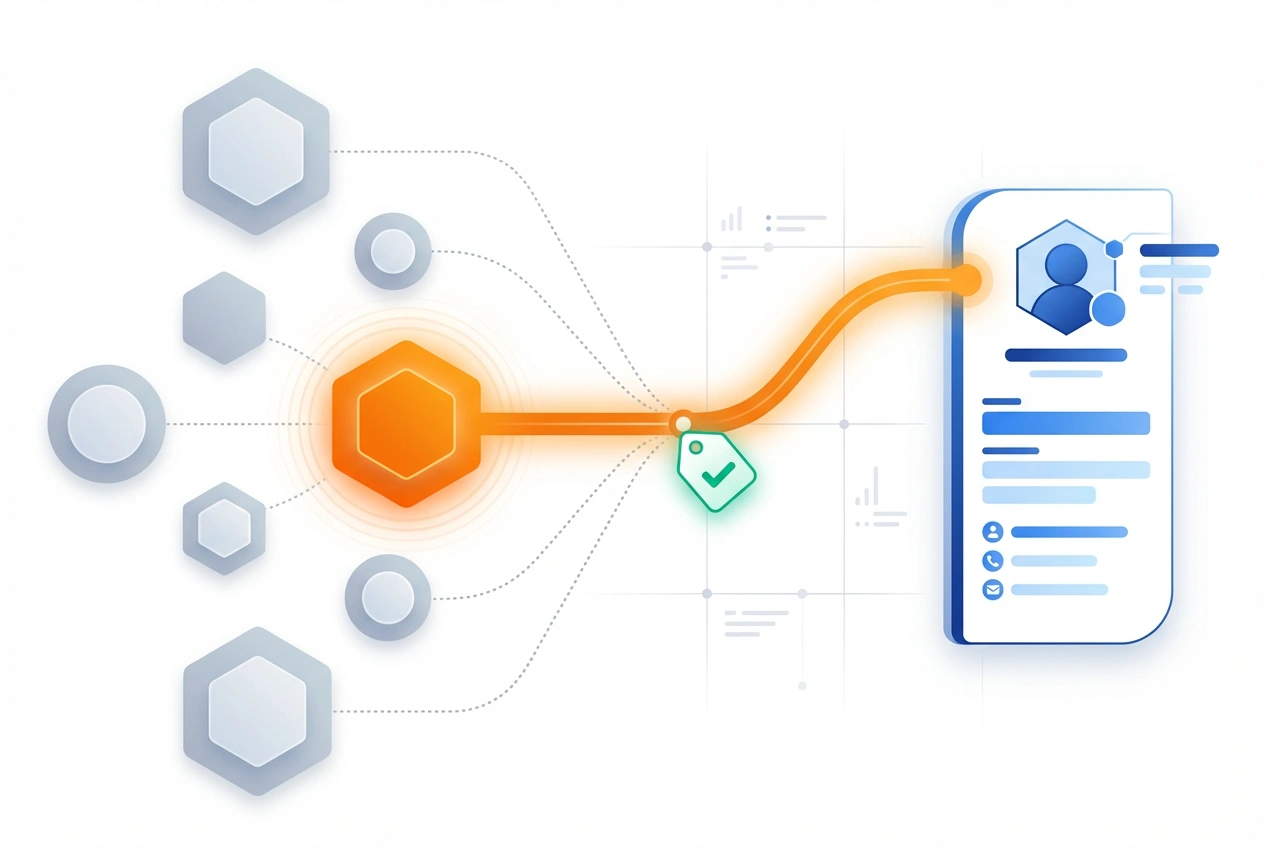
Lead Source Attribution is the practice of identifying and recording the specific marketing channel, campaign, or touchpoint that initiated a lead’s first engagement with your organization.
This first-touch data point answers a fundamental question: How did this lead discover us?
The lead source represents the original channel that drove awareness and prompted initial action—whether that’s a Google search, LinkedIn ad, referral link, event attendance, or direct website visit. When a prospect downloads a whitepaper after clicking a Facebook ad, Facebook becomes the attributed lead source, regardless of subsequent touchpoints.
Lead source attribution differs from multi-touch attribution by focusing exclusively on the entry point rather than distributing credit across multiple interactions. This single-source methodology enables CMOs to measure which channels generate net-new demand, calculate accurate cost-per-lead (CPL) by channel, and identify which acquisition sources deliver the highest-quality leads.
In CRM systems like Salesforce and HubSpot, lead source data populates at the contact record level and persists throughout the customer lifecycle. When a $50K deal closes, you can trace it back to the original webinar that created the lead 8 months earlier—connecting acquisition spend directly to revenue outcomes.
The framework requires technical implementation: UTM parameters on all marketing URLs, form hidden fields to capture referrer data, CRM integrations to persist source information, and standardized taxonomy to maintain data consistency across channels and campaigns.
Test LeadSources today. Enter your email below and receive a lead source report showing all the lead source data we track—exactly what you’d see for every lead tracked in your LeadSources account.
Lead Source Attribution vs. Multi-Touch Attribution
Lead source attribution and multi-touch attribution serve different analytical purposes.
Lead source attribution answers: “Which channel created this lead?” Multi-touch attribution answers: “Which combination of touchpoints converted this lead?”
Strategic Differences:
| Dimension | Lead Source Attribution | Multi-Touch Attribution |
|---|---|---|
| Focus | First interaction only | All touchpoints in journey |
| Primary Metric | Lead volume by source | Conversion influence across journey |
| Answers | “Which channel generates leads?” | “Which touchpoints convert leads?” |
| Implementation Complexity | Low (single data point) | High (full journey tracking) |
| Use Case | Top-of-funnel optimization, CPL analysis | Mid/bottom-funnel optimization, nurture effectiveness |
| Budget Decisions | Demand generation allocation | Conversion optimization allocation |
Both methodologies are complementary, not competitive. Lead source attribution reveals which channels fill your pipeline with net-new opportunities. Multi-touch attribution reveals which subsequent activities convert those leads to customers.
A channel might excel at lead generation but perform poorly at conversion—or vice versa. LinkedIn may generate high-volume, low-conversion leads (good lead source, poor conversion driver). Email nurture may convert leads effectively but generate zero new leads (poor lead source, excellent conversion driver).
The Lead Source Attribution Framework
Effective lead source attribution requires four integrated components working in harmony.
1. Standardized Taxonomy
Define a consistent lead source classification system before implementation. Categories must be mutually exclusive, collectively exhaustive, and aligned with your channel strategy.
Common taxonomy structure:
- Paid Search: Google Ads, Bing Ads brand and non-brand campaigns
- Paid Social: LinkedIn, Facebook, Twitter, Instagram sponsored content
- Organic Search: Non-paid search engine traffic
- Organic Social: Unpaid social media engagement
- Direct: URL direct entry (exclude if possible via better tracking)
- Referral: Inbound links from other domains
- Email: Marketing emails (nurture, newsletters, promotions)
- Events: Webinars, trade shows, field marketing
- Content: Blog, resources, downloadable assets
- Partner: Co-marketing, affiliate programs
Granularity matters but consistency matters more. Ten well-defined sources beat twenty inconsistent ones.
2. Technical Implementation
Lead source data must flow automatically from marketing touchpoint to CRM contact record. Manual entry fails at scale and introduces data quality issues.
Implementation requirements:
- UTM Parameters: Append utm_source, utm_medium, utm_campaign to all marketing URLs
- Form Hidden Fields: Capture UTM parameters and HTTP referrer data on form submission
- Landing Page Scripts: Track session data even when forms aren’t submitted
- CRM Integration: Map form fields to CRM lead source and campaign fields automatically
- Cookie Persistence: Store first-touch data in cookies for multi-session attribution
- Offline Attribution: Create unique registration links or codes for events, print, and broadcast
The technical stack typically includes: website tracking pixels, form builder with hidden field support, marketing automation platform (MAP) with UTM parsing, and CRM with custom field mapping.
3. Data Governance
Attribution accuracy depends on disciplined data hygiene and operational rigor.
Governance requirements:
- URL Building Standards: Documented UTM conventions that all teams follow
- Quality Audits: Monthly reviews of lead source distribution and “unknown” percentages
- Duplicate Prevention: Rules to avoid overwriting original lead source on subsequent form fills
- Manual Entry Protocols: Standardized process when automatic tracking fails (trade shows, phone calls)
- Training Requirements: All campaign creators trained on attribution tagging
Most organizations see 15-30% of leads with “unknown” or “direct” sources due to implementation gaps. Target under 10% for reliable attribution.
4. Reporting & Analysis
Lead source data only creates value when it drives decisions. Build reporting infrastructure that connects sources to outcomes.
Essential reports:
- Lead Volume by Source: Which channels generate the most leads?
- CPL by Source: What does each lead cost by channel?
- Lead Quality by Source: Which sources generate SQLs versus junk leads?
- Conversion Rate by Source: Which sources convert to opportunities and customers?
- Revenue by Source: Which original sources drive closed revenue?
- Time-to-Conversion by Source: Which sources have shortest/longest sales cycles?
Key Metrics for Lead Source Analysis
Track these metrics to quantify lead source performance with financial precision:
Cost Per Lead (CPL) by Source: Total marketing spend divided by leads generated from that source. Formula: CPL = Channel Marketing Spend / Number of Leads. Industry benchmarks vary widely: B2B SaaS paid search $200-$400, content marketing $50-$150, paid social $80-$250.
Lead-to-SQL Conversion Rate: Percentage of leads from each source that qualify as Sales Qualified Leads. Formula: SQL Rate = (SQLs from Source / Total Leads from Source) × 100. High-performing sources achieve 15-25% SQL conversion; low-quality sources fall below 5%.
Lead-to-Customer Conversion Rate: Ultimate measure of source quality—percentage of leads that become paying customers. Formula: Customer Rate = (Customers from Source / Total Leads from Source) × 100. Typical B2B ranges: 1-5% overall, 8-12% for high-intent sources.
Customer Acquisition Cost (CAC) by Source: Total source spend divided by customers acquired. Formula: CAC = Total Source Investment / Customers from Source. Compare against customer lifetime value (CLTV) to determine profitable sources. Target 3:1 CLTV:CAC minimum.
Revenue Per Lead by Source: Average revenue generated per lead from specific source. Formula: RPL = Total Revenue from Source Leads / Number of Leads. Reveals which sources drive highest-value customers, not just highest volume.
Time-to-Conversion by Source: Average days from lead creation to customer conversion. Shorter cycles enable faster revenue realization and reduce nurture costs. B2B benchmarks: 30-90 days mid-market, 90-180 days enterprise.
Source Mix Percentage: Distribution of leads across sources. Diversified portfolio reduces channel dependency risk. Red flag: Any single source representing more than 40% of total lead volume.
Implementing Lead Source Attribution
Deploy lead source attribution in three progressive stages based on technical maturity.
Stage 1: Foundation (Weeks 1-4)
Define Taxonomy: Document 8-12 primary lead source categories aligned with channel strategy. Create internal wiki page with definitions and examples. Get alignment from marketing, sales, and operations teams.
Implement Basic Tracking: Add UTM parameters to all digital marketing links using URL builder tool. Install hidden form fields to capture utm_source and utm_medium. Create basic CRM fields: Lead Source (picklist) and Lead Source Detail (text).
Manual Baseline: For offline channels (events, calls, referrals), train teams to manually select correct lead source from CRM picklist during lead entry. Document when and how to make manual selections.
Stage 2: Automation (Weeks 5-8)
Marketing Automation Integration: Connect website forms to marketing automation platform (Marketo, Pardot, HubSpot). Configure automatic UTM parameter parsing and lead source field population. Set up workflow to prevent lead source overwriting on subsequent form submissions.
CRM Sync Configuration: Map marketing automation lead source fields to CRM lead/contact source fields. Establish sync rules: first-touch data writes once and locks, subsequent touches write to campaign history but don’t overwrite origin.
Quality Monitoring: Create dashboard showing lead source distribution, “unknown” percentage, and week-over-week trends. Set alert threshold when unknowns exceed 15% or single source exceeds 50%.
Stage 3: Advanced Analytics (Weeks 9-12)
Revenue Reporting: Build multi-object reports connecting lead source → opportunity → closed revenue. Calculate CPL, SQL rate, conversion rate, and CAC by source with 90-day lookback window.
Attribution Enhancement: Layer in campaign-level detail below source-level (e.g., Paid Search → Google Non-Brand → Specific Campaign Name). Implement offline conversion tracking for phone calls and in-person interactions.
Optimization Loop: Establish monthly review process: analyze source performance, adjust budget allocation, test new sources, deprecate underperforming channels. Document changes and track impact quarter-over-quarter.
Common Implementation Challenges
The Direct Traffic Problem: 20-40% of leads often show “direct” as source—user typed URL or clicked bookmark. This inflates direct attribution and obscures true sources. Solution: Aggressive UTM tagging on all marketing assets, email signature links, social profiles, and QR codes. Implement first-party cookies to persist source data across sessions. Accept that some direct traffic is legitimate (brand search → URL entry).
Form Abandonment Attribution Gap: Leads that engage with content but don’t submit forms remain untracked. You see 10,000 landing page visits but only 500 form fills—where did the 9,500 visitors originate? Solution: Implement visitor-level tracking (clearbit reveal, 6sense, demandbase) to identify companies even without form submission. Capture partial attribution via intent signal platforms.
Cross-Device Journey Breaks: Prospect discovers you via mobile LinkedIn ad but converts days later via desktop email link. Standard cookie tracking shows email as source, not LinkedIn. Solution: Implement account-based tracking that stitches cross-device activity at company level. Use probabilistic matching algorithms when deterministic identity isn’t available.
Offline-to-Online Attribution: Conference attendee badge scan converts to website form fill days later. Which gets credit: event or website? Solution: Create time-based attribution windows—interactions within 7 days of event receive event attribution. Use unique tracking URLs in post-event emails to preserve event source even on delayed conversion.
Partner/Co-Marketing Attribution: Joint webinar with partner—whose lead source taxonomy applies? You track as “Webinar,” they track as “Partner Co-Marketing.” Creates reconciliation headaches. Solution: Establish lead source conventions in partnership agreements before campaign launch. Use sub-source fields to capture partner name while maintaining consistent primary source.
Source Overwriting: Lead fills out three forms over two months. Each form submission updates lead source field, losing original attribution. Solution: Implement lead source locking—first-touch writes to immutable “Original Lead Source” field. Subsequent touches write to “Latest Lead Source” or campaign history for multi-touch visibility.
Best Practices for Reliable Attribution
Separate First-Touch from Latest-Touch: Maintain two fields—Original Lead Source (locked) and Latest Lead Source (updates). This preserves attribution history while enabling recency analysis. Critical when leads convert via different channel than origin.
Implement Campaign Member Status: Don’t rely solely on lead source field. Use CRM campaign object to track all touchpoints with response status. This enables both single-touch (source) and multi-touch (campaign history) analysis from same dataset.
Audit Unknown Sources Monthly: When unknown leads exceed 10%, investigate root causes immediately. Common culprits: missing UTM parameters, broken form integrations, third-party lead vendors with no source data. Fix technical gaps before unknown percentage balloons.
Standardize URL Building: Create internal URL builder tool that enforces taxonomy and prevents typos. Ban manual UTM creation. One typo (“payed-search” versus “paid-search”) fragments reporting and dilutes insights. Automation eliminates human error.
Document Offline Attribution Logic: Create playbook explaining how to attribute event badge scans, phone calls, direct mail responses, and other offline conversions. Without documentation, attribution becomes inconsistent as team members make judgment calls differently.
Validate Against Spend Data: Lead source reporting should reconcile with marketing spend by channel. If paid search generates 40% of leads but represents only 10% of budget, validate tracking accuracy. Discrepancies signal attribution gaps or channel efficiency extremes.
Enable Source Reporting in Sales CRM Views: Sales teams should see lead source on contact records and in pipeline reports. This visibility builds confidence in marketing’s contribution and enables source-specific sales strategies (event leads get phone call, content leads get email sequence).
Technology Stack for Lead Source Attribution
Reliable attribution requires integrated technology across marketing and sales systems:
Core Infrastructure:
- CRM Platform: Salesforce, HubSpot, Microsoft Dynamics with custom lead source fields and locking rules
- Marketing Automation: Marketo, Pardot, HubSpot Marketing with UTM parsing and field mapping
- Form Builder: Unbounce, Instapage, Webflow with hidden field support and cookie reading
- Analytics: Google Analytics 4 for web behavior tied to source parameters
Enhancement Layers:
- Attribution Platforms: Bizible (Adobe), HubSpot Attribution, Dreamdata for advanced multi-touch alongside first-touch
- Visitor Identification: Clearbit Reveal, 6sense, Demandbase for company-level attribution without forms
- Call Tracking: CallRail, Invoca for offline phone conversion attribution
- Event Management: Bizzabo, Splash with CRM sync for automatic badge scan attribution
- URL Management: Bitly Enterprise, Rebrandly for branded short links with tracking
Implementation cost ranges from $500/month (basic HubSpot) to $10K+/month (enterprise Salesforce + Marketo + Bizible stack). Start with CRM and marketing automation foundation before layering enhancement tools.
Organizational Alignment on Attribution
Lead source attribution only drives value when organization agrees on definitions and uses data consistently.
Cross-Functional Ownership:
- Marketing Operations: Maintains taxonomy, implements tracking, audits data quality, trains teams on URL tagging
- Demand Generation: Uses source data to optimize channel mix, allocate budget, measure campaign performance
- Sales Operations: Ensures CRM lead source fields are configured, locked, and visible in sales workflows
- Sales Team: References lead source for context during outreach, provides feedback on source quality
- Finance: Validates marketing spend reconciliation against attributed lead volume and revenue
Define “Lead Source” Agreement: Document what qualifies as lead source versus campaign. Example convention: Lead Source = high-level channel (Paid Search), Campaign Source = specific campaign (Google Non-Brand Q4). Prevents semantic debates when building reports.
Establish Attribution Windows: Agree how long after event/interaction to attribute lead source. Standard: 7-day window for events, 30-day for content downloads, 90-day for brand awareness campaigns. Longer windows credit slower-converting channels fairly but create longer feedback loops.
Sales-Marketing SLA on Source Data: Marketing commits to maintaining source data quality (under 10% unknown). Sales commits to not manually overriding source fields except documented exceptions. Both teams review source-to-revenue reports quarterly to validate performance.
Frequently Asked Questions
What’s the difference between lead source and campaign source in CRM?
Lead source identifies the high-level channel category (Paid Search, Content, Event, Referral). Campaign source identifies the specific campaign within that channel (Google Brand Campaign Q4, Whitepaper – Marketing Automation Guide, Dreamforce 2026).
Lead source enables channel-level budget allocation and performance comparison. Campaign source enables granular optimization within channels. Most CRMs maintain both fields—Lead Source (picklist with 8-12 options) and Campaign (lookup to campaign object with unlimited detail).
Best practice: Lead source populates automatically from UTM parameters or form source. Campaign membership happens via marketing automation when lead engages with specific program.
Should lead source ever be updated after initial creation?
No. Original lead source should lock after first write and never change.
Many organizations make the mistake of updating lead source on every form submission, which destroys first-touch attribution. If a lead originates from paid search but later downloads a content asset, paid search remains the lead source—the content download becomes a campaign touchpoint.
Implementation: Create two CRM fields: “Original Lead Source” (locked after first population) and “Latest Lead Source” or “Latest Campaign” (updates with each interaction). This preserves both first-touch and latest-touch visibility for different analysis needs.
How do you attribute leads from dark social and private messaging?
Dark social (WhatsApp, Slack, private messages) strips referrer data, making leads appear as direct traffic. Standard UTM tracking fails because links shared privately lose parameters.
Solutions: Use branded short links (bit.ly, rebrandly) that maintain tracking even when copied. Implement campaign-specific landing pages with URLs that reveal source (yoursite.com/linkedin-offer). Add form field asking “How did you hear about us?” as fallback attribution. Accept that some attribution will remain uncertain—focus on directional accuracy rather than perfect precision.
Advanced: Use intent data platforms (6sense, Bombora) that detect account-level engagement signals even without form submissions, providing probabilistic attribution where deterministic fails.
What percentage of leads should have “direct” or “unknown” as source?
Target under 10% unknown/unattributed leads for reliable reporting. Most organizations start at 25-40% unknown before implementing proper attribution.
Direct traffic will always exist—people bookmark your site, save emails, type URLs from memory—but true direct should be under 15%. When direct exceeds 20%, investigation usually reveals tracking gaps: mobile apps stripping referrers, email clients blocking pixels, missing UTM parameters on social profiles.
Monthly audit: Review unknown lead sources, identify patterns (specific forms, pages, time periods), fix underlying tracking issues. Each percentage point reduction in unknowns improves attribution confidence and decision-making quality.
How do you measure lead quality by source, not just volume?
Lead quality metrics reveal which sources generate revenue-producing leads versus junk volume.
Essential quality indicators: SQL conversion rate (leads → sales qualified leads), opportunity conversion rate (leads → pipeline), customer conversion rate (leads → closed won), average deal size by source, time-to-close by source, customer lifetime value by source.
Build CRM report: Lead Source → Lead → Opportunity → Closed Won Revenue. Compare metrics across sources. A source generating 1,000 leads at 2% close rate delivers 20 customers. Another source generating 100 leads at 15% close rate delivers 15 customers. Second source has 90% lower volume but potentially better ROI depending on CPL.
Quality-adjusted CPL formula: CPL / SQL Conversion Rate. Paid search at $200 CPL with 20% SQL rate = $1,000 cost per SQL. Content at $50 CPL with 10% SQL rate = $500 cost per SQL. Content wins on SQL efficiency despite higher absolute CPL.
What’s the ROI timeline for implementing lead source attribution?
Basic implementation (UTM tracking + CRM integration): 4-6 weeks to deploy, 30-90 days to accumulate meaningful data, 6 months to optimize based on insights.
First value arrives quickly—within 60 days you’ll see which channels drive lead volume and can calculate basic CPL. Deeper insights require longer timeframes: conversion rate analysis needs 90-180 day lead lifecycle data, revenue attribution needs 6-12 months for B2B sales cycles.
Typical ROI pattern: Months 1-2 reveal obvious waste (high CPL, low conversion channels). Cutting these improves efficiency 10-20% immediately. Months 3-6 enable optimization (double down on high-performers). Months 6-12 deliver compounding gains as historical data guides increasingly precise decisions.
Most organizations achieve 15-30% improvement in marketing efficiency within first year by reallocating budget from low-performing to high-performing sources based on attribution data.
Should you use the same lead source taxonomy across different business units or regions?
Yes, maintain consistent taxonomy across entire organization. Standardization enables comparison, consolidation, and company-wide insights.
Common mistake: North America team uses “Paid Search,” European team uses “SEM,” APAC team uses “Google Ads.” Result: Fragmented reporting that prevents global optimization and executive visibility.
Implementation: Create master taxonomy document owned by central marketing operations team. All regions and business units use same picklist values. Use secondary fields for regional detail: Lead Source = “Paid Search” (consistent), Lead Source Detail = “Google UK” or “Bing APAC” (regional specificity).
Exception: Different business models may warrant different taxonomies. B2B division and B2C division could maintain separate schemas if go-to-market strategies are fundamentally different. But within each division, enforce consistency ruthlessly.
