

Pest control PPC looks expensive in 2026. It is not.
The real divide is not click cost but intent strategy.
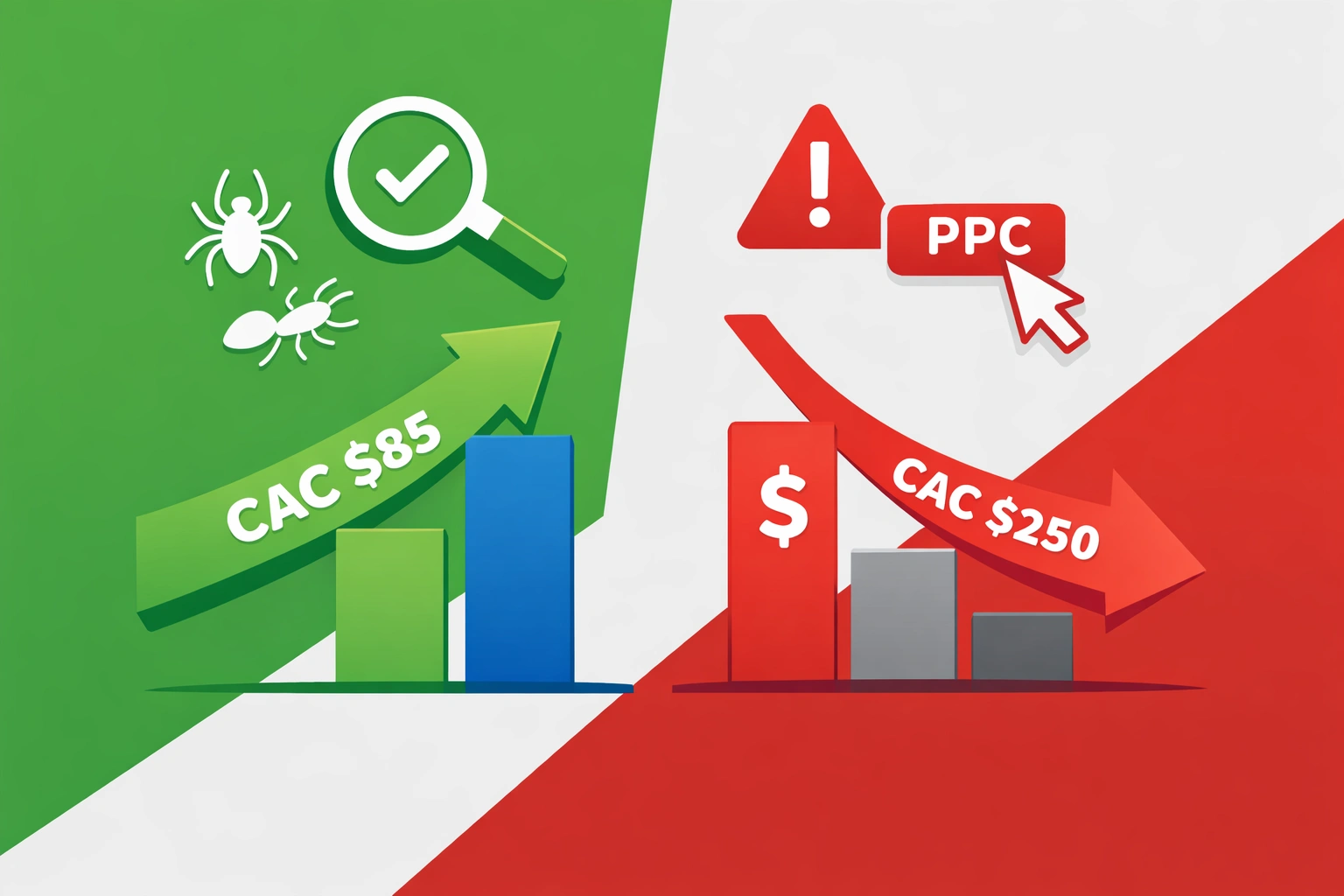
Companies optimizing for emergency keywords, Local Service Ads dominance, and seasonal budget shifts are acquiring customers at roughly $85 CAC with strong LTV economics.
Others, spending the same budgets on generic terms, are stuck near $250 CAC and compressed margins.
The difference is not tactical, it’s strategic. Let me explain.
The Real Economics of Pest Control PPC in 2026
Most pest control PPC programs don’t fail because clicks are expensive. They fail because intent is mispriced.
Here’s what the 2026 data shows:
- CPC ranges from $7.85 to $30 depending on competitiveness.
High click costs are real. But CPC variance is not what separates winners from laggards. - Conversion rates split sharply: 5.5% average vs 12 to 15% for high-intent emergency searches.
That 2 to 3x lift compresses CAC more than any bid adjustment ever will. - LSAs convert at 30 to 40% with $20 to $30 CPL and capture 13.8% of clicks (Hook Agency, 2026).
Prime placement plus urgency equals disproportionate pipeline capture. - Target CAC is $85. Many operators sit at $250. LTV averages $500.
That gap determines whether PPC compounds margin or erodes it.
The math is simple. Intent strategy, not click cost, defines profitability. Next, we look at where that intent actually lives.
Emergency Intent and Pest-Specific Campaigns Drive ROI
Generic keywords buy clicks. Emergency keywords generate customers.
The data paints a stark split: emergency-oriented terms like “bed bug exterminator now” and “emergency pest control” deliver conversion rates of 12 to 15 compared with a 5.5 average for broad pest control terms.
High-intent phrases convert 2 to 3 times better and close faster because prospects are in crisis mode, not researching options.
Segmenting campaigns by pest type such as termites, bed bugs, rodents and ants improves quality score and lowers wasted spend.
Dedicated landing pages for each pest type further lift conversion and reduce cost per acquisition.
Most competitors still invest a majority of their spend on broad, low-intent searches hoping volume compensates for poor quality.
If intent segmentation and pest-specific campaigns are not driving your PPC, you are funding competitors while missing the customers who are looking to buy right now.
In the next section we cover the channel that outperforms traditional PPC in conversion efficiency.
Why Local Service Ads Outperform Traditional PPC
If you only focus on standard Google Ads you are leaving the easiest conversions on the table.
Look at how Local Service Ads perform compared with traditional PPC:
- LSA captures 13.8 of all clicks and converts at 30 to 40
- while traditional pest control ads sit around 5.5 to 7.33.
With traditional Google Ads, you pay for clicks to your website. The conversion rate from click to sale is ~5%.

With Local Service Ads, you pay for leads (calls), and here the conversion rate from calls to sale is much higher than traditional Google Ads.
LSAs operate on a pay-per-lead basis with average cost per lead between $20 and $30 which, when tied to high urgency search intent, compresses customer acquisition cost far more predictably than auction-based bidding.
The Google Guaranteed badge also builds immediate trust in emergency scenarios where speed matters most.
Many CMOs still underallocate to this placement because they see only click costs not conversion economics.
If you can’t tie spend to predictable lead volume and urgency-driven conversions, you are optimizing the wrong metric and leaving revenue on the table.
Pro tip: To fully capitalize on emergency intent and LSA performance, you can also track the exact campaign, keyword, and ad variation behind every lead so that when a job closes, revenue is attributed back to its true source, allowing you to reallocate budget toward the keywords that drive the lowest CAC and the highest volume of closed deals. Tools like LeadSources.io allows you to do that.
The next section explains how seasonality amplifies these effects.
Seasonal Spend Makes or Breaks Pest Control PPC
If your budget never changes month to month you are ignoring the single biggest driver of ROI.
Seasonality in pest demand is dramatic:
- termites peak in spring,
- mosquitoes dominate summer
- and rodents surge in fall and winter.
Campaigns that shift 40 to 60 of spend into peak pest seasons consistently outperform static budgets because they capture real demand instead of diluted search volume.
Emergency queries spike during these windows and emergency-oriented keywords convert at 12 to 15 compared with generic terms around 5.5 (PCT Online, 2025).
Most operators maintain flat budgets year-round which means they underinvest when people need help now and overspend when demand is weakest.
Seasonally tuned budgets improve conversion velocity and compress CAC because you are in market when buyers are actively searching to solve an urgent problem.
If seasonal allocation is not part of your PPC strategy you are paying for clicks that would convert better in the next demand curve, and next we quantify the financial impact of these choices.
What the Numbers Really Mean for Your Growth
If PPC isn’t driving predictable CAC and strong ROI you are benchmarking the wrong outcomes.
Here’s what the performance data reveals when you connect spend to business results
An optimized pest control PPC program targeting high-intent keywords and integrating Local Service Ads (LSA) can achieve an $85 customer acquisition cost against an average $500 annual revenue per customer, creating roughly 5.8 ROAS.
Operators who focus on generic terms and static budgets often see CAC in the $200 to $250 range which erodes margin after overhead.
| Strategy Type | CAC | LTV | ROI Multiple |
|---|---|---|---|
| Generic PPC | $250 | $500 | ~2x |
| Optimized Intent + LSA | $85 | $500 | ~5.8x |
Emergency and pest-specific campaigns, combined with seasonal allocation and LSA conversion efficiencies, flip the math because every incremental conversion compounds across a fast sales cycle measured in days not months.
Most competitors treat PPC like a cost center instead of a revenue engine.
If your PPC doesn’t hit disciplined CAC targets aligned to LTV you will underperform competitors who have already restructured their campaigns around intent and seasonality.
Strategic PPC Wins Market Share
Pest control PPC is not a bidding game. It is an intent and allocation strategy.
CMOs who prioritize emergency keywords, integrate Local Service Ads, and shift budgets with seasonality compress CAC toward $85 and unlock durable LTV leverage.
Those who default to generic terms and static spend operate near breakeven.
In a high-CPC market, strategic intent capture is what separates margin expansion from margin erosion.
