


Online casino PPC is no longer a media-buy tactic; it is an operating-model decision that determines whether your acquisition engine scales or stalls.
Handled as “just another channel,” it exposes CMOs to policy whiplash, unsustainable CPCs, and opaque attribution that quietly erodes ROI.
The real opportunity sits where legal, compliance, data engineering, and UX are architected as a single, geo-aware, mobile-first system.
Those who align these pieces around first-party deposit signals can turn a constrained, high-cost auction into a durable growth moat, while competitors fight over surface-level optimizations on platforms like (Google Ads).
Online Casino PPC: Policy, Compliance, and Operational Integration
Online casino PPC is no longer a pure media-buy exercise; it is an operating model decision. CMOs who frame it as “just another performance channel” quickly run into policy volatility, inflated CPCs, and broken attribution.
To make the economics work, paid search and paid social must be architected with legal, compliance, data engineering, and UX as a single, integrated system.
In practice, that means geo-segmented accounts, mobile-first journeys, and first-party deposit-level signals wired into bidding, creative, and landing page logic.
Handled this way, a constrained, high-cost auction can become a defensible acquisition engine instead of a compliance liability.
Certification and Geo-Restricted Operations Are Non-Negotiable
For gambling, Google and Microsoft both start with the same premise: no certification, no reach. Google enforces “certification and country-specific rules,” while Microsoft treats gambling as a restricted category that is approved market by market.
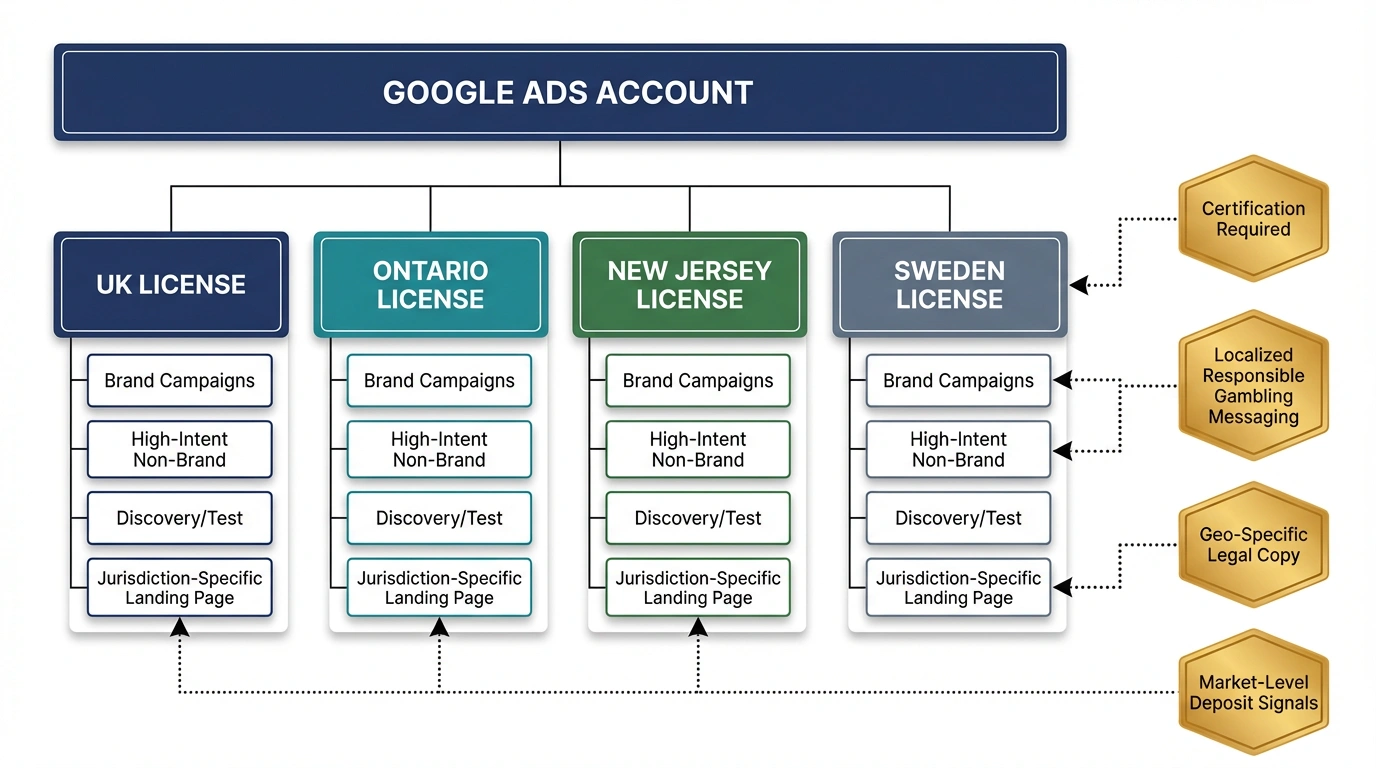
That policy reality hard-caps scale and forces CMOs to design account structures around jurisdiction, not just audience or keyword intent.
Practitioners on Reddit consistently report that even certified operators see frequent, sometimes unexplained disapprovals.
The common mitigation pattern is a dedicated compliance operations function that lives inside, or directly adjacent to, the performance team.
One operator reported that shifting to a geo-segmented campaign structure with jurisdiction-specific landing pages sharply reduced policy friction.
The payoff: fewer ad rejections, clean performance reads by market, and a more predictable testing roadmap.
- Country-by-country certification as a gating item for launch
- Campaigns and ad groups mapped explicitly to each license footprint
- Landing pages localized to legal, product, and responsible gambling rules
Strict Review Means Compliance and Creative Must Co-evolve
In online casino PPC, ad copy, extensions, and landing pages sit under continuous review. Minor wording changes, new bonus language, or a small geo-targeting tweak can trigger fresh disapprovals and learning phase resets.
Reddit threads on gambling ads highlight policy volatility as an ongoing, sometimes random, scaling risk that CMOs must price into their plans.
Winning operators treat compliance as a design constraint for creative, not a post hoc approval gate.
One widely cited model split campaigns by licensing footprint and baked responsible gambling and eligibility messaging directly into both ads and landings, which led to fewer disapprovals and more stable impression share.
The strategic implication is clear: creative testing frameworks need a compliance layer from the start.
Testing matrices should define “green zone” copy, imagery, and offers that legal signs off once and that can be reused across markets with minimal rework.
External policy documentation such as (Google Ads Help) becomes an input to creative briefs, not just a reference for the legal team.
Structured this way, performance marketing can move fast while staying inside the narrow guardrails that govern gambling in each jurisdiction.
Policy-Driven Scaling Models Are Mandatory, Not Optional
Once certification and creative-compliance alignment are in place, the scaling question becomes primarily structural. Geo-segmented, compliance-synced account frameworks provide cleaner data by jurisdiction and isolate policy risk.
Operators who divided PPC by license and market reported tighter cost control and clearer performance visibility for each regulatory regime.
This structure also makes it easier to plug in first-party deposit-level signals to bidding logic on a market-by-market basis.
Instead of chasing blended CPA, CMOs can make LTV-driven budget decisions that respect each jurisdiction’s regulatory and competitive dynamics.
Practitioners and Reddit contributors frequently share market launch checklists purpose-built for gambling PPC that all converge on the same pattern.
Policy-driven scaling is not an optimization afterthought; it is the operating system that enables sustainable growth in a tightly policed, high-CPC environment.
Performance Levers: Auction Constraints and Intent-Led Structuring in Casino PPC
Casino PPC is not a media line item; it is a high-stakes operating decision that lives at the intersection of legal, compliance, UX, and data engineering.
In a world of policy volatility, escalating CPCs, and fragile attribution, performance comes from how you architect the system, not from isolated campaign tweaks.
The operators winning share are those who geo-segment their structures, design mobile-first flows, and feed Google with clean, first-party deposit signals to let the algorithm work where it is strongest.
Within that system, three levers consistently separate efficient programs from budget sinkholes.
High CPCs and Query Saturation Demand Ruthless Tiering
With Google capturing the majority of search volume, casino auctions sit in the most restrictive and expensive ecosystem, where “money” terms are aggressively contested by operators and affiliates alike.
CPCs on core generic terms quickly spiral, while policy and inventory constraints mean there is far less scalable, high-intent traffic than in other verticals.
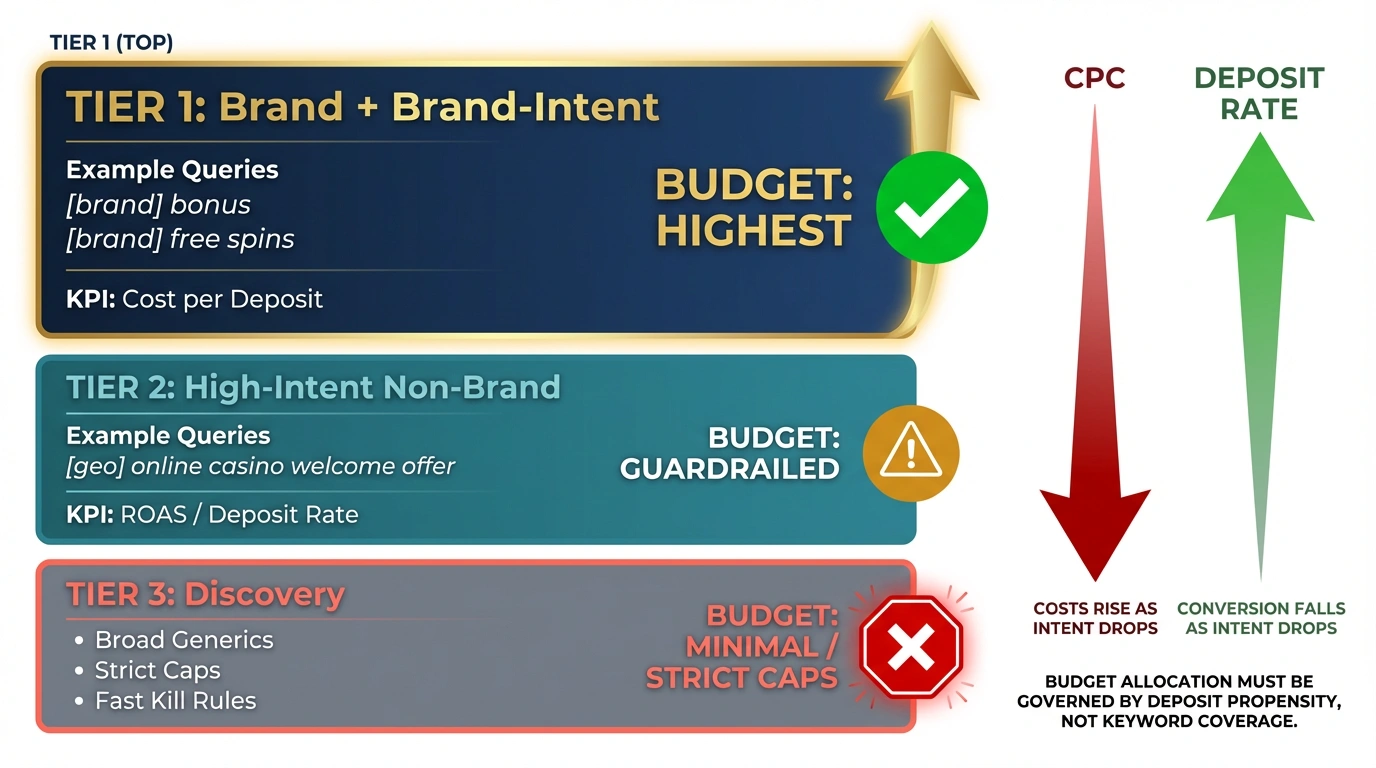
In this context, broad “coverage” is an unaffordable luxury; every dollar must track back to deposit propensity, not just click volume.
CMOs should direct budgets into distinct intent tiers that reflect real deposit likelihood, then defend those tiers relentlessly.
Brand and brand-plus-intent queries (for example, “[brand] bonus” or “[brand] free spins”) typically become Tier 1, with near-immediate revenue feedback and the cleanest attribution.
High-intent non-brand (such as “[geo] online casino welcome offer”) can form Tier 2, with tight guardrails on CPCs and eligibility.
Mid- and low-intent discovery should be last in line and subject to strict testing budgets, frequency caps, and fast kill criteria.
Reddit case discussions and operator anecdotes echo this pattern: shifting budget from “nice to have” generics into brand and high-intent non-brand terms consistently reduces CAC and smooths volatility.
The operational implication is clear: your paid search roadmap should be led by deposit tiers, not keyword coverage benchmarks.
Creative and Landing Iteration are Table Stakes, Not Bonus Points
With mobile driving a majority of casino traffic, any friction between click and first deposit quietly multiplies your effective CPC.
Slow load speeds, misaligned offers, or desktop-first flows turn even the best-intent queries into wasted spend.
In high-CPC auctions, UX flaws behave like an invisible tax on every impression.
Effective operators treat creative, message-to-query match, and landing experience as a continuous test bench rather than a quarterly project.
That means building variant pipelines for headlines and offers tied to specific intent tiers, updating creatives across geos when policy or bonus structures shift, and validating that mobile deposit flows can be completed quickly on mid-range devices, not just on a designer’s latest smartphone.
In one real-world case, aligning ad copy, bonuses, and mobile landing layouts tightly to search intent produced step-change gains in quality score and conversion rate.
The net effect was a meaningful reduction in blended CAC, even as auctions remained expensive, similar to performance lifts documented in search UX experiments on platforms like (Think with Google).
Tiered Account Structures Give Bidding Flexibility and Loss Control
Tiered account architectures are how CMOs translate strategy into daily auction behavior.
Instead of one blended campaign set, high performers separate brand, high-intent, and discovery into discrete structures with their own budgets, KPIs, and bidding strategies.
This preserves flexibility to lean into proven deposit drivers while containing experimental loss.
Practically, that looks like dedicated brand campaigns with aggressive protection, high-intent non-brand campaigns governed by strict ROAS or cost-per-deposit targets, and tightly ring-fenced discovery programs with low daily caps.
Negative keyword frameworks are used not just for hygiene, but to actively suppress low-value patterns such as serial bonus hunters, informational-only queries, or geos with weak regulatory clarity.
The most sophisticated teams ingest first-party deposit-level signals into their bidding logic so that Google optimizes toward downstream profitability, not shallow conversion proxies like registrations.
Across operator and affiliate audits, this combination of intent-led tiers, negative keyword discipline, and segmented budgets consistently shifts PPC from a volatile cost center into a more predictable acquisition engine.
Attribution, Tracking & Data: Building a Defensible PPC Engine
In online casino PPC, your real competitive edge is not ad creative or bid strategy. It is how precisely you capture, stitch, and activate first-party data across fragmented journeys.
With policy volatility and high CPCs, every missed registration, KYC, or deposit event compounds into wasted budget and distorted CAC. Treating PPC as an isolated media buy guarantees those leaks. Treating it as part of an integrated operating model allows you to turn complex journeys into a durable growth asset.
The CMOs winning today are the ones who can walk into the boardroom with clean, defensible numbers on net-new depositors by geo, device, and funnel stage.
That requires server-side measurement, disciplined attribution design, and market-specific data engineering working as a single machine.
First-Party, Server-Side Measurement Is Now Table Stakes
With Chrome deprecating third-party cookies and platforms shifting to modeled outcomes, client-side casino tracking is no longer fit for purpose.
Your players register on mobile, complete KYC on desktop, then deposit via app days later. If you rely on browser pixels alone, that journey is effectively invisible.
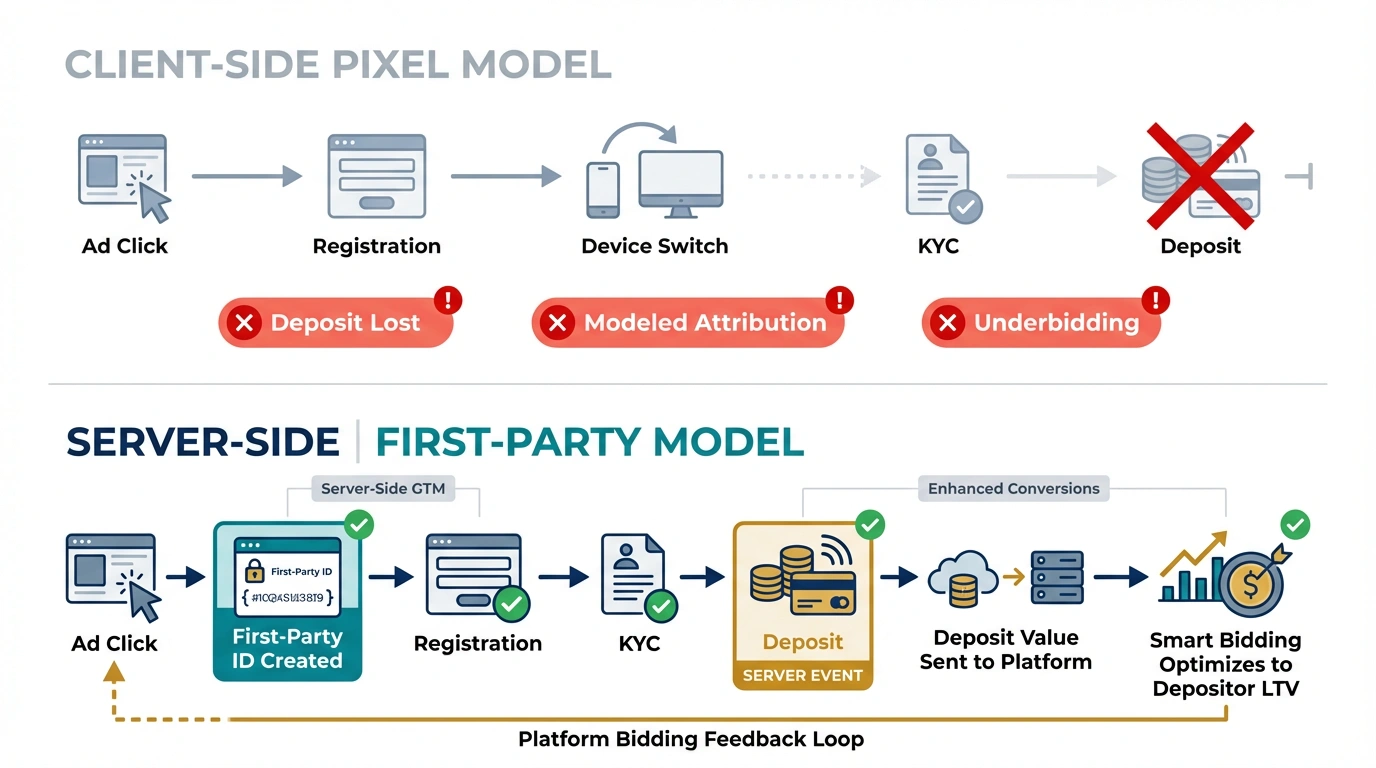
First-party, server-side tracking solves this by moving the “source of truth” from the browser to your own infrastructure.
In practice, that means server-side GTM, enhanced conversions, and secure event streams that tie ad clicks to verified deposit events instead of proxy actions like page views.
One operator that migrated to server-side GTM with enhanced conversions saw a step-change in bidding quality.
Once deposits were passed back as clean, deduplicated server events, their smart bidding strategies could optimize to real depositor value rather than modeled sign-ups, yielding higher-quality players at lower effective CAC.
This alignment between ad click, first-party ID, and downstream deposit is exactly what experienced practitioners now recommend in specialist communities such as (Reddit).
The consensus is clear: without server-side, first-party measurement, casino PPC is flying blind.
Attribution Gaps Open CAC Leaks and Bidding Waste
Attribution gaps are not a reporting nuisance. They are a direct margin drain.
When client-side pixels undercount conversions due to privacy settings, ad blockers, or cross-device behaviour, your platforms “see” fewer deposits than you actually generate.
The result is predictable.
Smart bidding algorithms underbid on high-value segments, overfund noisy upper-funnel traffic, and gradually inflate CAC while eroding share in your best markets.
Reddit and practitioner forums consistently warn casino CMOs that relying on generic pixels without strict UTM governance and first-party events is a fast track to budget drift.
Campaigns look healthy at the click and impression level, yet deposit economics deteriorate quarter over quarter.
In one featured case, a CMO rebuilt their attribution approach around first-party event tracking.
Registrations, KYC completions, and deposits were all captured server-side with disciplined UTM taxonomies. Within weeks, the team saw a visible jump in attributed deposits and could reallocate budget into the highest LTV combinations of geo, device, and creative concept.
The lesson is simple.
Every untracked or misattributed depositor pushes your blended CAC higher. Closing those gaps is one of the fastest ways to recover wasted PPC spend.
Market-Specific Data Engineering Drives Compound Gain
Compliance fragmentation is often treated as a tax on growth. In PPC, it can become your moat.
Forward-thinking casino CMOs partner tightly with data engineering and compliance to build jurisdiction-specific data pipelines and dashboards that reflect real regulatory, payment, and UX nuances.
Instead of a single global view, they maintain geo-level schemas that feed deposit-quality signals into bidding algorithms in near real time.
That allows them to bid differently in markets where, for example, KYC friction depresses conversion or certain payment rails drive higher LTV cohorts.
Operationally, this means unifying three functions for each market.
Compliance defines what can be tracked and how. Data teams model and route first-party events into ad platforms and BI tools. UX ensures that consent, tracking, and funnel flows are optimised on mobile and app environments.
When those pieces are aligned, every incremental improvement in verification rates, payment success, or session continuity flows straight back into your PPC bidding logic.
Over time, the compounding effect is significant: you win more auctions in the right pockets of the market, at lower effective CAC, with higher LTV cohorts.
In a crowded auction where policy shifts keep resetting the playing field, that kind of geo-specific, first-party data engine is one of the few truly defensible advantages a casino CMO can build.
Make Online Casino PPC a Growth Engine, Not a Liability
For online casino PPC, the strategic question is no longer “how much media can we buy,” but “how defensible is our data engine.”
CMOs who win here treat PPC as an integrated operating model that connects compliance, engineering, and growth around a single source of truth for depositors.
The core shift is from pixel-based reporting to first-party, server-side measurement that accurately maps every registration, KYC, and deposit to its originating click.
This closes attribution gaps that quietly inflate CAC and starve your highest-value segments of budget.
At the same time, geo-segmented architectures turn regulatory complexity into advantage.
Jurisdiction-level schemas, consent flows, and event streams let you bid differently where KYC friction, payment methods, and mobile UX drive meaningfully different LTV curves.
For the CMO, this means walking into the boardroom with clean numbers on net-new depositors by geo, device, and funnel stage, backed by a verifiable first-party data spine.
Practitioner communities such as (Reddit) consistently show that operators with this setup see smarter bidding, stronger LTV, and more predictable unit economics.
When attribution, tracking, and data engineering are built around online casino PPC as a single machine, even constrained ad inventory becomes a compounding acquisition engine instead of a volatile line item.
