


ppc consulting
Most engagements still orbit around channel efficiency metrics like CTR and CPC, while your real leverage sits in how search intent, measurement, and offline revenue signals get redesigned around profit.
This article unpacks why treating consultants as “bid-tuners” quietly caps your CAC advantage, and how a few structural shifts in ownership, data, and incentives can turn the same media budget into a defensible pipeline engine.
Think less about tactical optimizations and more about re-architecting how demand, quality, and value are defined across your funnel, using examples from partners who operate at enterprise scale like (Google).
PPC Consulting’s Value Is Limited by Outdated Measurement Priorities
Performance channels have become more expensive, more competitive, and more automated, yet many PPC consulting engagements are still scoped around surface level efficiency.
Click metrics like CTR or CPC may look cleaner in dashboards, but they rarely map cleanly to revenue, profit, or payback windows that your board actually cares about.
When consultants are incentivized to improve channel optics instead of commercial impact, they optimize for cheaper traffic instead of better customers.
The result is a widening gap between “green” reports and disappointing pipeline, even as budgets rise and auctions intensify.
Forward leaning CMOs are reframing PPC consulting away from bid tweaks and toward redesigning measurement, intent strategy, and conversion quality.
The priority shifts from marginally cheaper clicks to reliably profitable growth at scale.
Misaligning to Channel Metrics Undercuts Growth
Most PPC dashboards still elevate CTR, CPC, and impression share as headline indicators of success.
That focus anchors your consultants in channel ergonomics instead of commercial impact, which creates the illusion of progress while customer acquisition costs quietly deteriorate.
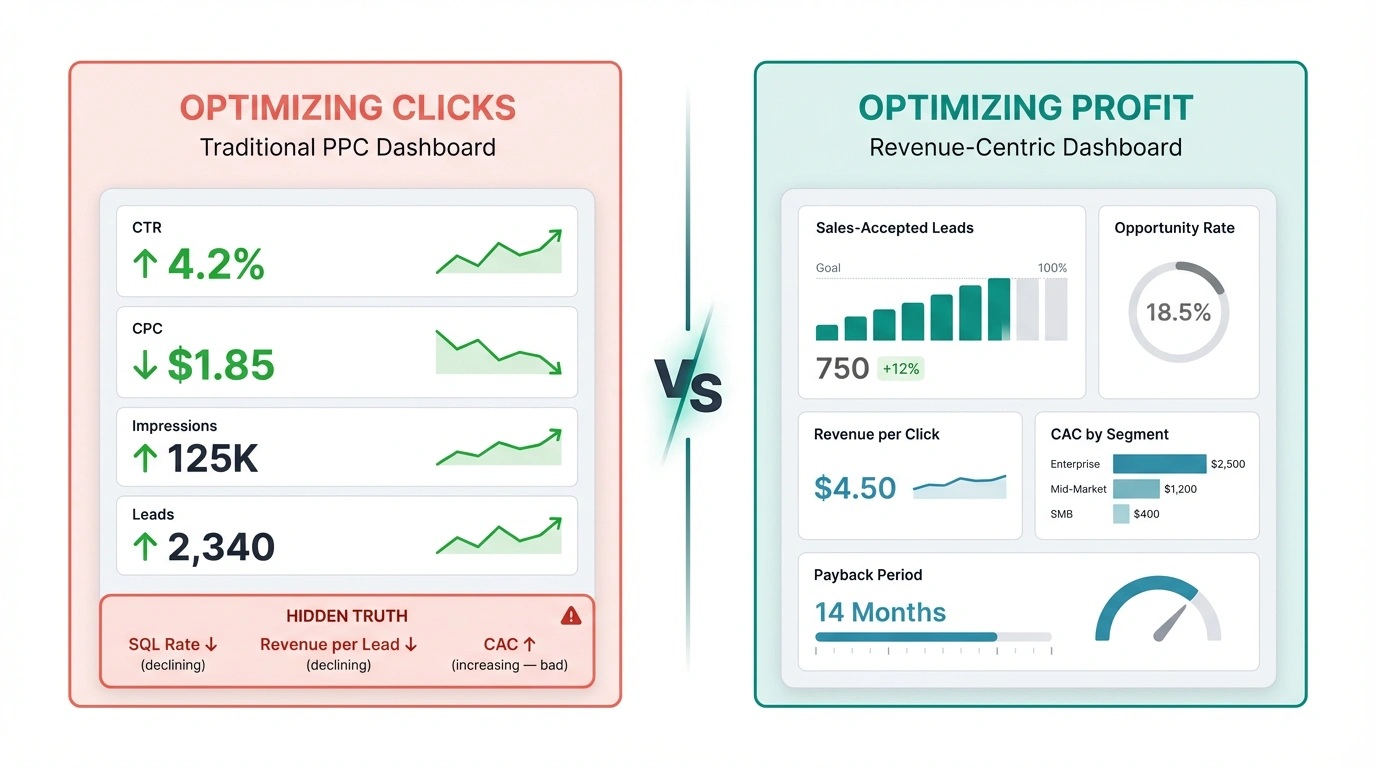
When your internal reviews start with “Why did CTR drop this month?” you implicitly define the consultant’s job as defending click metrics.
They pivot keywords, audiences, and creative to restore engagement, even if those moves dilute purchase intent or attract lower value segments.
A revenue centric mandate looks different.
It prioritizes questions like “Which search intents lead to qualified opportunities and multi product deals?” or “Which campaigns generate accounts that expand in year two?” and then rebuilds tracking so that lifecycle milestones, not just front end clicks, flow back into the ad platforms.
Consultants who recalibrate conversion events around high intent milestones such as demo-held, proposal-issued, or opportunity-created can often reverse perceived performance drops in weeks.
Spend shifts from broad, cheap traffic to narrower, commercially proven segments, which compresses CAC and improves payback even if CTR or CPC look worse at the surface level.
Attribution Gaps Stall ROI and Misguide Bidding
In many B2B environments, CPAs look healthy on paper while sales leaders struggle with volatile volume and inconsistent deal quality.
The core issue is rarely the bidding algorithm itself; it is fragmented attribution that feeds the algorithm partial or misleading signals.
Common failure points include duplicate form conversions across devices, marketing automation events counted as net new leads, and total absence of offline milestones like discovery calls, pricing approvals, or closed won data.
When those blind spots exist, “target CPA” or “target ROAS” strategies train on quantity instead of quality.
A more rigorous consulting engagement starts with auditing the full funnel measurement path, from first click through CRM and finance systems.
The consultant then rebuilds conversion hierarchies so that platforms optimize to qualified meetings, sales accepted opportunities, or revenue brackets rather than raw leads.
In practice, this often means fewer total conversions in your dashboards, but materially higher SQL rates and higher contract values from the same budget.
Once the feedback loop includes offline revenue data, PPC bidding decisions align with segments that actually renew and expand, not just those that fill top of funnel reports.
CMOs Must Move Beyond “Bid-Tuning” Roles
As global digital ad spend approaches the hundreds of billions, auction dynamics increasingly favor brands that connect creative, audience, and pricing strategy to real commercial outcomes.
Yet many CMOs still cast PPC consultants as narrow tacticians responsible for cost control instead of as partners accountable for profitable growth.
When scopes are limited to “manage bids, test ads, and report on performance,” consultants default to defensive optimizations and channel specific narratives.
They lack permission to challenge lead definitions, overhaul tracking, or reshape offer strategy, even when those constraints are the primary cause of stagnant pipeline.
CMOs who capture more value from performance channels do three things differently.
They tie consultant compensation and renewal to opportunity quality and revenue contribution, not only to CPA or impression share.
They require transparent, board ready reporting that connects PPC to sales productivity and unit economics.
And they invite consultants into upstream conversations about positioning and offers so that campaigns reflect real buying triggers, not just keyword lists informed by [Statista].
This expanded charter turns PPC consulting from a cost line item into a lever for strategic customer acquisition, enabling your team to outlearn, not simply outbid, competitors in saturated auctions.
PPC Consulting as a Revenue-Design Function: Key Strategies
PPC only creates real enterprise value when it is accountable for revenue, not just channel-level efficiency. When consultants are measured on click-through rate, cost per click, or cost per acquisition alone, they inevitably optimize for cheap activity, not profitable growth.
CMOs who reframe PPC consulting as a revenue-design function can win in saturated auctions without simply outspending competitors. The shift is subtle but material: from tuning bids in-platform to redesigning the full measurement system around offline quality and profit. Done right, the same budget begins to generate a more resilient pipeline and structurally lower CAC.
Linking PPC to Sales Outcomes, Not Just Leads
Lead quantity is easy to grow; lead quality is what moves revenue. When PPC is briefed to “drive more leads,” consultants are pushed into commoditized optimization that ends at the form-fill.
The inflection point is aligning PPC goals with sales outcomes such as sales-accepted leads, opportunities created, and opportunities won. For a B2B SaaS engagement, shifting goal tracking from “all leads” to revenue-stage events did not increase spend but dramatically improved the share of leads accepted by sales. The consulting role changed from traffic manager to strategic partner in pipeline design.
Practically, this requires a redefinition of success metrics at the CMO level. Instead of reporting on impression share and lead volume, the PPC brief and dashboard focus on:
- Sales-accepted lead rate and opportunity conversion by campaign and keyword
- Pipeline and revenue per click, not just cost per click
- Time to first sales touch and its impact on close rate
When this framing is set from the top, consultants can reallocate budget away from “cheap leads” into segments that demonstrate higher downstream value, even if top-of-funnel metrics look less efficient.
Importing Offline Conversions Improves Profitability Metrics
Automated bidding is only as smart as the signals it receives. If the platform only sees form submissions, it will aggressively optimize for low-intent conversions that rarely progress. High-intent actions, like opportunity creation or qualified calls, remain invisible to the algorithm and underfunded in the auction.
Consultants who operationalize offline conversion imports change this equation. By feeding CRM events such as call-qualified leads, sales-accepted leads, or closed-won deals back into Google Ads, bidding strategies can prioritize users who resemble high-value customers, not just form-fillers.
The impact is felt first in variance reduction. Campaigns that looked “efficient” on cost per lead often prove unprofitable once offline stages are considered. After implementing offline imports in a multi-location services account, budget shifted toward campaigns consistently producing call-qualified leads, while superficially “cheap” sources were systematically defunded.
In crowded auctions, this becomes a structural advantage. Competitors are still paying to win low-quality clicks, while your bidding models quietly compound learning on the leads that sales actually wants.
Value-Based Segmentation Over Pure Cost Focus
Rising cost per click is a reality, but high CPCs can be a bargain if they reliably acquire profitable customers. The mistake is treating CPC as the primary lever instead of segmenting by value and margin.
In an e-commerce context, a profit-first consulting approach reorients campaigns around contribution margin by category, product, and customer segment. Rather than chasing the lowest CPC inventory, investment levels are set by expected lifetime value and incremental profit.
In practice, this often means isolating high-margin categories, new customer acquisition campaigns, and repeat-buyer audiences into distinct structures with tailored targets. High-intent, high-margin segments tolerate higher CPCs, because the economics support it.
Peer marketers increasingly confirm this shift in forums such as (Reddit), where practitioners report better ROI when PPC consultants pivot from blanket efficiency targets to value-based segmentation. For CMOs, the takeaway is clear: brief your PPC partners not to “lower CPC,” but to engineer an account that reflects your profit pools and strategic customer segments.
PPC Consulting Engagements That Deliver Durable Competitive Advantage
Most PPC programs are still optimized to channel metrics like CTR, CPC, and surface-level CPA, even as auctions become more crowded and expensive.
That approach cannot defend margin when every competitor has access to the same platforms, the same AI bidding, and the same audience tools.
Durable advantage now comes from consultants who are chartered to redesign measurement and intent strategy around revenue, not just clicks.
When partners are accountable for offline conversion quality, margin, and long-term CAC, the same media budget starts behaving like a strategic asset instead of a variable expense.
In practice, this means rethinking how you compete in saturated auctions, how you measure value across long sales cycles, and how you hold consulting partners accountable for growth outcomes, not just channel efficiency.
Defending Margin in Auction-Saturated Environments
In high-cost auctions, incremental bid tweaks and budget reallocation rarely move enterprise-level numbers.
Your competitors are running the same playbook, so any efficiency gain is quickly neutralized.
Margin defense starts with using PPC as a precision instrument for intent, not as generic reach.
That requires segmenting by buyer stage, profitability, and lifetime value, then aligning creative and offers to each segment’s motivation.
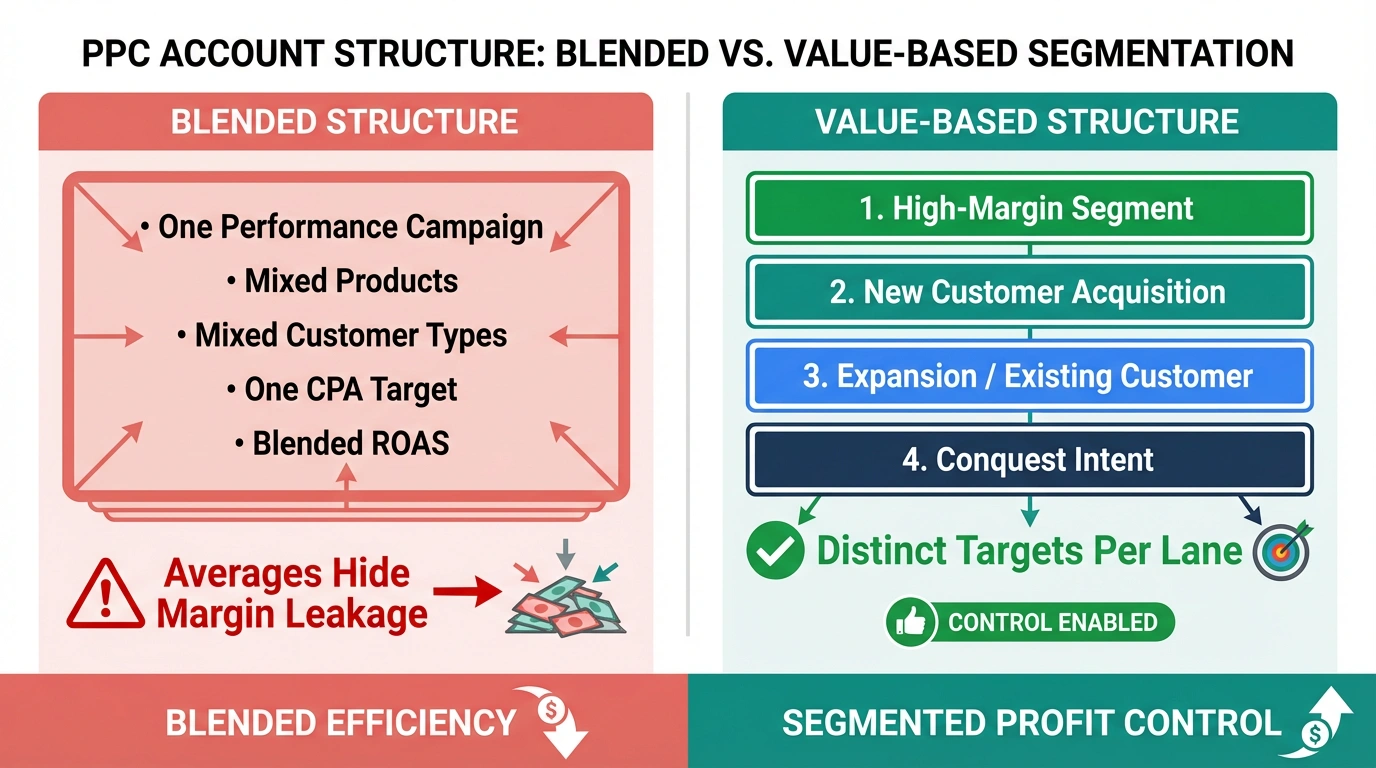
Instead of treating CPC inflation as a universal problem, advanced consulting isolates pockets where higher CPCs are acceptable because downstream value is structurally superior.
This is where revenue-grade segmentation beats broad “performance” campaigns that average out the numbers.
Effective engagements typically focus on a few critical levers:
- Rebuilding account structure around profit pools, not product lines
- Separating conquest, category demand, and existing-customer expansion into distinct intent lanes
- Engineering ad and landing page combinations for each lane to maximize qualified conversion rate, not raw volume
Handled this way, PPC stops being a cost line exposed to auction volatility and becomes a controlled entry point into your highest-value segments.
Closing the Loop on Measurement for Sustainable CAC
When tracking is incomplete or leaking, the platform’s “best” audiences often reflect the easiest conversions, not the most valuable customers.
That distortion drives bidding algorithms toward cheap leads that look efficient on paper but erode CAC and sales productivity over time.
Strategic PPC consulting prioritizes a measurement-first mandate.
Offline conversion imports, clean UTM governance, and CRM-integrated scoring give platforms a higher-fidelity view of what a profitable customer actually looks like.
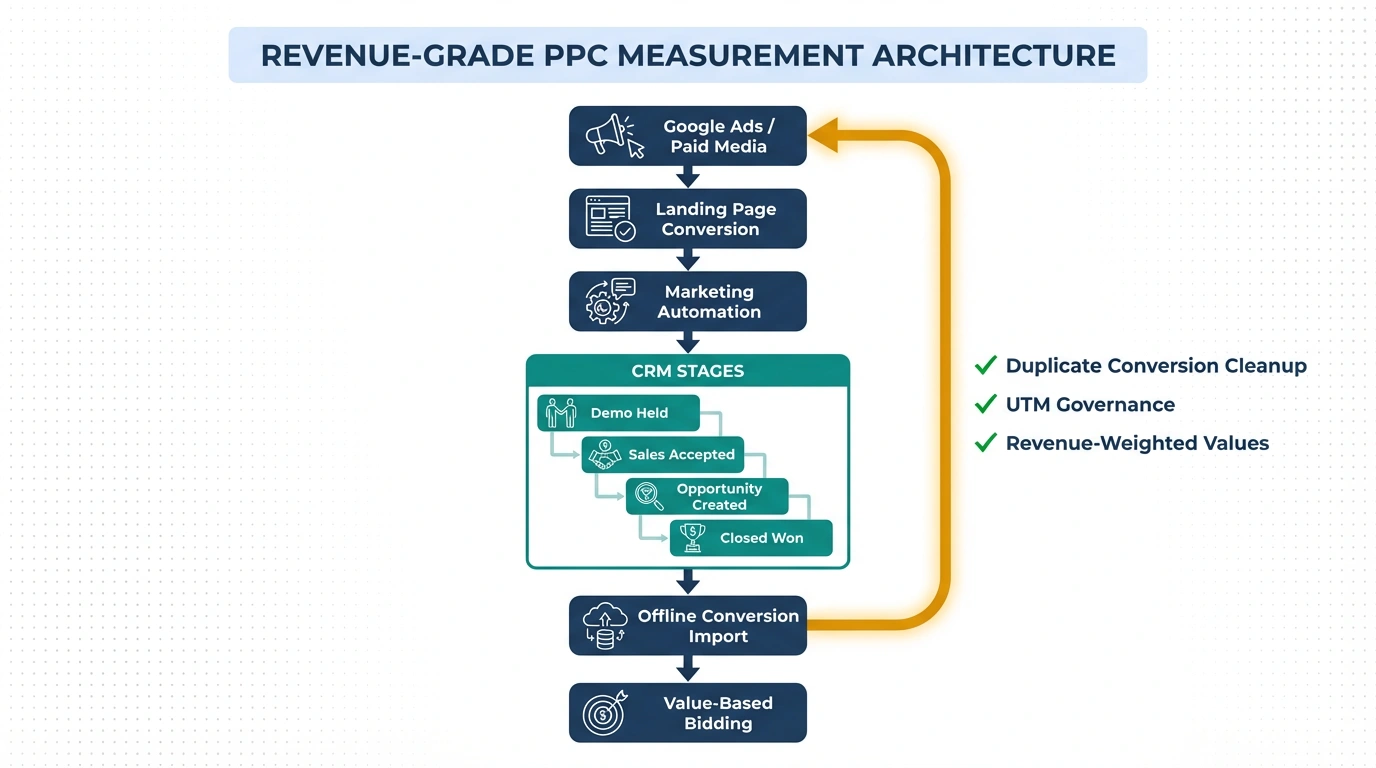
Once that signal is live, you can recalibrate bidding strategies around revenue and margin instead of lead count.
CAC becomes more predictable because the system is optimizing to pipeline quality, not top-of-funnel noise.
For senior leaders, the payoff is twofold.
First, the finance team can see clear links between spend, opportunity creation, and closed revenue.
Second, marketing can confidently hold or even reduce budgets while improving pipeline consistency, rather than reflexively increasing spend to compensate for mixed attribution.
Elevating Consulting Accountability from Tactics to Growth Ownership
PPC consulting still often lives in a narrow remit: manage keywords, adjust bids, tidy up ad groups.
In auction-saturated categories, that scope keeps your brand locked in a tactical arms race.
To convert PPC into a strategic advantage, CMOs need partners who own more than in-platform settings.
They should influence positioning, on-site experience, and how the organization defines and scores qualified demand.
Transparent, executive-ready reporting is central to this shift.
Instead of dashboard dumps, consultants should deliver narrative insights that link campaign decisions to pipeline, sales cycle speed, and contribution to total revenue, referencing category benchmarks from sources such as (Statista) to ground planning assumptions.
When you structure engagements this way, PPC becomes a continuous testbed for your broader go-to-market strategy, not just a media line item.
Consultants evolve from vendors managing clicks to growth partners accountable for durable CAC advantage and executive-level outcomes.
What Elite CMOs Demand: Redefining the Charter for PPC Consulting
Elite CMOs are reframing ppc consulting as an instrument for revenue strategy, not channel maintenance.
When partners are tasked with defending margin, improving CAC, and advancing pipeline quality, the same media spend shifts from incremental lift to structural advantage.
The CMOs who win are those who demand three upgrades from their consulting partners.
First, insist on revenue-grade segmentation that treats PPC as targeted intent capture, with clear lanes for conquest, in-market demand, and existing-customer expansion.
This directs budget into your highest-value profit pools instead of broad, blended performance campaigns.
Second, require a measurement-first charter that closes attribution gaps.
Offline conversion imports, CRM-integrated scoring, and disciplined UTM governance allow algorithms to optimize to qualified pipeline and margin, not just cheap leads.
Third, elevate accountability from tactical execution to growth ownership.
Consultants should shape positioning, on-site experience, and qualification rules, then translate all activity into executive-ready narratives that connect spend to revenue outcomes.
CMOs who set this standard turn ppc consulting into an ongoing testbed for go-to-market strategy.
In a world where every competitor has the same tools, the advantage goes to leaders who redefine PPC as a profit engine and hold partners to that mandate.
