


Search engine marketing intelligence is quickly becoming a C-suite priority, not a channel tactic. In a noisy, hyper-automated, Google-dominated landscape, the real advantage comes from building your own SEM intelligence layer that sits above platforms like (Google).
This article explores why CMOs who unify search, auction, and CRM signals into one source of truth will be the ones who turn paid search into a profit engine instead of a reporting artifact.
Building the SEM Intelligence Layer: Core Capabilities for Modern CMOs
Search engine marketing is no longer a channel tactic. It is a CMO-level intelligence discipline that decides how profitably you can grow.
In a noisy, automated, Google-dominated landscape, the advantage now comes from your own independent SEM intelligence layer, not from platform-reported dashboards.
The goal is simple: rebase every paid search dollar on incrementality, revenue, and profit, then reallocate spend dynamically as competition and query economics shift week by week.
That requires unifying measurement, cross-network views, competitive insight, and rigorous experimentation into one coherent system your CFO trusts.
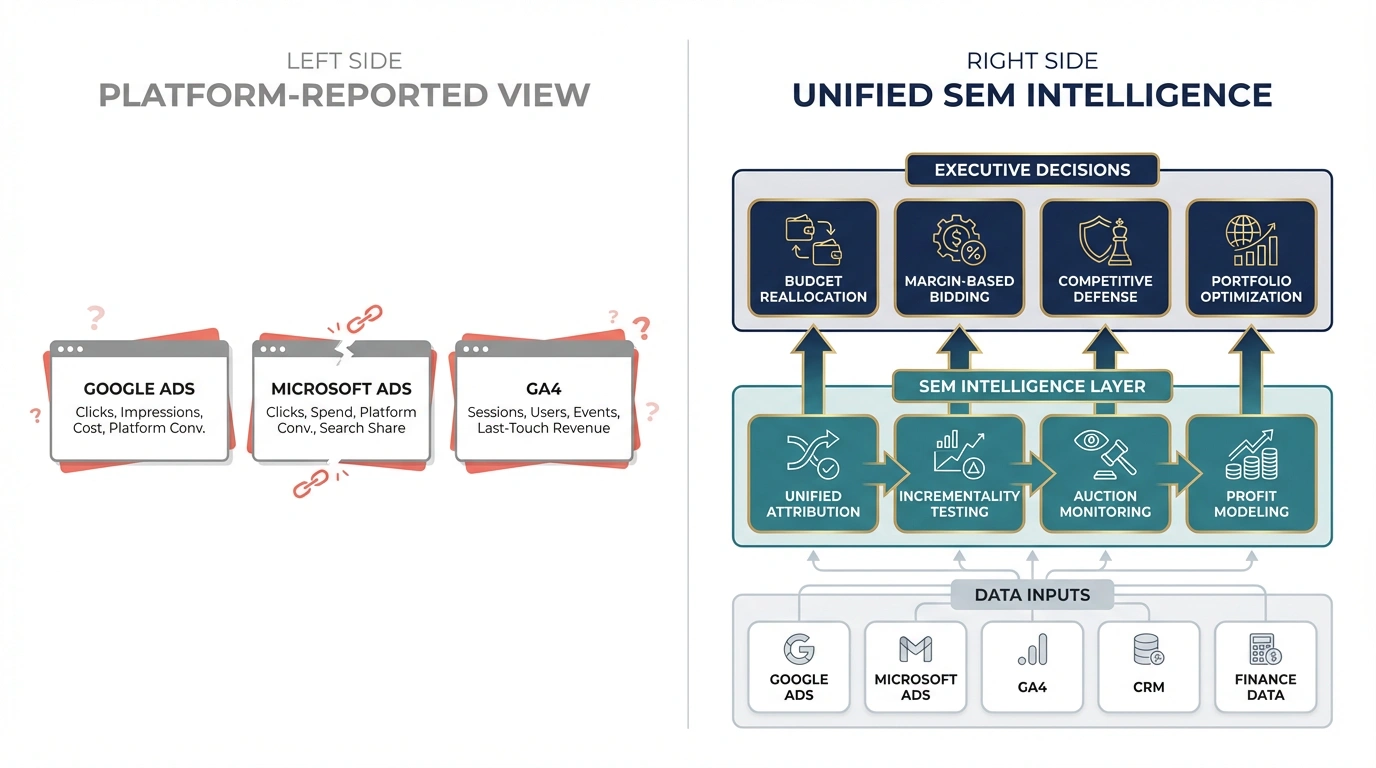
Unified measurement breaks down attribution debates
Attribution is no longer a reporting debate you can delegate to performance teams. It is a strategic risk issue.
CMOs need Ads, GA4, and CRM data stitched into a single, finance-approved source of truth that ties every search impression back to revenue-qualified pipeline and closed-won revenue.
Practitioners in Reddit communities routinely describe confusion between Google Ads numbers, GA4 conversions, and CRM reality, and recommend CRM plus modeled lift as the only credible gold standard.
When one B2B SaaS CMO wired ad spend directly to revenue-qualified leads inside the CRM, sales finally trusted the numbers and alignment on SEM budgets improved by 18 percent.
In practice, this unified layer should answer three questions in seconds, not days: which queries are generating revenue, which campaigns are truly incremental, and which levers create profit, not just conversions.
Without that, every automation upgrade from Google simply obscures the real unit economics of your search investment.
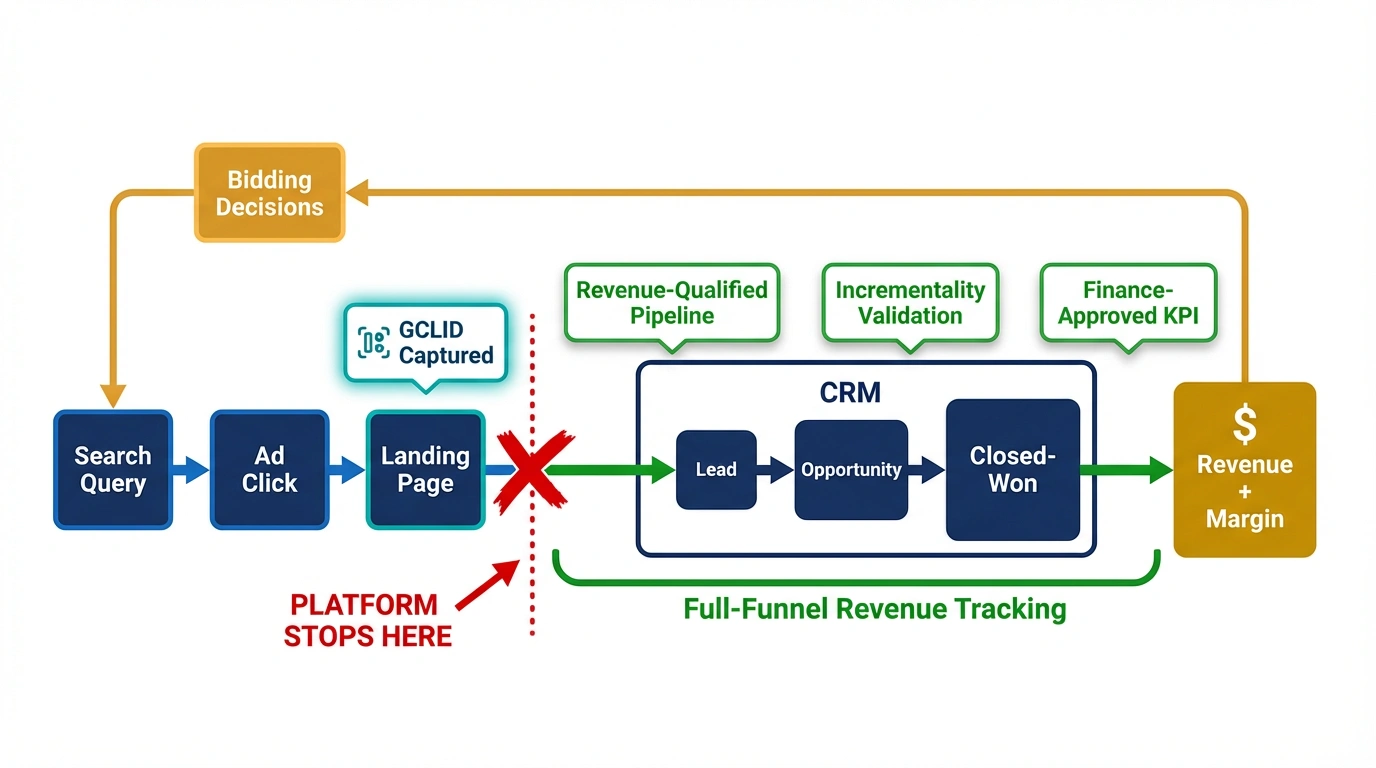
Cross-network insights unlock incremental growth
If your SEM intelligence lives only inside Google, you are managing a monopoly, not a portfolio.
Microsoft Advertising now reaches over 1 billion people globally, which means your buyers are searching in more places than your dashboards suggest.
When a fintech brand combined cross-network data, they discovered mid-funnel queries on Microsoft Ads that behaved very differently from Google.
Same intent, different economics.
The result was a segment of keywords on Microsoft with a 25 percent lower cost per conversion than their Google equivalents, as highlighted in a public case study.
The CMO benefit is clear: a centralized SEM intelligence layer that shows where marginal dollars work harder.
Instead of asking how much to spend in Google, you ask where the next dollar earns the best incremental return across all search surfaces.
Competitive and auction intelligence enables dynamic budget control
With Google controlling an estimated 39 percent of global digital ad revenue, you are operating inside a highly competitive auction, not a fixed media plan.
CMOs who win treat auction and competitive data as a live signal for budget and creative decisions.
A retailer that monitored competitor impression share saw rivals surge during key promo windows.
Armed with SEM alerts, they pivoted creative, refreshed offers, and reweighted budgets within 48 hours, using paid search as a defensive shield to protect revenue when promotions hit.
This is the role of the SEM intelligence layer at the C-suite level: translate auction volatility into proactive budget shifts, protect branded demand, and avoid overpaying when competitors are irrationally aggressive.
Experimentation and incrementality restore clarity in automated campaigns
Automated products like Performance Max now drive the majority of spend for many brands, but they also obscure channel paths and incremental impact.
Experienced marketers on Reddit emphasize running independent experiments such as geo splits, controlled holdouts, and non-platform tagging to regain clarity.
One ecommerce brand executed brand search holdouts and learned that only 22 percent of branded clicks were genuinely incremental.
Armed with that insight, they cut low-value branded spend and reallocated budget into non-brand conquesting where incremental revenue per dollar was significantly higher.
For CMOs, this is the new standard: every major SEM line item should be backed by an incrementality narrative proven through structured tests.
Automation still does the execution, but your SEM intelligence layer sets the rules of the game and decides where automation is allowed to spend.
To go deeper on building this type of measurement and experimentation backbone, leaders often benchmark against guidance from (Google) while layering in independent analytics to avoid platform bias.
Directing Paid Search for Incrementality and Profit, Not Platform Conversions
Paid search is now too expensive and too automated to manage on channel metrics alone.
CMOs need a unified intelligence layer that ties search behavior, auction dynamics, and CRM outcomes into a single view of profit, not a patchwork of platform dashboards.
That means treating SEM less like a bid management exercise and more like financial portfolio management, with clear tests, guardrails, and reallocation rules.
The goal is simple: every dollar must earn its place in the plan based on incremental revenue and margin, not what a platform attribute report claims.
Third-party cookie loss demands first-party measurement rigor
As third-party cookies disappear, your ability to measure paid search impact depends on first-party data design, not ad platform pixels.
The brands that win are rebuilding their measurement spine around server-side tagging, consent-aware identity, and CRM-linked outcomes, so they can see which search queries actually move pipeline and revenue.
Think of SEM performance reviews as a finance meeting, not a channel review.
Impressions, clicks, and even platform-reported conversions are directional at best; the real scorecard is sourced and influenced pipeline, sales velocity, and unit economics by query, audience, and intent cluster.
One consumer brand, for example, re-engineered its tagging and CRM pipelines so every paid search click was stitched to leads, opportunities, and closed-won deals.
Once they rebased spend decisions on pipeline dollars instead of Google Ads conversion counts, long-running arguments with finance disappeared, and the team discovered entire keyword groups that looked efficient in-platform but were value destructive after returns and discounts.
This is the new minimum standard:
Paid search budgets are justified in the same language your CFO uses, with incrementality tests embedded into everyday operations instead of treated as ad hoc research projects.
Automation opacity drives need for independent testing frameworks
As black-box formats like Performance Max consume more spend, the “what changed and why” signal gets harder to see.
With [Search Engine Land] reporting that advertisers now direct most Google budgets into Performance Max, you cannot afford to fly blind on creative, feed, and audience-level impact.
The answer is not turning automation off; it is surrounding it with your own testing frameworks.
That means continuous experiments that sit outside the platform’s auto-optimization narrative and answer a different question: where is the true incremental lift?
Leading practitioners, including many sharing playbooks in Reddit case studies, run weekly experiment sprints that include:
- Structured feed and creative swaps, tracked to downstream revenue, not just click-through rate
- Always-on geo, audience, or time-based holdouts that measure lift vs a clean baseline
This independent experimentation gives you answers automation will never disclose, such as which segments are being overbid, where cannibalization of organic and branded traffic is highest, and which assets actually move qualified pipeline instead of vanity conversions.
Budget is dynamically reallocated based on auction and query economics
In a fluid auction, static budgets are a tax on profit.
Competitor bids, promotions, and seasonality shift query-level economics weekly; your investment plan should move just as fast.
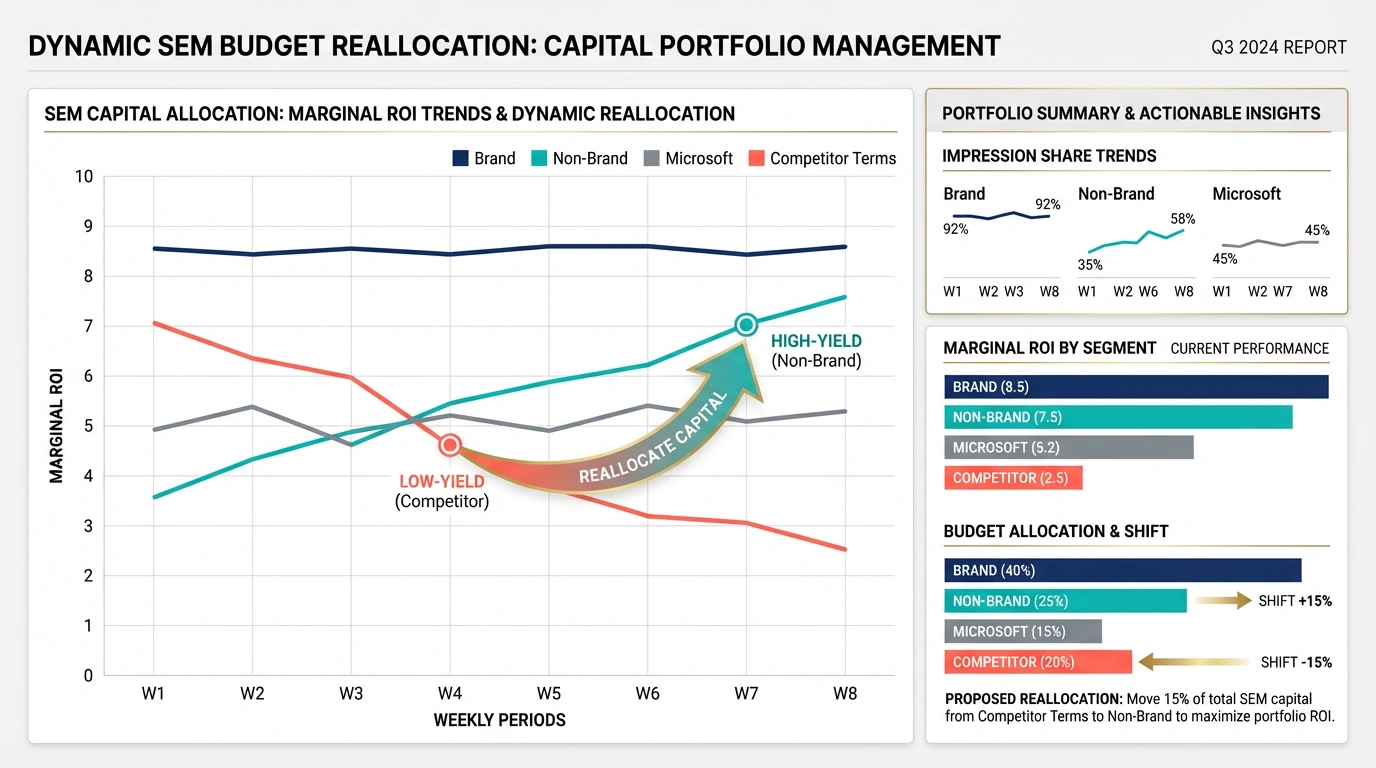
CMOs need a cadence where auction metrics and CRM outcomes trigger reallocation, without waiting for quarterly reviews.
That means monitoring impression share, search term reports, and marginal ROI in short windows, then codifying rules that route dollars toward the best incremental return.
One SaaS company instituted weekly auction and impression share monitoring tied directly to opportunity creation and expansion revenue.
When a competitor pulled back, the system automatically funneled budget into high-intent, non-brand queries that showed rising marginal ROI; underperforming segments were paused until they cleared hurdle rates.
Over sequential 4-week periods, this rules-based approach delivered roughly 13% better marginal ROI than their previous “set and forget” structure.
The broader lesson is strategic: SEM budgets should behave like a living portfolio, reweighted continuously according to auction conditions, query intent, and real business outcomes.
That is how you turn paid search from a cost center driven by platform-reported conversions into an adaptive profit engine for the entire go-to-market motion.
Unlocking SEM Intelligence: From Faster Decisions to Market Share Defense
Search engine marketing intelligence has moved from channel tactic to C-suite discipline.
In a noisy, automated, Google-dominated landscape, you cannot afford to run paid search on platform-reported conversions alone.
The CMOs who win are building an independent SEM intelligence layer that unifies search, auction, and CRM signals.
They rebase every paid search dollar on incrementality and profit, then reallocate budget dynamically as competition and query economics shift week by week.
Done well, SEM intelligence becomes a strategic control system, not just another dashboard.
It gives you the confidence to scale, cut, or pivot spend in days instead of quarters, while defending share against both digital natives and legacy incumbents.
From Platform Dependency to Independent SEM Intelligence
Most teams still let the platforms grade their own homework.
They rely on native conversions, opaque optimization goals, and “smart” bidding that hides the true cost of growth.
An independent SEM intelligence layer changes that by connecting:
- Search and auction data that reveal intent, competitive pressure, and price dynamics
- CRM and revenue data that show who became a customer, at what value, and over what horizon
- Cost and margin data that tie every click to unit economics and profit, not just top-line volume
When these streams are unified, the conversation shifts from “What did Google say we drove?” to “What profit did we truly create, and at what risk?”
Rebasing Every Dollar on Incrementality and Profit
SEM intelligence reframes paid search from a spend-to-hit-targets exercise to a disciplined profit engine.
Instead of chasing the lowest CPA or highest ROAS in the interface, you ask one question: what is the incremental value of the next dollar in each segment?
That requires a rigorous framework that:
- Separates organic, branded, and paid effects so you can see true lift, not cannibalization
- Connects keyword, audience, and device performance to actual margin per order or per customer
- Flags where platform algorithms overbid for low-quality or low-margin conversions that look efficient but erode profit
With this view, you can deliberately trade volume for quality, shifting investment into queries, audiences, and products that expand profitable share, not just impression share.
Dynamic Budget Reallocation as Competitive Advantage
Search economics now change weekly as competitors adjust bids, inventory, and creative.
Static annual plans cannot keep up, and “set it and forget it” automation often reinforces the wrong trends.
A mature SEM intelligence system supports rapid decision cycles so your team can:
- Spot rising acquisition costs early and pivot from over-heated auctions toward higher-yield segments
- Rebalance budgets across brands, categories, and markets based on real-time profit signals, not last-click metrics
- Identify where defending a key query protects strategic share and where it is smarter to exit and redeploy
As you institutionalize this cadence, SEM intelligence becomes a continuous feedback loop.
Your team is always testing, always reallocating, and always aligning search investment to business outcomes, not platform noise.
For CMOs under pressure to prove marketing’s impact on growth and profitability, this operating model is quickly becoming table stakes.
Independent SEM intelligence is now as critical to your revenue engine as your CRM or your analytics stack, a view reinforced by performance-focused leaders at (Harvard Business Review).
Unlocking SEM Intelligence: From Faster Decisions to Market Share Defense
Search engine marketing intelligence is no longer a channel metric exercise.
It is a control system for how your organization acquires customers, allocates capital, and protects market share.
The CMOs who are winning have moved beyond platform-reported conversions and “smart” bidding.
They run an independent SEM intelligence layer that connects search, auction, CRM, and margin data into one profit-centered view.
This lets you evaluate every dollar on true incrementality instead of interface-level CPA or ROAS.
You can see where paid search is cannibalizing organic and branded demand, where algorithms overpay for low-value customers, and where targeted investment expands profitable share.
In practice, this becomes a weekly operating rhythm, not a quarterly post-mortem.
Your team continuously tests, reallocates budgets across brands and markets, and exits overheated auctions while doubling down on high-yield segments.
For CMOs under strict growth and profitability scrutiny, search engine marketing intelligence is now table stakes.
Treated as a C-suite discipline alongside CRM and analytics, it turns paid search from an opaque cost center into a transparent, defensible driver of enterprise value, a shift increasingly highlighted in performance-focused publications such as (Harvard Business Review).