


An SEM consultant is no longer just a tactician tweaking bids and keywords; for modern CMOs, the real value is de-risking growth in an increasingly automated, opaque search landscape.
The right partner transforms your search budget into a controlled, revenue-optimized system, where intent, creative, and landing pages work in lockstep.
They give you the measurement clarity to separate true incremental pipeline from platform-inflated performance, so you can scale spend with confidence instead of reacting to rising CAC and reassuring dashboards from (Google Ads).
SEM Consultant Expertise: Controlling Spend and Qualifying Growth
For CMOs, the strategic value of an SEM consultant is not cheaper clicks, it is controlled, de-risked growth.
In a world of opaque automation, they turn paid search into a disciplined system where intent, creative, and budgets are aligned to revenue, not vanity metrics.
Done well, SEM becomes a predictable lever for qualified pipeline and CAC control instead of a volatile line item in the channel mix.
The focus shifts from “Are CPCs going up?” to “Which segments are truly incremental for revenue and margin?”
SEM Consultants Control Wasted Spend Through Intent and Segmentation
Paid search is one of the largest digital channels, with the IAB documenting its persistent dominance in overall ad spend ([IAB]).
At that scale, even modest inefficiencies compound into seven-figure leakages across a year and across portfolios.
Effective SEM consultants treat search queries as demand signals, not just keywords.
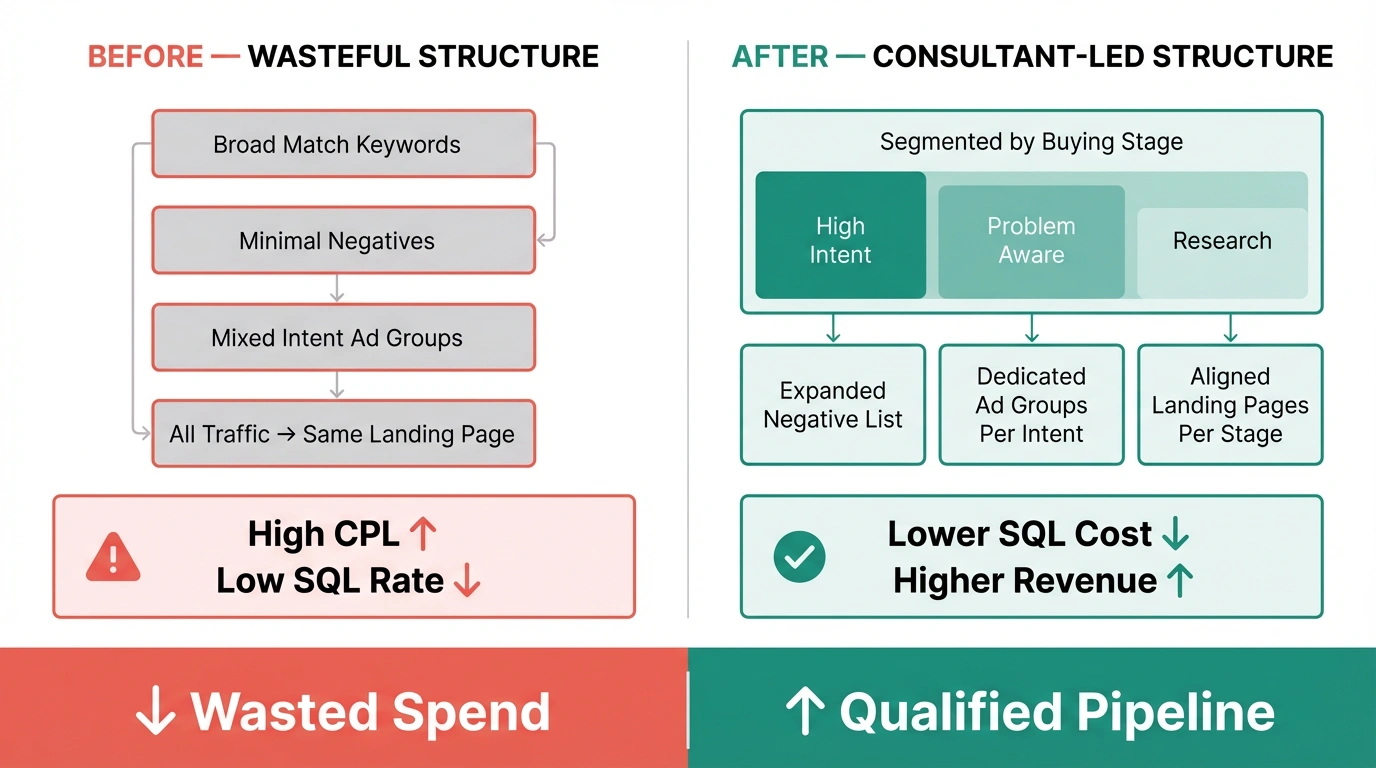
They isolate commercial intent, segment by buying stage, and strip out research-only or job-seeker queries that inflate volume while eroding lead quality.
Weak negatives and broad match without guardrails send budgets into low-intent traffic and unqualified geos or audiences.
The outcome is familiar: CPCs rise, lead quality falls, CPL climbs, and sales teams lose confidence in marketing-sourced pipeline.
Practitioners in communities like r/digital_marketing repeatedly describe “CPCs up, leads down” turnarounds that hinge on three moves:
tightening intent targeting, expanding negative lists, and rebuilding ad group structures around discrete segments instead of catch-all themes.
For a CMO, this level of control means you can dial spend up on proven, high-intent clusters while capping or exiting segments that may look fine in-platform but underperform on SQLs and revenue.
Landing Pages Engineered for Qualified Conversions
Google reports that businesses earn about $2 in revenue for every $1 spent on Google Ads.
That ratio only holds when landing experiences are aligned to the right visitors and to the right next action in the buying journey.
SEM consultants optimize for qualified conversions, not generic form fills.
They tune messaging, offer, and friction level to reflect query intent and funnel stage, so high-intent visitors see proof, pricing signals, and sales paths while early-stage visitors see content and soft conversions.
In one real engagement, an SEM consultant shifted optimization from raw form fills to CRM-qualified leads.
By piping CRM-qualified data directly into Google Ads, they trained bidding to favor segments that generated pipeline and closed revenue, cutting noise from trial signups and low-intent demos.
This approach turns landing pages into filters that attract and progress buyers while discouraging unqualified submissions that bloat “conversions” and distort channel performance in dashboards.
Structure, Measurement, and Performance Stability
As privacy, consent, and signal loss reshape tracking, measurement complexity is rising sharply.
Google’s 2024 guidance highlights the importance of robust first-party signals and clean conversion setups for automation to work as intended.
Modern SEM consultants respond by building resilient account structures and exacting measurement systems.
They define clear conversion hierarchies, maintain asset hygiene, and ensure every tracked action is mapped to a business outcome, not just a click on a page.
Communities like r/PPC emphasize that asset quality and conversion definitions heavily influence automated bidding behavior.
Consultants with tight processes often outperform larger in-house teams that rely on default platform settings and noisy conversion data.
For CMOs, this rigor delivers stability in CAC and revenue contribution, even as cookies, modeling, and attribution rules evolve.
It also creates the analytical foundation to answer harder questions: which search segments are truly incremental, and which would have converted via brand or organic anyway.
Measurement Precision: De-Risking Search Budgets at Scale
For growth-focused CMOs, the real value of an SEM consultant is rigorous measurement that separates true revenue from platform noise.
When Google Ads reporting looks healthy but CAC is creeping up in your finance dashboards, you are not optimizing, you are gambling.
Measurement precision turns that gamble into a controlled system, where every incremental dollar of search spend is tied to observable pipeline and revenue.
This is how you scale budgets with confidence instead of reacting to lagging CAC surprises.
Turning “Noisy” Conversions into Revenue-Clean Signals
Most platforms happily count every form fill or trial start as a conversion, regardless of eventual value.
In B2B, that inflates performance and hides the gap between reported CPA and true CAC.
The result is attribution ambiguity, which is one of the most consistent pain points senior marketers raise in board conversations.
A specialized SEM consultant focuses on stitching online intent to offline revenue outcomes so optimization aligns with commercial reality.
That means pushing beyond default tracking to wire CRM and MAP data back into Google Ads and analytics environments.
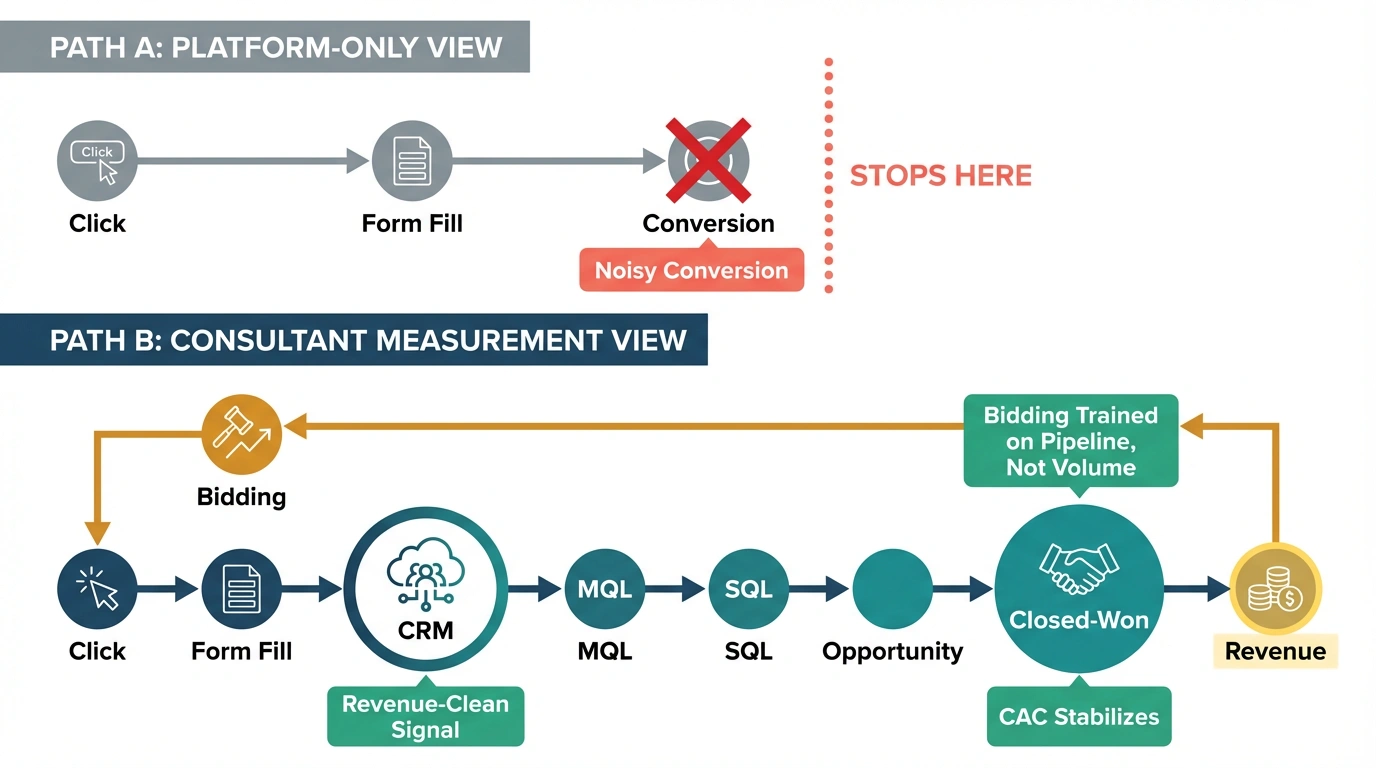
In practice, this looks like:
- Mapping key CRM milestones such as MQL, SQL, Opportunity, and Closed Won directly into ad platforms so bids favor revenue-producing segments, not just cheap leads.
- Defining negative signals such as “disqualified” or “no budget” and feeding them back, so smart bidding stops chasing lookalikes of low-value accounts.
- Building cohort views that compare platform CPA against CAC by segment, so your team can reallocate spend toward channels and queries that yield profitable customers.
Consider a B2B SaaS scenario where the consultancy linked Salesforce opportunity stages into Google Ads.
Once automation could see which keywords generated real pipeline, bids shifted toward fewer but higher-intent queries.
Sales stopped chasing low-quality demo requests, and finance finally saw CAC stabilize within target bands despite higher overall spend.
Insulating Budgets from Automation Volatility with Structured Testing
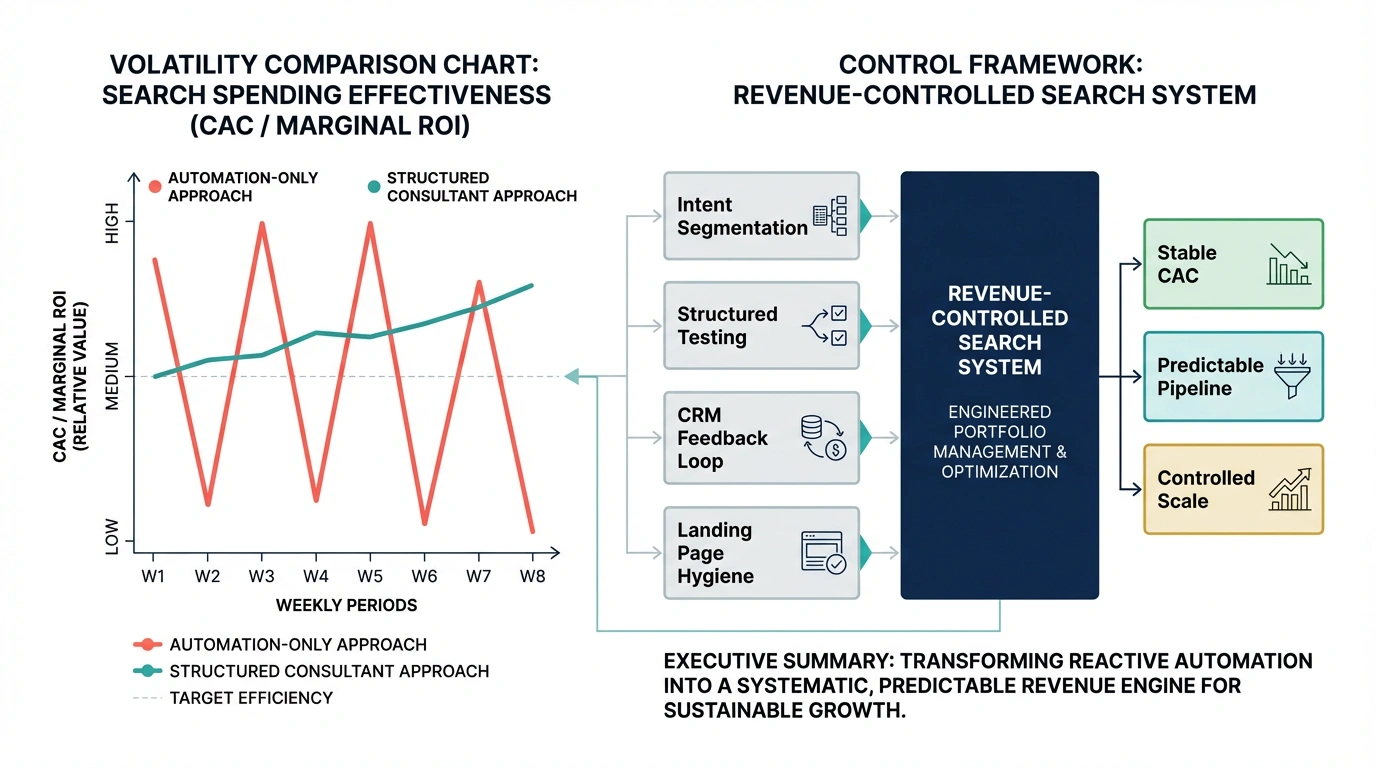
Smart bidding and Performance Max are powerful, but they are also volatile.
Many CMOs have experienced the pattern where a campaign performs well for months, then suddenly tanks after a creative refresh or a tracking change.
Reddit and other practitioner forums are filled with stories of performance collapsing when conversion signals weaken or shift.
SEM consultants de-risk this volatility by reintroducing methodical experimentation discipline.
Instead of reactive tweaks inside opaque automation, they enforce clear hypotheses, control groups, and stage gates.
Key elements include:
- Hypothesis-driven audits that prioritize a small number of high-impact variables such as bidding strategy, query mix, and audience layering.
- Experiment roadmaps that define test cadence, success thresholds, and rollback rules, so budgets are never fully exposed to unproven changes.
- Systematic versioning of feeds, creative assets, and offers, which keeps Performance Max and smart bidding supplied with fresh but structured input data.
The effect is renewed predictability.
Your team understands which levers moved performance, why certain tests scaled and others were killed, and how much variance is acceptable before an intervention is required.
Search budgets become an engineered portfolio, not a black-box line item.
On-Page Speed and Conversion Hygiene as Measurable CAC Levers
Precision measurement also extends past the click.
Slow, unclear landing experiences quietly inflate CAC because automation keeps buying traffic that never has a chance to convert.
According to (Think with Google), a delay of just a few seconds can spike bounce rates by up to 32 percent, especially on mobile.
A data-driven SEM consultant treats page speed and conversion hygiene as core media levers, not a “web team” afterthought.
They benchmark load times, above-the-fold clarity, and form friction, then quantify how each improvement feeds back into Quality Score, CPC, and conversion rate.
Typical focus areas include:
- Compressing images, streamlining scripts, and improving server response to reduce mobile load times and stabilize performance during peak traffic.
- Clarifying the above-the-fold offer and aligning messaging tightly with query intent, which reduces pogo-sticking and strengthens engagement signals.
- Simplifying forms and adding trust indicators such as proof points and security cues to lift qualified form completion without sacrificing lead quality.
In one consultancy engagement, addressing mobile speed and above-the-fold clarity yielded more than 30 percent growth in qualified lead volume at constant spend.
Quality Scores improved, effective CPCs dropped, and the CMO could report higher revenue per dollar of search investment without needing a larger budget.
Strategic SEM Consultant Selection for Sustainable Revenue Impact
For a CMO, the real value of an SEM consultant is not a lower CPC, it is de-risked growth.
Done right, search spend shifts from opaque and automated to a controlled, revenue-optimized system.
That system aligns intent, landing experiences, and precise measurement so finance, sales, and marketing can trust what the numbers are saying.
The priority is not more volume in Google Ads, but more verifiable, incremental pipeline you can scale with confidence.
Select on Measurement and Structure, Not Just Platform Proficiency
Most SEM vendors look similar on paper: certifications, case studies, and a list of platforms they manage.
What separates the best from the rest is their operating system, not their logo slide.
Across practitioner discussions and client stories, the same pattern appears: value comes from process rigor.
That means structured audits, explicit experiment cadences, and measurement strategies built to survive real-world complexity, not just hit platform-level targets.
Instead of locking into long retainers, CMOs increasingly use short, paid audits or 60–90 day trials to validate fit.
The strongest partners welcome this, because their differentiator is the clarity and discipline of their approach, not headcount or hourly volume.
When evaluating candidates, prioritize:
- A documented audit framework that surfaces structural issues, tracking gaps, and wasted spend within 2–4 weeks.
- A clear testing roadmap with hypotheses, guardrails, and pre-defined success metrics tied to qualified pipeline.
- A reporting structure that connects platform data to CRM and revenue outcomes, not just in-platform “conversions.”
The Ideal SEM Consultant Sells a Growth System, Not Tactics
The consultants who consistently drive durable ROI think in systems, not isolated optimizations.
They architect an engine where every element serves intent clarity and measurable revenue impact.
At minimum, expect them to design and implement:
- Intent segmentation that separates high-purchase, problem-aware, and research traffic, so bids, ads, and budgets match commercial value.
- Tailored landing paths for each intent cluster, engineered for qualified conversions and sales-ready leads, not generic form fills.
- An incrementality-focused measurement framework that distinguishes real net-new pipeline from what platforms already claim they influenced.
High-performing consultants lead with conversion tracking and data integrity before they touch bids or creative.
If they cannot explain exactly how a lead becomes an opportunity and then revenue in your systems, they cannot optimize for it reliably.
Turning Paid Search into Predictable, Attributable Revenue
With modern automation, it is easy to spend more and feel productive while CAC quietly drifts up.
The right SEM consultant reverses that pattern by bringing confidence and control back to digital budgets.
They help you validate whether performance actually holds when budgets scale, and whether “conversions” reflect real opportunities in Salesforce or HubSpot.
They build guardrails so you can push spend into proven segments while capping exposure in speculative areas.
Paid search continues to deliver strong average returns, with [Google] reporting roughly 2 dollars in revenue for every 1 dollar spent.
Your challenge is ensuring that ratio is real for your business, repeatable over time, and clearly attributable to high-intent pipeline rather than low-quality leads.
The consultant worth hiring is the one who can show you, in detail, how they will make your search program measurable, auditable, and scalable before you commit significant budget.
Once that system is in place, you are no longer guessing why CAC is climbing while reported conversions look fine.
You are managing a controlled revenue machine you can scale deliberately.
CMO Action Plan: Transforming Paid Search from a Cost Center to a Growth Asset
For growth-focused leaders, the right SEM consultant is not a media buyer, but an architect of predictable, attributable revenue.
Their mandate is to turn opaque platform activity into a controlled, measurable system that your CFO and CRO can trust.
Prioritize partners who start with audit rigor and data integrity, not quick bid tweaks.
Look for a documented audit framework that exposes structural issues, tracking gaps, and wasted spend within weeks, paired with an incrementality-focused measurement plan that connects search activity to qualified pipeline and closed revenue.
From there, insist on a clear test-and-learn roadmap.
That roadmap should define hypotheses, guardrails, and success metrics tied to CAC, opportunity creation, and payback period, not just in-platform “conversions.”
The outcome is a search program grounded in intent segmentation, tailored landing experiences, and consent-aware offline attribution.
When this system is in place, you can scale into proven segments confidently, cap speculative spend, and explain every major budget decision in the boardroom.
Paid search then evolves from a line item you tolerate into a growth asset you actively manage.
With the right SEM consultant, your investment behaves like a controllable revenue engine, not a black box that requires faith in platform reporting from (Google).