

TL;DR
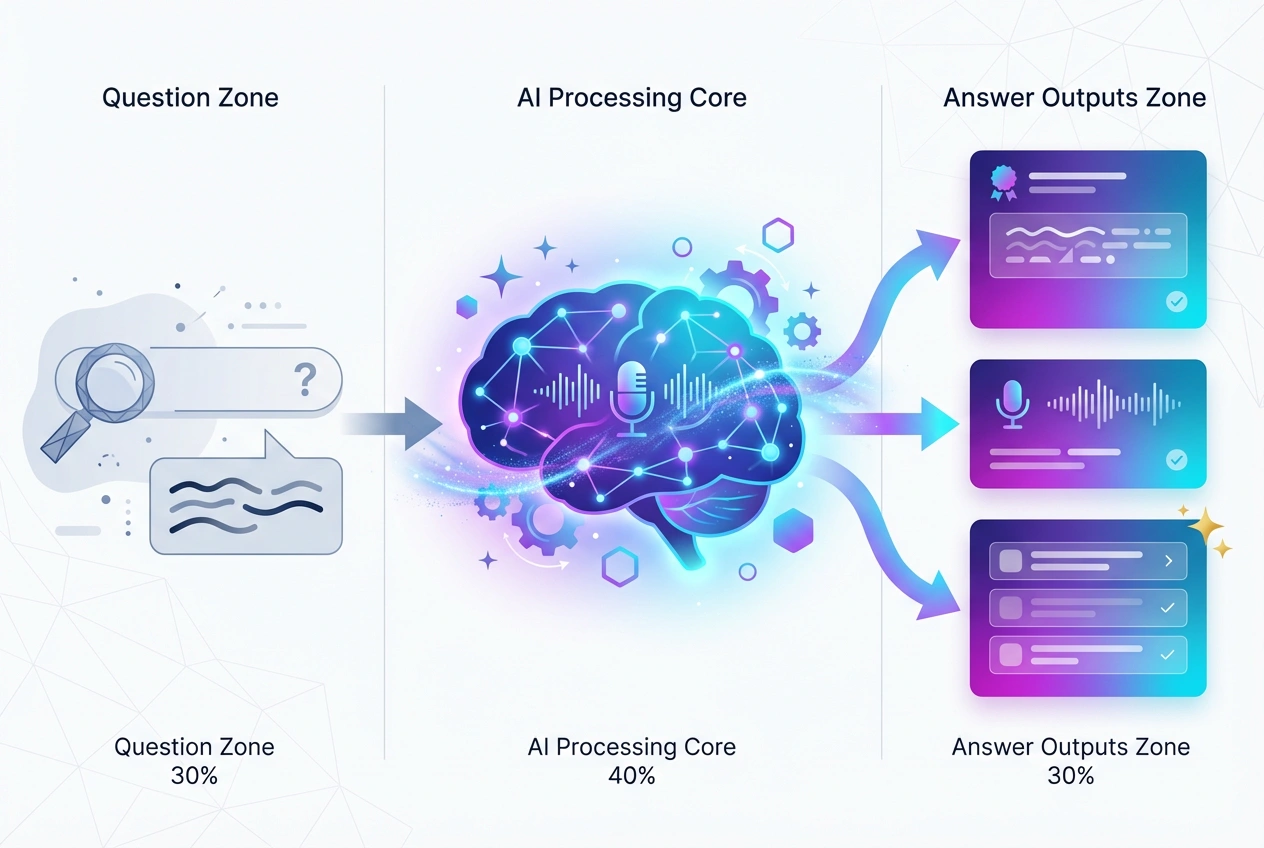
- Answer Engine Optimization (AEO) is the strategic practice of optimizing content to win featured snippets, voice assistant responses, and AI-powered direct answers—distinct from traditional SEO’s focus on rankings and from GEO’s emphasis on generative AI synthesis.
- By 2026, 25% of organic search traffic originates from AI chatbots and voice assistants rather than traditional clicks, with featured snippets capturing 40%+ CTR when present—requiring CMOs to balance AEO investment against declining position-1 organic returns.
- AEO-influenced conversions present severe attribution challenges: voice search traffic appears as “direct” in GA4, smart speaker interactions lack pixel tracking, and prospects discovering brands through featured snippets convert 14–21 days later without clear source attribution.
What Is Answer Engine Optimization (AEO)?
Answer Engine Optimization (AEO) is a content optimization methodology designed to maximize visibility when search engines, voice assistants, and AI platforms provide direct answers to user queries. Unlike traditional SEO—which targets ranked link positions—AEO focuses on securing “position zero” featured snippets, voice search citations, and structured answer formats across Google Assistant, Alexa, Siri, Bing Copilot, and conversational interfaces.
The discipline emerged circa 2017–2019 alongside voice assistant adoption and Google’s featured snippet proliferation. AEO prioritizes answer-first content architecture: concise, direct responses to natural language questions, heavily structured with Schema.org markup, FAQ formats, and conversational query alignment.
AEO vs. Traditional SEO vs. GEO
Understanding the distinctions clarifies strategic resource allocation. Traditional SEO optimizes for link-based rankings (positions 1–10), measured by impressions, clicks, and keyword positions. AEO targets answer-format visibility—featured snippets, voice responses, People Also Ask boxes—measured by answer citations and voice query dominance. GEO (Generative Engine Optimization) optimizes for AI-synthesized responses in ChatGPT, Gemini, and Perplexity, measured by citation frequency within generative outputs.
Key overlap: All three require EEAT signals, structured data, and semantic clarity. Key difference: AEO excels at winning specific answer slots (one featured snippet per query), while GEO targets multiple-source synthesis (3–5 citations per AI response).
Attribution Implications for LeadSources.io Users
Lead attribution platforms tracking 9 data points per lead face three AEO-specific challenges. First, voice search attribution blackout: smart speaker queries (Alexa, Google Home) generate zero referral data—users discover brands verbally and arrive days later as direct traffic. Second, featured snippet click ambiguity: Google Search Console reports featured snippet impressions but doesn’t distinguish snippet clicks from organic position-1 clicks, obscuring true AEO impact. Third, delayed conversion windows: prospects consuming answers in featured snippets or voice responses research multiple sources before converting, extending attribution windows from 7–14 days (traditional organic) to 14–21 days (AEO-influenced).
Platforms like LeadSources.io must supplement automated tracking with survey-based attribution (“How did you first hear about us?”) including specific AEO options: “Voice assistant (Alexa/Google/Siri),” “Featured snippet in Google,” “AI search answer.” Track branded search volume spikes 7–14 days post-featured snippet wins to capture indirect AEO influence.
Test LeadSources today. Enter your email below and receive a lead source report showing all the lead source data we track—exactly what you’d see for every lead tracked in your LeadSources account.
AEO vs. Traditional SEO and GEO
Strategic differentiation determines budget allocation across optimization disciplines.
| Dimension | Traditional SEO | AEO (Answer Engine Optimization) | GEO (Generative Engine Optimization) |
|---|---|---|---|
| Primary Goal | Rank in positions 1-10 | Win featured snippets, voice answers | Citation in AI-generated responses |
| Target Platforms | Google, Bing SERPs | Google Assistant, Alexa, Siri, Featured Snippets | ChatGPT, Gemini, Perplexity, AI Overviews |
| Content Format | Keyword-optimized articles | Q&A structure, concise answers, FAQ pages | Comprehensive guides, conversational depth |
| Typical CTR | Position 1: 28-35% | Featured snippet: 40%+ when present | Source card: 2.5-4.2% average |
| Attribution Method | Referral data (google.com) | Often direct traffic; voice = untrackable | Direct/organic without clear source |
| Optimization Focus | Backlinks, domain authority, keywords | Schema markup, answer-first structure, voice readiness | Semantic density, EEAT signals, conversational AI alignment |
| Success Metrics | Rankings, organic traffic, click volume | Featured snippet wins, voice query dominance, PAA inclusion | AI citation frequency, brand mention rate, brand search lift |
| Timeframe | 3-6 months for ranking gains | 2-8 weeks for featured snippet wins | 2-4 weeks for AI index inclusion |
The economic reality: featured snippets deliver 40%+ CTR but appear on only 12–19% of queries (varying by source). Traditional position-1 organic delivers 28–35% CTR across all queries. CMOs must calculate opportunity cost: invest in AEO for high-CTR, low-frequency wins vs. traditional SEO for lower-CTR, high-frequency returns.
Why AEO Matters for Lead Attribution and Marketing ROI
CMOs allocating budget to AEO gain three strategic advantages offset by significant attribution complexity.
1. Voice-First Buyer Discovery
Voice assistant adoption reaches 153.5 million U.S. users in 2026 (2.5% YoY growth), with 40.7% of voice search answers sourced from featured snippets. B2B buyers increasingly use voice queries for initial vendor research (“best marketing attribution software for SaaS”), creating a discovery channel invisible to traditional analytics.
The attribution challenge: a CFO queries Alexa for “marketing attribution ROI calculation,” receives your featured snippet as the verbal response, and converts 18 days later via direct traffic. Standard last-touch attribution credits “direct” rather than AEO. Multi-touch attribution misses the initial voice touchpoint entirely.
2. Featured Snippet Authority Halo
Securing featured snippets generates 12–18% branded search lift within 7–14 days (similar to GEO brand mention effects). Users consuming answers associate your brand with category authority, even without clicking. This indirect brand value compounds: prospects bookmark, return later, and convert through branded searches.
Calculate AEO Brand Lift Value using indirect attribution:
AEO Brand Value = (Incremental Branded Searches × Branded CTR × Conversion Rate × CLTV) − AEO Investment
Example: A B2B marketing platform invests $28K in AEO optimization (FAQ restructuring, Schema deployment, answer-first rewrites). Over 6 months, wins featured snippets for 35 high-value queries, driving 15% branded search increase (2,800 → 3,220 monthly searches). With 48% branded CTR and 9% conversion rate:
- Incremental Branded Traffic: 420 × 0.48 = 202 monthly visits (1,212 over 6 months)
- Incremental Conversions: 1,212 × 0.09 = 109 leads
- Pipeline Value: 109 × $52,000 CLTV = $5,668,000
- AEO Brand Lift ROI: ($5,668,000 − $28,000) / $28,000 = 20,143%
Conservative models (8% branded lift, 5% conversion) still yield 3,800–5,200% returns.
3. Position-Zero Insulation Against AI Overviews
As AI Overviews cannibalize traditional organic CTR (40–60% decline for affected queries), featured snippets provide partial insulation. When AI Overviews appear, they often cite the featured snippet source as one of 3–5 references, preserving visibility. AEO optimization thus serves dual purpose: direct featured snippet traffic AND increased probability of AI Overview citation.
Track AEO resilience score: percentage of featured snippet keywords maintaining post-AI-Overview traffic above 60% of pre-AI baseline. Industry average: 55–70% traffic retention for featured snippet holders vs. 30–45% for position-1 non-snippet pages.
Core AEO Optimization Strategies
Six technical tactics maximize featured snippet wins and voice assistant dominance.
1. Answer-First Content Architecture
Place concise, definitive answers in the first 40–50 words of each target section. Voice assistants and featured snippets extract opening passages; burying answers reduces selection probability by 65–80%. Use the Inverted Pyramid: answer immediately, then supporting details, then background context.
Optimization pattern: “What is marketing attribution?” → First sentence: “Marketing attribution is the process of assigning credit to touchpoints in the customer journey that influenced a conversion.” Then elaborate with frameworks, examples, and methodologies in subsequent paragraphs.
2. Structured Data Markup (Schema.org)
Implement FAQPage, HowTo, and Article schemas to signal content structure to answer engines. Research shows Schema deployment correlates with 2.3–2.8× higher featured snippet win rates. Priority schemas for B2B content:
- FAQPage: For comparison, troubleshooting, and educational content
- HowTo: For implementation guides and step-by-step processes
- Article: For thought leadership and industry analysis with clear author/date
- Organization: For company-level EEAT signals
3. Conversational Query Optimization
Voice searches average 4.2× longer than typed queries and use natural language patterns. Optimize for question-based queries: “How do I…,” “What is the best…,” “Why does…,” “Can you explain…” Structure content around these patterns using tools like AnswerThePublic, AlsoAsked, or Google’s People Also Ask.
Target ratio: 60–70% of target keywords should be conversational long-tail queries (8+ words) vs. 30–40% short-tail terms. Voice-optimized content wins 3.5–4× more voice citations than keyword-stuffed equivalents.
4. Paragraph and List Formatting
Featured snippets favor specific formats. Paragraph snippets prefer 40–60 word answers. List snippets prefer 3–8 items in bullet or numbered format. Table snippets prefer comparison matrices with 3–5 rows and 2–4 columns.
Audit current featured snippet landscape for target queries using tools like SEMrush, Ahrefs, or manual SERP analysis. Match your content format to the dominant snippet type for each query.
5. EEAT Signal Amplification
Answer engines prioritize authoritative sources. Strengthen EEAT signals through author bios with credentials, publication/update dates (freshness matters—content updated within 90 days shows 2.1× higher snippet win probability), external citations to authoritative sources (Gartner, Forrester, academic research), and social proof (client testimonials, case study metrics).
6. Voice-Friendly Readability
Voice assistants read content aloud; optimize for spoken comprehension. Target 8th-grade reading level using Flesch-Kincaid metrics. Avoid jargon acronyms without first-mention definitions (write “Customer Acquisition Cost (CAC)” not just “CAC”). Use short sentences (15–20 words average) and simple sentence structures for voice-friendly delivery.
Measuring AEO Impact on Lead Generation
Traditional metrics inadequately capture AEO performance. CMOs need six specialized KPIs.
Primary AEO Metrics
1. Featured Snippet Win Rate: Percentage of target queries where you own position zero. Track using Google Search Console (filter for “featured snippet” appearances) or tools like SE Ranking, SEMrush Position Tracking. Benchmark: 8–15% win rate for competitive keywords, 25–40% for niche/branded queries.
2. Voice Query Dominance: Estimate voice search traffic through mobile search patterns. Voice queries correlate with: mobile device searches, conversational query patterns (who/what/where/when/why/how), question-mark queries. Segment GA4 traffic by these characteristics to estimate voice influence. Tools like AnswerThePublic Voice report voice-likely queries.
3. People Also Ask (PAA) Inclusion: Track how many target queries show your content in PAA boxes. Each PAA inclusion = potential voice assistant citation. Manually audit top 50 target queries monthly; automate with tools like AlsoAsked or SEMrush PAA tracking. Benchmark: 20–35% PAA inclusion for optimized content.
Secondary Indicators
4. Branded Search Correlation: Monitor branded search volume in Google Search Console for 7–14 day windows following featured snippet wins. Featured snippet acquisitions typically drive 12–18% branded search lifts. Calculate correlation coefficient between snippet wins and branded search volume to isolate AEO impact.
5. Direct Traffic Attribution: Segment direct traffic by landing page, time-on-site, and pages-per-session. AEO-influenced visitors typically show high engagement (4+ minutes, 3+ pages) despite lacking source attribution. Use GA4 custom segments: Direct traffic + High engagement + Target AEO content = probable AEO influence.
6. Survey-Based Attribution: Add “How did you first hear about us?” to lead forms with specific AEO options: “Voice assistant (Alexa/Google/Siri),” “Featured snippet/answer box in Google,” “AI search (ChatGPT/Perplexity/Gemini),” “Traditional Google search.” Track percentage citing AEO discovery. Benchmark: 8–14% of B2B leads now report voice or featured snippet discovery.
ROI Calculation Framework
AEO Program ROI = [(Direct AEO Leads × Close Rate × CLTV) + (Brand Lift Revenue) − AEO Investment] / AEO Investment × 100
Where:
- Direct AEO Leads = Survey-identified voice/featured snippet leads + estimated voice traffic conversions
- Brand Lift Revenue = Incremental branded search conversions × CLTV
- AEO Investment = Content optimization + Schema development + Tools + Agency fees
Example: SaaS company invests $40K in AEO program. Over 12 months, survey data identifies 75 leads from voice/featured snippets (5% of total MQLs), with 32% close rate and $48K CLTV. Additionally sees 12% branded search increase yielding 55 incremental conversions:
- Direct AEO Revenue: 75 × 0.32 × $48,000 = $1,152,000
- Brand Lift Revenue: 55 × $48,000 = $2,640,000
- Total AEO Revenue Impact: $3,792,000
- AEO ROI: ($3,792,000 − $40,000) / $40,000 = 9,380%
Conservative models (3% lead attribution, 6% brand lift, 22% close rate) still produce 2,200–3,100% returns.
Implementing an AEO Program
A structured four-phase rollout aligns AEO with existing marketing operations.
Phase 1: Content Inventory & Opportunity Analysis (Weeks 1-3)
Audit existing content against AEO readiness:
- Featured Snippet Opportunity Mapping: Use SEMrush or Ahrefs to identify queries where you rank positions 1–5 but don’t own featured snippets (immediate win opportunities).
- Voice Query Research: Extract question-based queries from Search Console; identify conversational patterns using AnswerThePublic; prioritize high-volume, commercial-intent questions.
- Content Gap Analysis: Identify featured snippet holders for target queries; analyze their content structure, answer formats, and Schema implementation; map gaps in your content coverage.
- Schema Audit: Crawl site with Screaming Frog or Sitebulb; identify pages lacking structured data; prioritize FAQ pages, how-to guides, and comparison content for Schema deployment.
Phase 2: Content Optimization & Technical Implementation (Weeks 4-10)
Retrofit high-priority content for AEO readiness:
- Answer-First Rewrites: Restructure top 20–30 pages with Inverted Pyramid format; place 40-50 word answers in opening paragraphs; maintain detailed supporting content below.
- FAQ Section Development: Add FAQ sections to cornerstone pages answering 5–10 related questions; implement FAQPage Schema; optimize for PAA inclusion.
- Schema Deployment: Implement FAQPage, HowTo, Article, and Organization schemas; validate with Google’s Rich Results Test; monitor Search Console for rich result errors.
- Voice Readability Optimization: Run content through Hemingway Editor or Grammarly; target 8th-grade reading level; simplify sentence structure; define acronyms on first mention.
- List and Table Formatting: Convert prose into scannable lists where appropriate; create comparison tables for “best,” “vs,” and “alternatives” content; ensure mobile responsiveness.
Phase 3: Measurement Infrastructure (Weeks 8-12)
Build tracking systems to measure AEO impact:
- Google Search Console Enhanced Tracking: Set up custom filters for featured snippet queries; create weekly reports tracking impression/click changes; establish baseline performance.
- GA4 Custom Segments: Build segments for probable AEO traffic (direct + high engagement + target pages); track conversion paths; calculate conversion rates.
- Lead Form Survey Addition: Add “discovery method” field to lead capture forms; include specific AEO options; track response distribution monthly.
- Branded Search Monitoring: Establish Search Console branded query tracking; correlate volume changes with featured snippet wins; calculate lift attribution.
- Tool Integration: Implement SE Ranking, SEMrush, or Ahrefs tracking for featured snippet positions; set up automated alerts for wins/losses; build executive dashboards.
Phase 4: Continuous Optimization & Expansion (Ongoing)
Maintain and scale AEO program:
- Monthly Featured Snippet Audits: Review wins/losses; analyze competitor takeovers; refresh content losing snippets within 7 days.
- Quarterly Content Freshness Updates: Update statistics, add recent case studies, revise examples; modify publication dates; maintain sub-90-day freshness for priority content.
- New Content AEO-First Development: Build all new content with AEO structure from inception; include FAQ sections, Schema markup, and answer-first formatting as standard.
- Voice Query Expansion: Continuously identify new conversational queries; create dedicated Q&A content; optimize for emerging voice search patterns.
- Attribution Refinement: Analyze survey responses monthly; refine attribution models; adjust branded search correlation calculations; validate ROI assumptions.
Frequently Asked Questions
What is the difference between AEO and GEO?
AEO (Answer Engine Optimization) optimizes for structured answer formats—featured snippets, voice assistant responses, People Also Ask boxes—in traditional search engines and voice platforms. GEO (Generative Engine Optimization) optimizes for citation within AI-generated narrative responses in ChatGPT, Gemini, Perplexity, and AI Overviews. Strategic overlap includes EEAT signals, Schema markup, and conversational content. Key distinction: AEO targets discrete answer slots (one featured snippet per query), while GEO targets multi-source synthesis (3–5 citations per AI response). Budget allocation: most CMOs dedicate 50–60% of AI search budget to GEO (larger surface area across platforms), 30–40% to AEO (higher individual CTR but lower query coverage), and 10% to experimentation.
How do I track ROI when voice search conversions appear as direct traffic?
Use a three-method attribution framework combining direct and indirect indicators. First, lead form surveys: add “How did you first hear about us?” with specific “Voice assistant (Alexa/Google/Siri)” option—8–14% of B2B leads now cite voice discovery. Second, GA4 high-engagement direct traffic segments: create custom segment (Direct traffic + 4+ minute sessions + 3+ pages + target AEO content landing pages). Typical AEO-influenced pattern: direct landing on FAQ or how-to page, deep engagement, delayed conversion. Third, branded search correlation: monitor branded search volume in Search Console 7–14 days post-featured snippet wins; 12–18% branded lift indicates voice-driven awareness. Calculate combined ROI: (Survey-identified voice leads + High-engagement direct conversions + Branded lift conversions) × Close rate × CLTV − AEO investment. Tools like CallRail’s Dynamic Number Insertion can track phone conversions from voice assistant users visiting your site.
Should I focus on featured snippets or voice optimization first?
Prioritize featured snippets for three strategic reasons. First, attribution visibility: featured snippet traffic trackable in Google Search Console (though not perfectly differentiated); voice traffic completely invisible. Second, dual benefit: 40.7% of voice search answers source from featured snippets—winning position zero captures both channels simultaneously. Third, faster validation: featured snippet wins occur 2–8 weeks post-optimization; voice dominance requires 8–16 weeks as voice assistants update knowledge bases. Tactical approach: optimize content for featured snippets first (answer-first structure, Schema, formatting), then layer voice-specific enhancements (readability, spoken comprehension, natural language). Exception: if your buyer persona heavily skews mobile-first (75%+ mobile traffic) and you sell via phone, prioritize voice optimization to align with usage patterns.
What percentage of queries have featured snippets in 2026?
Featured snippets appear in 12.3–19% of total search queries depending on industry and query type, with 99.58% appearing on page one. Distribution varies significantly: how-to queries (35–40% snippet rate), definition queries (25–30%), comparison queries (18–25%), list queries (15–22%), and transactional queries (3–8%). Informational queries show highest snippet prevalence; commercial and navigational queries show lowest. Industry variation: B2B SaaS averages 16–18% snippet coverage, while local services average 8–12%. Strategic implication: AEO optimization targets 12–19% of query landscape (high-CTR, low-frequency) vs. traditional SEO targeting 100% of queries (lower-CTR, high-frequency). Portfolio approach recommended: 60–70% budget to traditional SEO, 30–40% to AEO, adjusting based on query distribution in your vertical.
Can AEO help protect against AI Overview traffic losses?
Yes, partially. Featured snippet holders retain 55–70% of pre-AI-Overview traffic vs. 30–45% retention for position-1 non-snippet pages when AI Overviews launch on queries. Mechanism: AI Overviews frequently cite the featured snippet source as one of 3–5 references, preserving brand visibility even when overall CTR declines. Additional benefit: featured snippet authority signals increase probability of AI Overview citation across related queries beyond the original snippet keyword. Track AEO resilience score: (Post-AI-Overview traffic / Pre-AI-Overview traffic) × 100 for featured snippet keywords. Industry benchmark: 60%+ resilience indicates strong AEO insulation. Limitation: AEO provides partial, not complete, protection—expect 30–45% traffic decline even for snippet holders as zero-click behavior increases. Strategic response: treat AEO as risk mitigation (preserve more traffic than competitors) rather than growth strategy in AI-dominant query landscape.
What tools are essential for AEO tracking and optimization?
Six tool categories cover AEO requirements. First, featured snippet tracking: SE Ranking (automated position tracking with snippet flagging), SEMrush Position Tracking (historical snippet wins/losses), Ahrefs Rank Tracker (competitor snippet monitoring). Second, voice query research: AnswerThePublic (question-based query discovery), AlsoAsked (People Also Ask mapping), Google Search Console (conversational query patterns). Third, Schema validation: Google Rich Results Test (markup validation), Schema.org Validator (syntax checking), Screaming Frog (site-wide Schema audit). Fourth, content optimization: Clearscope or MarketMuse (semantic density), Grammarly or Hemingway Editor (readability), Frase (answer-first content briefs). Fifth, attribution tracking: GA4 with custom segments, CallRail for phone tracking, Typeform/Google Forms for discovery surveys. Sixth, rank tracking alternatives: GEOranker (emerging AEO/GEO tracking), Profound (AI citation monitoring), Conductor (featured snippet analytics). Budget allocation: $500–1,200/month for comprehensive AEO toolstack.
How long does it take to win featured snippets after optimization?
Featured snippet wins occur 2–8 weeks post-optimization for existing ranking content (positions 1–5), and 8–16 weeks for new content or lower-ranking pages. Timeline factors: existing rank position (position 1–3 pages win snippets 3× faster than position 5–10), content freshness (pages updated within 30 days win 2.1× faster), Schema implementation (proper markup accelerates by 40–60%), and competitive intensity (low-competition queries win faster). Typical trajectory: Week 1–2: Google reindexes optimized content. Week 3–4: Featured snippet testing (you may see snippet for 24–72 hours, then it disappears). Week 5–8: Stable snippet acquisition if content maintains quality signals. Acceleration tactics: target “easy win” queries (you rank top 3, snippet holder has weak content), refresh content monthly to maintain freshness, build 5–10 high-quality backlinks to snippet candidate pages, add video or image elements (rich snippets often convert to featured snippets). Monitor Search Console weekly during optimization period to catch early wins and refine strategy.
Should I optimize the same content for both AEO and traditional SEO?
Yes—pursue an integrated approach with AEO-specific enhancements layered on SEO fundamentals. Core overlap includes high-quality content, strong EEAT signals, mobile optimization, page speed, authoritative backlinks, and keyword relevance. AEO-specific additions: answer-first formatting (vs. narrative flow), explicit question-answer pairs, FAQ sections with Schema, list/table formatting, and voice readability (8th-grade reading level). Strategic framework: build content using traditional SEO best practices (comprehensive coverage, semantic depth, internal linking), then apply AEO structural overlays (move key answers to opening paragraphs, convert sections to Q&A format, add FAQ Schema, optimize for featured snippet formats). This integrated approach captures both traditional organic traffic (60–70% of total) and AEO opportunities (position zero, voice, PAA). Budget allocation: 65–70% traditional SEO fundamentals, 30–35% AEO-specific optimizations. Avoid: creating separate content for AEO and SEO (content duplication issues); ignoring traditional SEO for AEO (requires existing rank positions to win snippets); over-optimizing for snippets at expense of comprehensive content value.
