

TL;DR
- Buying groups now average 10-11 stakeholders per B2B purchase, expanding to 15-20 for multinational deals—requiring contact-level attribution to track individual engagement patterns across the collective decision unit.
- Attribution models that credit only primary contacts miss 60-75% of actual buying influence, systematically misallocating budget to channels that reach decision-makers while ignoring touchpoints that engage technical evaluators and financial approvers.
- Account-based metrics (buying group coverage, stakeholder engagement velocity, role-based attribution) provide more accurate pipeline forecasting than individual lead metrics, improving forecast accuracy by 30-40% in complex B2B sales.
What Is a Buying Group?
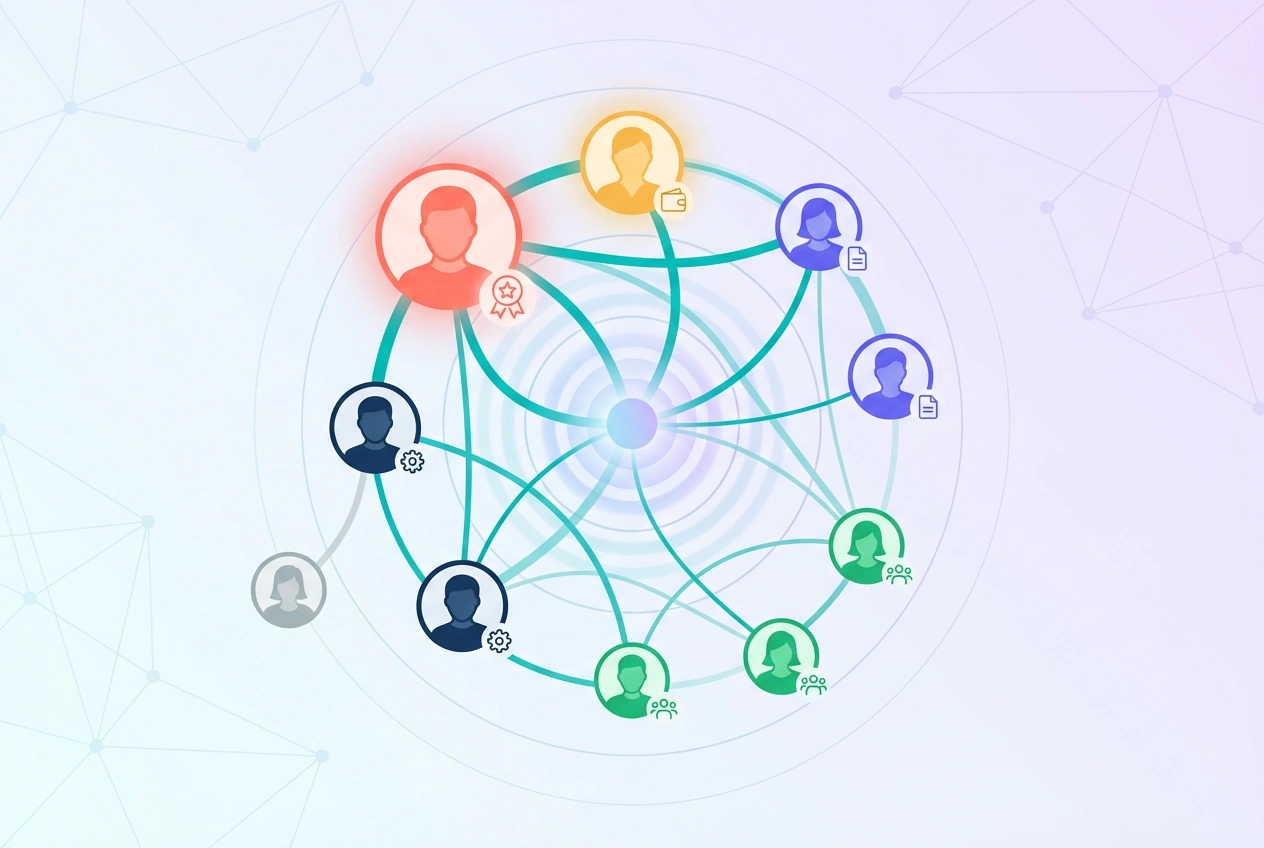
A buying group is the collective set of stakeholders within an organization who share decision authority, budget influence, or implementation responsibility for a purchase.
Unlike individual buyers, buying groups function as decision-making systems where multiple personas must reach consensus before contracts execute. Each member brings distinct evaluation criteria—technical teams assess implementation complexity, finance reviews ROI projections, executives weigh strategic alignment, end users evaluate usability.
The strategic implication for marketing leaders: traditional lead-centric attribution systematically undervalues marketing activities because it assigns conversion credit to individual contacts rather than measuring collective engagement across the buying unit. When 8-10 people influence a purchase but attribution tracks only the form submitter, you’re optimizing for volume metrics that don’t correlate with closed revenue.
Modern B2B selling requires tracking buying group composition, identifying role-specific engagement patterns, and measuring collective readiness rather than individual qualification scores. This shift from lead-based to account-based measurement fundamentally changes how marketing proves ROI and allocates budget.
Test LeadSources today. Enter your email below and receive a lead source report showing all the lead source data we track—exactly what you’d see for every lead tracked in your LeadSources account.
Understanding Buying Group Dynamics
Buying group size and composition vary systematically by deal complexity, with measurable patterns across industries.
Enterprise software purchases averaging $50K+ ACV involve 10-11 stakeholders according to 6sense data. Multinational implementations expand to 15-20 participants as regional managers, compliance officers, and local IT teams join evaluation processes. SMB transactions maintain smaller groups (4-6 people) but still require multi-stakeholder consensus beyond single-champion models.
The composition follows predictable role archetypes. Economic buyers control budget approval but rarely engage early-stage content. Technical evaluators consume product documentation and attend demos but lack final authority. Champions advocate internally but need ammunition to overcome competitor preferences held by other committee members. Coaches provide insider intelligence about decision timelines and political dynamics.
This structural complexity creates attribution challenges because different stakeholders engage different channels at different funnel stages. Your economic buyer discovers you through LinkedIn ads, your technical evaluator finds your comparison guide via organic search, your champion downloads case studies from your nurture sequence. Single-touch attribution credits only one of these touchpoints. Multi-touch models distribute credit but still track individuals rather than collective group progression.
Why Buying Groups Matter for Attribution Tracking
Traditional lead attribution fails because it measures the wrong unit of analysis.
When attribution systems assign conversion credit to individual contacts, they create systematic blind spots around group dynamics. A CMO optimizing for MQL volume generates contacts but can’t see whether marketing reaches complete buying groups or repeatedly engages the same persona types across different accounts.
Consider this scenario: Your attribution report shows paid search generates 40% of SQLs at $85 CPL. Looks efficient. But deeper analysis reveals paid search predominantly reaches technical evaluators while economic buyers discover you through LinkedIn ads that show only 8% SQL contribution. If technical evaluators can’t close deals without economic buyer buy-in, you’re over-investing in partial group coverage based on incomplete attribution visibility.
Buying group attribution measures different metrics. Instead of tracking individual lead progression (MQL→SQL→Opportunity), you measure stakeholder coverage (percentage of key roles identified), engagement breadth (number of active stakeholders per account), and role-specific journey patterns (which channels reach which personas).
This perspective shift changes budget allocation. Traditional attribution might suggest increasing paid search spend because it generates high-converting leads. Buying group analysis reveals you’re saturating technical evaluators while missing economic buyers, suggesting budget reallocation toward executive-focused channels even if those channels show lower individual conversion rates.
Identifying and Mapping Buying Groups
Effective buying group identification combines data sources across marketing automation, CRM, and engagement platforms.
Role-Based Identification
Start with job title mapping that categorizes contacts into decision archetypes. VP Finance becomes economic buyer. Director of Engineering becomes technical evaluator. Operations Manager becomes end user stakeholder. Implementation Consultant becomes technical buyer.
CRM systems with buying center features (Salesforce Opportunity Contact Roles, HubSpot Buying Groups, Pipeliner Buying Center) enable explicit role assignment. Marketing automation platforms track engagement patterns that suggest role types even without explicit classification—someone downloading TCO calculators likely holds budget authority, while product documentation consumers signal technical evaluation responsibility.
Behavioral Pattern Recognition
Engagement sequences reveal buying group composition through interaction patterns. Multiple contacts from the same account consuming related content within compressed timeframes (2-4 weeks) indicates active group evaluation. Sequential engagement where technical content consumption precedes executive-focused asset downloads suggests internal information flow from evaluators to decision-makers.
Email domain clustering identifies organizational participation breadth. Seeing @company.com engagement from engineering, finance, and operations subdomains confirms multi-departmental involvement characteristic of formal buying committees.
Intent Signal Aggregation
Account-level intent platforms (6sense, Demandbase, Bombora) aggregate behavioral signals across buying group members to produce collective intent scores. This approach measures whether you’re reaching sufficient group coverage to progress deals rather than tracking isolated contact activities that may not represent organizational momentum.
Types of Buying Group Structures
Buying groups organize along three primary structures, each requiring distinct engagement approaches.
Consensus-Based Committees
Formal committees with defined membership, structured evaluation processes, and documented decision criteria. Common in regulated industries (healthcare, finance) and large enterprises with procurement policies. These groups move slowly but predictably, requiring content that facilitates internal consensus-building rather than individual persuasion.
Champion-Led Coalitions
Informal groups where a primary champion assembles stakeholder support without formal committee structure. Typical in mid-market and growth-stage companies. The champion becomes the critical node—marketing must arm this person with assets that help them sell internally to skeptical colleagues.
Distributed Decision Networks
Loosely connected stakeholders who influence the purchase through separate evaluation paths that converge at final approval. Common in decentralized organizations and multinational deployments. Requires parallel engagement across independent stakeholder groups who may not actively coordinate but collectively determine deal outcome.
Measuring Engagement Across Decision-Makers
Buying group metrics replace individual lead scoring with collective readiness indicators.
Stakeholder Coverage Ratio
Calculate the percentage of identified buying group roles currently engaged. If your ideal buying group includes 7 personas (economic buyer, technical buyer, champion, 2 technical evaluators, CFO, legal) and you’ve identified/engaged 5, coverage sits at 71%. Research shows deals with 80%+ coverage close at 2-3x rates of partial-coverage opportunities.
Formula: (Engaged Roles / Total Required Roles) × 100
Buying Group Engagement Velocity
Measure the rate at which new stakeholders join active evaluation. Healthy opportunities add 1-2 new engaged contacts weekly during active buying cycles. Stalled deals show no new stakeholder engagement for 3+ weeks. This metric predicts deal momentum better than individual engagement scores because it captures organizational commitment through expanding participant counts.
Role-Based Attribution
Distribute conversion credit across buying group members weighted by their decision influence. Economic buyers receive higher attribution weight (30-40%) than technical evaluators (15-20%) even when evaluators show higher engagement volume. This approach more accurately reflects how deals actually close compared to position-based models that don’t account for role influence.
Attribution Models for Complex B2B Sales
Standard attribution models require modification to handle buying group dynamics.
Single-touch models (first-touch, last-touch) fail completely in buying group contexts because they ignore 80-90% of stakeholder interactions. Don’t use these for deals involving 4+ decision participants.
Multi-touch models improve by distributing credit but still treat each contact as an independent lead rather than recognizing interdependent group dynamics. A technical evaluator downloading a comparison guide only converts if an economic buyer separately engages and approves budget. Linear attribution gives both equal credit without recognizing this dependency.
Account-based attribution models measure collective group progression through buying stages. These models assign credit to marketing activities based on whether they moved the entire account forward (first stakeholder identified, 50% role coverage achieved, economic buyer engaged, consensus indicated) rather than tracking individual contact advancement.
Implementation requires CRM customization. Create account-level custom fields tracking buying group completeness, role coverage, and collective engagement scores. Marketing automation should trigger notifications when key roles engage for the first time (“Economic buyer just downloaded pricing guide”) rather than generic “new lead created” alerts.
Common Challenges in Tracking Buying Groups
Three systematic obstacles undermine buying group visibility for most B2B marketing teams.
Incomplete Contact Discovery
Marketing typically identifies 40-60% of actual buying group members according to LeanData research. Sales discovers additional stakeholders during conversations, but these contacts bypass marketing attribution entirely. The result: marketing receives credit for partial group coverage while sales relationship-building that expands stakeholder participation goes untracked.
Solution: Implement regular contact enrichment processes that scan LinkedIn organization charts, email signature intelligence, and meeting attendance data to identify previously unknown stakeholders. Add these contacts to CRM with proper attribution tagging showing discovery method.
Role Misclassification
Job titles don’t reliably indicate decision roles. A “Director” might control budget at one company while playing pure advisory roles at another. Systems that auto-classify buying roles based on titles alone misidentify 30-40% of stakeholders, corrupting role-based attribution models.
Solution: Use behavioral signals to validate role assignments. Someone downloading TCO calculators and engaging pricing content likely holds budget authority regardless of title. Engagement pattern analysis provides better role classification than static job title mapping.
Anonymous Group Activity
Buying group members research anonymously before providing contact information. Account-level analytics show 5-8 visitors from target accounts consuming content, but only 1-2 convert to known contacts. Traditional attribution ignores anonymous group activity even though this engagement influences eventual decisions.
Solution: Deploy account-level tracking that measures aggregate organizational engagement independent of contact identification. Platforms like 6sense and Demandbase track company-level behavior before individual contacts convert, enabling attribution credit for marketing activities that drove account awareness even when specific stakeholders remain unidentified.
Best Practices for Buying Group Engagement
Five operational approaches maximize marketing effectiveness in buying group contexts.
Map ideal buying group composition before launching campaigns. Define the specific roles required for your typical deal (economic buyer, technical buyer, champion, evaluators, approvers). Build target account lists that include contact counts and role coverage gaps. Prioritize accounts where you’ve already identified 3+ key roles over accounts with single-contact engagement regardless of individual lead scores.
Create role-specific content journeys rather than generic nurture sequences. Technical evaluators need implementation guides, integration documentation, and technical specifications. Economic buyers need ROI calculators, analyst reports, and competitive TCO analyses. Champions need internal presentation decks, FAQ documents for common objections, and case studies featuring similar company profiles. Segment content delivery by inferred or explicit role rather than funnel stage.
Measure account-level engagement saturation, not individual lead scores. Track what percentage of buying group roles have engaged content, attended events, or responded to outreach. An account with 40% role coverage and moderate individual engagement shows more deal potential than an account with one highly engaged contact representing 14% role coverage. Adjust lead scoring models to incorporate buying group coverage metrics.
Implement stakeholder expansion campaigns targeting known accounts. When you identify one buying group member, launch targeted campaigns to reach their colleagues with relevant role-specific content. Use LinkedIn relationship targeting, email domain matching, and organizational hierarchy data to identify and engage additional stakeholders. Measure success by stakeholder expansion rate (new roles identified per month) rather than net-new account acquisition.
Enable sales with buying group intelligence, not just lead alerts. Sales notifications should include buying group context: “New technical evaluator engaged (3rd identified role, still missing economic buyer and CFO approval).” This intelligence helps SDRs prioritize accounts with strong group formation and identify coverage gaps requiring targeted outreach. CRM dashboards should visualize buying group completeness for each opportunity.
Frequently Asked Questions
How do I track buying group engagement when most stakeholders remain anonymous?
Use account-level analytics platforms that track organizational engagement independent of contact identification. Tools like 6sense, Demandbase, and Bombora measure aggregate company-level behavior through IP tracking, firmographic enrichment, and bidstream data. When you see 8-10 visitors from a target account consuming content over 3 weeks, that pattern indicates buying group activity even if only 2 contacts formally converted. Attribute marketing influence to the account level rather than requiring individual contact identification for every stakeholder. Combine this with progressive profiling strategies that gradually identify additional contacts through gated content offers targeted to unidentified account visitors.
What’s the difference between a buying group and a buying committee?
The terms overlap significantly but carry subtle operational distinctions. Buying committees typically reference formal organizational structures with defined membership, documented evaluation processes, and explicit decision authority. Common in regulated industries and large enterprises with procurement policies. Buying groups encompass broader stakeholder involvement including informal influencers, end users, and technical evaluators who affect decisions without formal committee membership. For attribution purposes, track both formal committee members and informal buying group participants—marketing activities that engage technical evaluators outside the official committee still influence deal outcomes even if those contacts don’t appear on procurement paperwork.
How does buying group attribution change my marketing budget allocation?
Buying group attribution typically reveals that channels you’ve undervalued actually drive critical stakeholder engagement. For example, organic search might show low MQL conversion but analysis reveals it’s the primary channel reaching technical evaluators who complete 60% of deals. LinkedIn ads might have high CPL but uniquely reach economic buyers who approve budgets. Budget allocation should shift toward channel portfolios that achieve complete buying group coverage rather than optimizing individual channel efficiency. Expect 15-25% budget reallocation when moving from lead-based to buying group attribution as you invest more heavily in channels reaching underserved personas even if those channels show lower individual lead conversion rates.
At what deal size do I need to track buying groups versus individual leads?
The threshold sits around $25K-30K ACV where buying group influence becomes statistically significant in close rates. Below $25K, single decision-makers or minimal committees (2-3 people) handle most purchases, making individual lead tracking sufficient. Above $30K, buying group size expands to 6-10 stakeholders, making group-level tracking critical. Enterprise deals exceeding $100K involve 10-15+ participants where buying group dynamics completely dominate outcomes. However, consider sales cycle length alongside ACV—even lower-value deals with 6+ month cycles often involve expanded buying groups as more stakeholders enter evaluation over extended timelines. If your average sales cycle exceeds 90 days regardless of deal size, implement buying group tracking.
How do I calculate ROI when attribution is distributed across multiple buying group members?
Shift from lead-based to account-based ROI calculations. Instead of calculating (Revenue from Leads / Marketing Spend), measure (Revenue from Accounts / Marketing Spend Allocated to Account Coverage). Track marketing costs at the account level by summing all channel spend that reached any buying group member. For a $50K closed deal where marketing engaged 7 stakeholders across paid search ($400), content downloads ($200), webinar ($150), and LinkedIn ads ($350), total marketing investment is $1,100, yielding 45x ROI. This approach captures full marketing contribution across the buying group rather than isolating individual channel ROI which ignores stakeholder interdependencies. Use account-level CAC as your primary efficiency metric rather than per-lead CPL.
What CRM configuration do I need to properly track buying groups?
Implement three core CRM customizations for buying group tracking. First, create a buying group role picklist field on contacts/leads with values matching your typical decision archetypes (Economic Buyer, Technical Buyer, Champion, Technical Evaluator, End User, Legal Approver, etc.). Second, build account-level custom fields tracking buying group completeness metrics (Total Roles Identified, Required Roles Engaged, Coverage Percentage, Last Role Addition Date). Third, configure opportunity-level contact roles that link multiple contacts to single deals with explicit role assignments. Salesforce users should leverage Opportunity Contact Roles. HubSpot users should enable the Buying Groups feature. These configurations enable reporting on buying group coverage, role-based attribution, and stakeholder expansion velocity that standard CRM setups can’t provide.
How do I know if I have complete buying group coverage before advancing opportunities?
Build a buying group coverage checklist based on your typical closed-won deals. Analyze your last 20-30 closed opportunities and identify which stakeholder roles appeared in 70%+ of deals—these represent your required buying group. Common patterns: deals closing with only technical evaluator engagement fail at 70-80% rates, while deals engaging both technical and economic buyers close at 40-50% rates. Deals with champion + economic buyer + technical buyer coverage close at 60-70% rates. Use this historical analysis to define coverage thresholds (e.g., “Must identify champion + economic buyer + 1 technical evaluator before advancing to late-stage pipeline”). Implement opportunity stage gates requiring minimum buying group coverage before sales can advance deals to negotiation stages. This prevents premature pipeline inflation from opportunities lacking required stakeholder participation.