

TL;DR
- Lift Testing measures the incremental impact of a campaign by comparing conversion rates between an exposed group and a holdout control group — isolating what your marketing actually caused.
- Without it, attribution models overcount conversions by 30–50%, systematically inflating ROAS and misallocating budget across channels.
- Lift tests are the gold standard for validating whether a channel genuinely drives leads or merely correlates with users who would have converted anyway.
What Is Lift Testing?
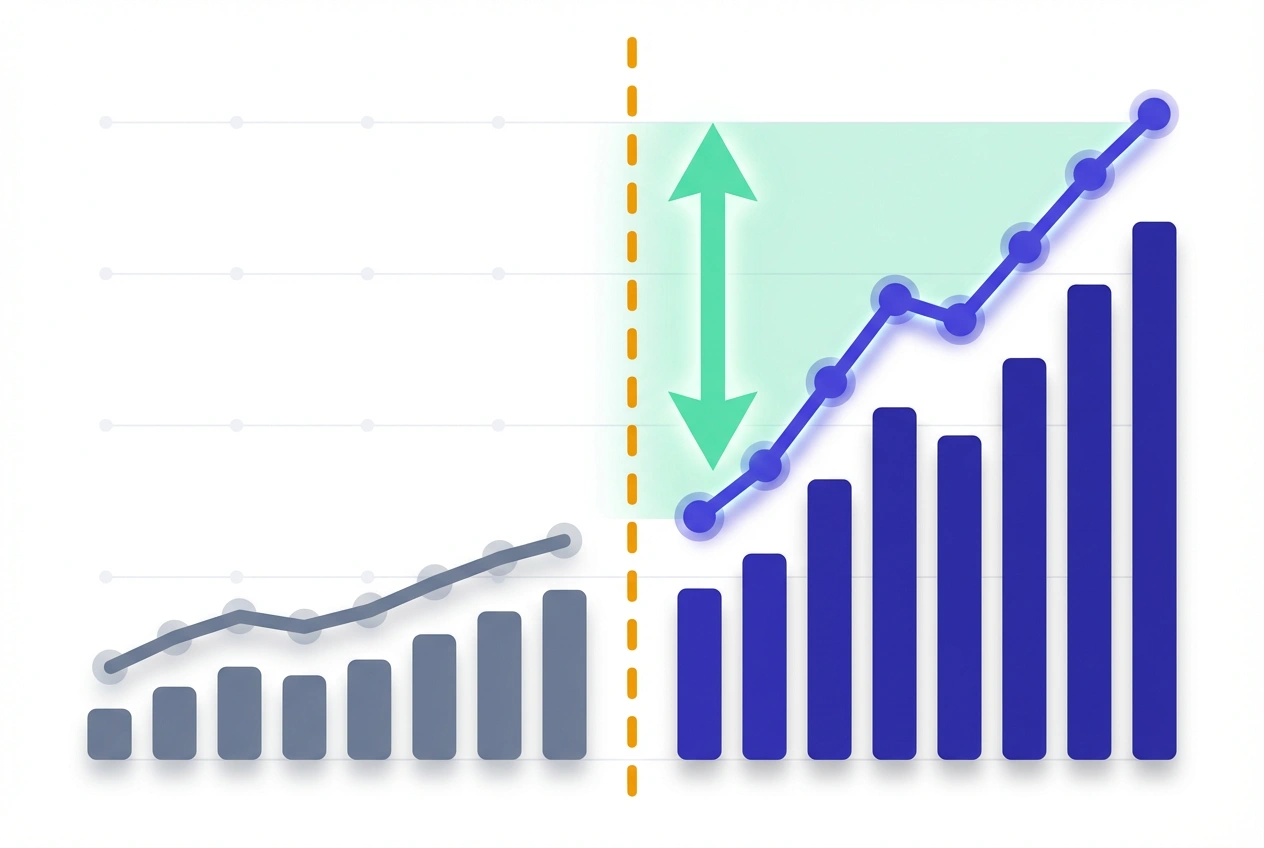
Lift Testing is a controlled experiment that quantifies the incremental effect of a marketing campaign by measuring the difference in conversion rates between a randomly assigned exposed group and a holdout control group that received no campaign exposure.
The core output is incremental lift — the percentage of conversions that exist solely because of the campaign, not because of organic demand, brand recognition, or coincidental timing.
This distinguishes lift testing from traditional attribution: where attribution asks “which touchpoints were present before a conversion?”, lift testing asks “how many conversions would not have happened without this campaign?”
Test LeadSources today. Enter your email below and receive a lead source report showing all the lead source data we track—exactly what you’d see for every lead tracked in your LeadSources account.
How Lift Testing Works
At its core, lift testing is a randomized controlled experiment applied to marketing audiences.
The campaign’s target audience is split into two cells before the campaign launches:
- Treatment group — the majority of the audience (typically 80–90%) who are exposed to the campaign as normal.
- Holdout group — a randomly selected subset (typically 10–20%) who are deliberately withheld from the campaign for the study’s duration.
Conversion rates are tracked independently for both groups across the same measurement window. The lift calculation is then applied to produce actionable metrics.
Three primary formulas govern lift test analysis:
- Absolute Lift = CVRexposed − CVRholdout
- Relative Lift (%) = [(CVRexposed − CVRholdout) / CVRholdout] × 100
- Incremental Conversions = (CVRexposed − CVRholdout) × Total Exposed Users
Example: A B2B SaaS paid social campaign reaches 25,000 users. CVRexposed = 4.2%; CVRholdout = 2.8%.
- Absolute Lift = 1.4 percentage points
- Relative Lift = (1.4 / 2.8) × 100 = 50%
- Incremental Conversions = 0.014 × 25,000 = 350 leads
- At $35,000 spend: Incremental CPL = $100
The holdout group’s CVR represents the organic baseline — the share of users who would have converted without any campaign intervention.
Why It Matters for Lead Attribution
Standard attribution models — last-touch, linear, time-decay, and even data-driven — share a fundamental flaw: they measure correlation, not causation.
A lead that clicked a retargeting ad and then converted three days later may have converted regardless. Attribution models credit the ad; lift testing would have revealed it added zero incremental value.
This creates attribution inflation — the systematic overstatement of channel performance that Analytic Partners estimates inflates reported ROAS by 30–50% on average across B2B programs.
For CMOs making multi-million-dollar channel allocation decisions, this gap is consequential. Shifting 20% of budget from a zero-lift channel to a high-lift channel can reduce blended CAC by 15–30% without increasing total spend.
Lift testing also operates at the lead quality level, not just volume. Tracking MQL-to-SQL conversion rates and LTV for exposed vs. holdout cohorts through the CRM reveals whether a channel drives pipeline — or just form fills.
Holdout Design Variants
Not all lift tests use the same holdout architecture. The design choice materially affects result accuracy, especially in B2B contexts with long sales cycles.
| Holdout Type | Mechanism | Best For | Key Limitation |
|---|---|---|---|
| Standard Holdout | Audience segment excluded from campaign targeting | Broad channel-level tests | Auction dynamics distorted; CPMs may shift |
| Ghost Ads (Bid-to-Lose) | Platform bids in auction but intentionally loses; no ad shown | Paid social incrementality | Platform-limited (Meta, select DSPs) |
| Geo-Based Holdout | Geographic markets assigned to treatment vs. control | Broad awareness, OOH, TV | Spillover between adjacent markets |
| Time-Based (Dark Period) | Campaign paused for a defined period; pre/post comparison | Always-on channels (SEO, email) | External confounders (seasonality, news) |
Ghost ads preserve auction dynamics and eliminate the CPM distortion that plagues standard holdouts, making them the preferred design for paid social lift testing at scale.
Sample Size and Statistical Validity
A lift test that lacks statistical power produces unreliable results — and unreliable results are worse than no results, because they create false confidence in allocation decisions.
The minimum sample size per cell is calculated as:
n = (Z² × p(1 − p)) / MDE²Where Z = z-score for desired confidence level (1.96 for 95%), p = baseline CVR, and MDE = minimum detectable effect (expressed as an absolute value).
Practical benchmarks for B2B lead generation:
| Baseline CVR | Relative MDE Target | Min. Users / Cell (95% CI, 80% Power) |
|---|---|---|
| 1.0% | 20% | ~38,400 |
| 2.0% | 20% | ~19,200 |
| 3.0% | 20% | ~12,700 |
| 5.0% | 20% | ~7,500 |
Low-CVR B2B programs face a structural challenge: the sample sizes required for statistically valid lift tests often exceed the reach of a single campaign cycle. Geo-based or longer-window tests address this constraint.
Implementing a Lift Test: 5-Step Framework
- Pre-define success metrics and thresholds — specify the primary KPI (form submissions, MQLs, pipeline value), the minimum acceptable lift, and the confidence level required before the campaign launches. Post-hoc metric selection invalidates results.
- Calculate required sample size — use the formula above. If campaign reach is insufficient, extend the test window, broaden targeting, or switch to a geo-based design.
- Randomize audience assignment — use platform-native tools (Meta Experiments, Google Brand Lift) or a third-party measurement vendor for holdout cell construction. Never use manual segmentation; it introduces selection bias.
- Run the test to its pre-determined endpoint — peeking at interim results and stopping early when results look favorable inflates Type I error rates by up to 26% (Kohavi et al., Microsoft Research). Set a fixed end date before launch.
- Analyze results at multiple funnel stages — capture CVR lift at the top of funnel, then track exposed vs. holdout cohorts through MQL, SQL, and closed-won stages in the CRM. A channel with 40% CVR lift but identical MQL-to-SQL rates adds volume without adding pipeline quality.
Industry Benchmarks
Lift benchmarks vary significantly by channel, funnel position, and audience maturity. These directional ranges are drawn from Analytic Partners, Nielsen, and Meta internal studies.
| Channel | Typical Relative Lift Range | Signal Interpretation |
|---|---|---|
| Paid Search — Brand Keywords | 40–65% | Strong incremental impact |
| Paid Social — B2B SaaS | 15–35% | Healthy channel contribution |
| Display / Programmatic | 5–15% | Monitor for diminishing returns |
| Video — Awareness Stage | 8–20% | Upper-funnel impact only |
| Retargeting (High-Frequency) | −5% to +10% | Potential negative lift at saturation |
Retargeting frequently shows near-zero or negative lift at high frequency — users who would have converted organically are simply being shown ads that claim attribution credit without driving incremental action.
Common Mistakes in Lift Test Design
Execution errors in lift testing are more dangerous than not testing at all, because they generate statistically dressed misinformation.
- Early stopping (peeking) — monitoring live results and ending the test when significance appears artificially inflates false-positive rates. Commit to the pre-determined end date.
- Holdout contamination — holdout users inadvertently reached through retargeting, lookalike audiences, or organic posts compress measured lift toward zero. Audit holdout exposure post-test.
- Ignoring novelty effects — new channels, creatives, or audience segments generate inflated short-term lift that typically regresses within 4–6 weeks. Run studies for at least one full conversion cycle.
- Single-funnel measurement — measuring lift only at CVR and ignoring downstream MQL and SQL stages misses the most actionable signal: whether the channel is driving pipeline or just activity.
- Conflating statistical significance with business significance — a 5% relative lift that is statistically significant at p < 0.05 may still represent an Incremental CPL that exceeds target CAC. Statistical validity does not equal commercial viability.
Lift Testing Best Practices
A mature lift measurement program operates with governance, not ad hoc experimentation.
- Pre-register all test parameters — document KPI, MDE, confidence threshold, holdout size, and study duration in a shared test plan before any campaign goes live.
- Run channel-isolated tests — cross-channel lift tests obscure which specific channel is generating or destroying incremental value. Test one channel variable at a time.
- Integrate holdout tags into CRM — assign exposed/holdout status at the contact level so pipeline and revenue impact can be tracked through full sales cycles, not just form submissions.
- Repeat quarterly — audience behavior, creative fatigue, competitive dynamics, and seasonality all shift lift baselines. Annual or one-off tests produce stale signals that drive poor allocation.
- Pair with MMM — Marketing Mix Modeling provides strategic budget guidance across channels; lift testing validates the channel-level causal assumptions that MMM relies on. Used together, they eliminate both strategic and tactical blind spots.
- Apply Bayesian methods for always-on programs — frequentist approaches require fixed test windows. Bayesian adaptive testing frameworks allow continuous measurement without inflating false-positive rates, making them the preferred methodology for always-on lead generation programs.
Frequently Asked Questions
How does lift testing differ from A/B testing?
A/B testing compares two variations of a campaign asset — creative, copy, landing page — within an exposed audience to identify which version performs better. Lift testing compares an exposed group against a non-exposed holdout to determine whether running the campaign at all drives incremental conversions. A/B testing optimizes execution within a channel; lift testing validates whether the channel deserves investment.
Can lift testing be applied to lead generation programs with low conversion volumes?
Yes, but low-CVR programs require either larger audience pools, extended test windows, or higher MDEs to achieve statistical validity. For programs generating fewer than 500 conversions per month, geo-based holdout designs or longer-window tests (8–12 weeks) are more practical than user-level randomization. Alternatively, setting the MDE at 30–40% relative lift reduces required sample size at the cost of detecting smaller effects.
What is the difference between lift testing and incrementality testing?
The two terms are often used interchangeably. When distinguished, incrementality testing typically refers to the broader framework — the philosophy of measuring causal impact across all channels — while lift testing refers specifically to the experimental methodology used to measure that impact. All lift tests are incrementality tests; not all incrementality programs use controlled lift experiments (some use econometric modeling or synthetic control methods instead).
How do you account for holdout contamination in lift test results?
Post-test, audit holdout exposure by cross-referencing holdout user IDs against ad exposure logs, retargeting pixel fires, and organic touchpoint records. If contamination rate exceeds 5–10% of the holdout cell, the measured lift is likely understated. For future tests, use platform-native ghost ad infrastructure or stricter audience exclusion lists to protect holdout integrity at the campaign setup stage.
Which platforms natively support lift testing?
Meta offers Conversion Lift through its Experiments tool, including ghost ad holdout support. Google provides Conversion Lift and Brand Lift studies within Google Ads. LinkedIn’s Campaign Manager supports audience segment comparisons with limited native holdout controls. For cross-platform or CRM-integrated lift measurement, third-party vendors including Measured, Rockerbox, and Nielsen provide independent holdout infrastructure and unified reporting.
How should lift test results inform channel budget allocation?
Use Incremental ROAS — not platform-reported ROAS — as the primary budget allocation signal. Channels with Incremental ROAS above the blended hurdle rate warrant increased investment; channels below it should be reduced or restructured before scaling. Rank channels by Incremental CPL relative to target CAC, then reallocate toward the highest-lift, lowest-incremental-CPL channels. This systematic reallocation typically reduces blended CAC by 15–30% in programs that have not previously run lift measurement.
How does lift testing interact with multi-touch attribution (MTA) models?
MTA models distribute credit across touchpoints but cannot validate whether those touchpoints caused conversions. Lift testing provides the causal ground truth that MTA cannot generate. The practical application: run lift tests by channel, then calibrate MTA model credit weights to align with measured incremental contribution. When MTA-reported ROAS diverges significantly from lift-measured Incremental ROAS, the MTA model is mis-attributing conversions — typically over-crediting high-frequency retargeting and under-crediting upper-funnel channels.
