
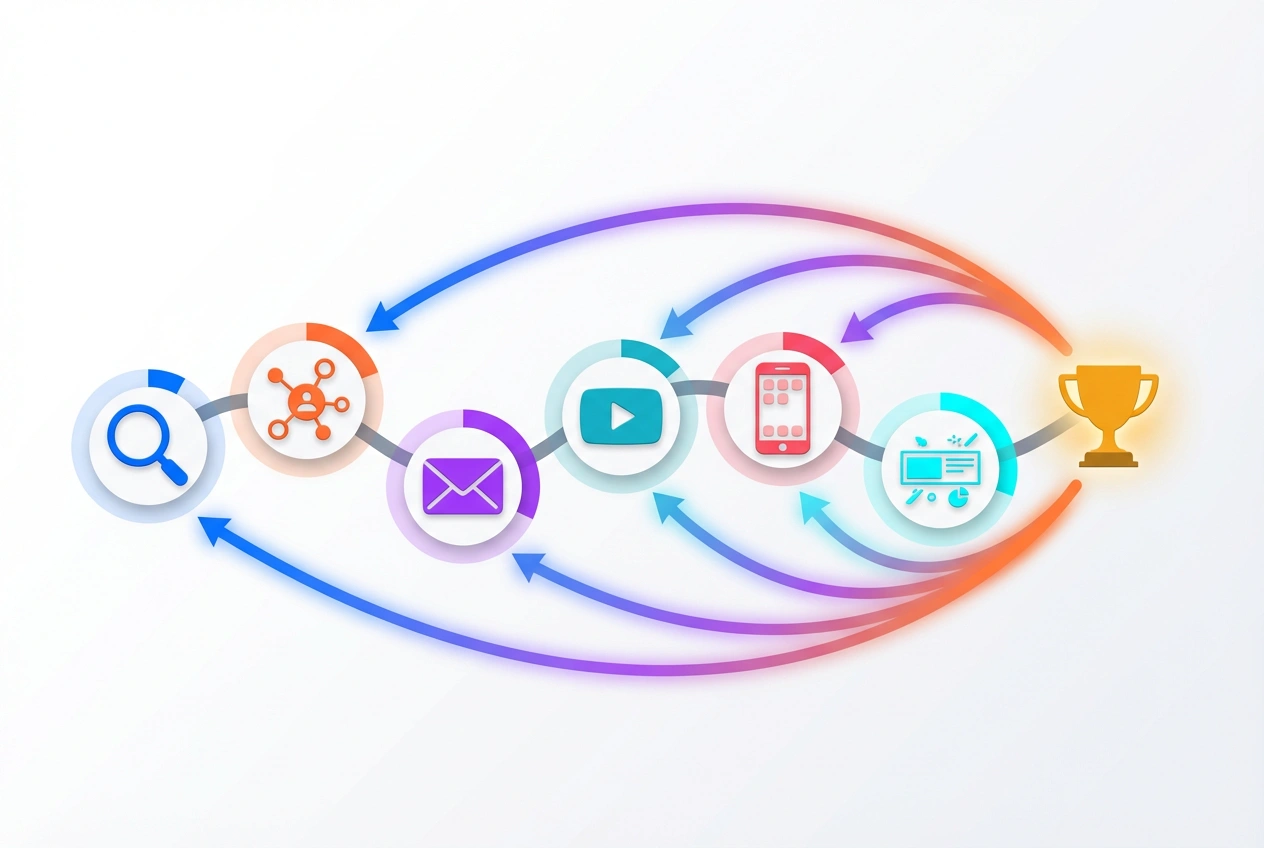

Multi-touch attribution is an advanced marketing measurement approach that assigns conversion credit across multiple customer touchpoints rather than crediting a single interaction. This methodology recognizes that modern buyers engage with brands through numerous channels and interactions before converting, providing marketers with a complete picture of which touchpoints contribute to revenue generation.
Unlike single-touch attribution models that credit only the first or last interaction, multi-touch attribution distributes value across the entire customer journey. Marketing teams gain visibility into how different channels work together to drive conversions, enabling more accurate budget allocation and strategic optimization across the complete funnel.
What Is Multi-Touch Attribution?
Multi-touch attribution is a measurement framework that recognizes and credits multiple marketing touchpoints throughout the customer journey. Rather than assigning 100% of conversion value to a single interaction, this approach distributes credit among all contributing touchpoints based on a predetermined weighting model.
The methodology acknowledges a fundamental reality of modern marketing: customers rarely convert after a single interaction. A typical B2B buyer might discover your brand through organic search, return via a social media post, attend a webinar, receive nurture emails, and finally convert through a retargeting ad. Multi-touch attribution ensures each of these interactions receives appropriate credit for influencing the eventual conversion.
This comprehensive view transforms marketing analysis from simplistic attribution to sophisticated journey mapping. Teams can identify which channel combinations drive the highest conversion rates, understand how touchpoints influence each other, and optimize the entire funnel rather than individual channels in isolation.
Different multi-touch attribution models distribute credit using various methodologies. Linear attribution spreads credit equally across all touchpoints, while time-decay models give more weight to recent interactions. Position-based models emphasize specific touchpoints like the first and last interaction, and algorithmic models use machine learning to determine optimal credit distribution based on actual conversion patterns.
LeadSources.io automatically tracks every touchpoint across the complete customer journey, capturing all interactions from first visit to final conversion so you can implement sophisticated multi-touch attribution models without complex tracking infrastructure.
Test LeadSources today. Enter your email below and receive a lead source report showing all the lead source data we track—exactly what you’d see for every lead tracked in your LeadSources account.
Why Multi-Touch Attribution Matters for Marketing Optimization
Marketing teams operating without multi-touch attribution make decisions based on incomplete data, often over-investing in channels that appear effective under single-touch models while undervaluing crucial mid-funnel touchpoints. Multi-touch attribution solves this problem by revealing the true contribution of every marketing activity.
Eliminate Attribution Blind Spots
Single-touch attribution creates systematic blind spots that distort marketing performance analysis. Last-touch models make nurture campaigns appear worthless because they rarely serve as the final interaction, while first-touch models suggest closing tactics deliver no value. Multi-touch attribution eliminates these blind spots by crediting all contributing interactions, enabling accurate evaluation of every marketing investment.
Optimize Multi-Channel Strategy
Modern marketing operates across dozens of channels, each playing distinct roles in the customer journey. Content marketing builds awareness, social proof influences consideration, and remarketing drives conversions. Multi-touch attribution reveals how these channels work together, showing which combinations produce the best results and where to allocate incremental budget for maximum impact.
Justify Mid-Funnel Investment
Mid-funnel activities like email nurture campaigns, webinars, and educational content often struggle for budget because their impact is invisible in single-touch models. Multi-touch attribution quantifies their contribution by showing how prospects who engage with mid-funnel content convert at higher rates and generate more revenue, providing concrete justification for continued investment.
Improve Forecasting Accuracy
Understanding which touchpoint combinations lead to conversions enables more accurate pipeline forecasting. Marketing teams can predict conversion likelihood based on prospect engagement patterns, identifying high-intent leads who have completed specific journey sequences and flagging at-risk prospects who need additional nurturing before they’re ready to convert.
How Multi-Touch Attribution Works
Implementing multi-touch attribution requires systematic tracking infrastructure, a chosen attribution model, and analytical processes to transform raw touchpoint data into actionable insights. The methodology involves several interconnected components working together to attribute conversions accurately.
Step 1: Capture All Customer Touchpoints
Effective multi-touch attribution begins with comprehensive touchpoint tracking across every channel where prospects interact with your brand. This includes paid advertising clicks, organic search visits, social media engagement, email opens and clicks, webinar attendance, content downloads, website page views, and direct visits. Each interaction must be timestamped and associated with an individual prospect.
Modern attribution platforms use cookies, tracking pixels, UTM parameters, and cross-device identification to maintain complete journey records. When a prospect visits your website from a social ad, the system captures this touchpoint. When they return three days later through organic search, this second touchpoint is recorded and linked to the same individual, building a comprehensive journey map.
Step 2: Connect Touchpoints to Individual Journeys
Raw touchpoint data becomes meaningful only when connected into complete customer journeys. Attribution systems must identify when multiple touchpoints belong to the same prospect, creating unified journey records that show the complete path to conversion.
This identity resolution presents significant technical challenges. Prospects clear cookies, switch devices, and interact across channels that don’t share identifiers. Sophisticated attribution platforms address these challenges through probabilistic matching, cross-device graphs, and deterministic linking when prospects provide identifying information like email addresses.
Step 3: Apply Attribution Model
Once complete journey data exists, an attribution model distributes conversion credit across touchpoints. The chosen model fundamentally shapes how marketing performance is evaluated, making model selection a strategic decision with significant budget allocation implications.
Linear models divide credit equally among all touchpoints, treating every interaction as equally valuable. A journey with five touchpoints would assign 20% credit to each. Time-decay models give more weight to recent interactions, operating on the theory that touchpoints closer to conversion exert greater influence. Position-based models assign preset percentages to specific positions like first touch (40%), last touch (40%), and middle touches (20% divided equally).
Algorithmic or data-driven models use machine learning to analyze conversion patterns across thousands of journeys, identifying which touchpoint combinations and sequences correlate most strongly with conversion. These models automatically adjust credit distribution based on observed behavior rather than preset assumptions.
Step 4: Aggregate and Analyze Attribution Data
Individual journey attribution becomes actionable through aggregation and analysis. Marketing teams need reports showing total attributed conversions by channel, average attributed revenue per touchpoint, most common conversion paths, and channel performance at different funnel stages.
Effective analysis compares current attribution data against historical baselines, identifies emerging trends, and reveals optimization opportunities. You might discover that prospects who engage with both webinars and case studies convert at three times the rate of those who interact with only one, suggesting a strategy to drive more combined engagement.
Common Multi-Touch Attribution Models
Different attribution models suit different business models, sales cycles, and analytical objectives. Understanding each model’s assumptions and biases helps marketing teams select the approach that best aligns with their strategic priorities.
Linear Attribution
Linear attribution distributes conversion credit equally across all touchpoints in the customer journey. A prospect who interacts with five touchpoints before converting would see each touchpoint receive 20% credit. This model assumes all interactions contribute equally to conversion regardless of timing, position, or channel type.
Linear attribution works well for organizations new to multi-touch attribution because it’s conceptually simple and avoids controversial assumptions about which touchpoints matter most. However, it treats awareness touches and conversion touches identically, which may not reflect actual influence.
Time-Decay Attribution
Time-decay models assign more credit to recent touchpoints based on the assumption that interactions closer to conversion exert greater influence on the decision. Credit typically decays exponentially, with the last touchpoint receiving the most credit and the first receiving the least.
This approach suits organizations with short sales cycles where recent interactions genuinely drive conversion decisions. For long sales cycles with extended consideration periods, time-decay may undervalue crucial early-stage touchpoints that established initial awareness and interest.
Position-Based (U-Shaped) Attribution
Position-based attribution assigns preset credit percentages to specific journey positions. The most common variant is U-shaped attribution, which credits the first touch and last touch with 40% each, dividing the remaining 20% equally among middle touchpoints.
This model recognizes that initial discovery and final conversion touchpoints often play outsized roles while still crediting nurturing interactions. Organizations focusing simultaneously on acquisition and conversion optimization often find position-based models align well with their strategic priorities.
W-Shaped Attribution
W-shaped attribution extends position-based logic by emphasizing three key moments: first touch (30%), lead creation touch (30%), and last touch (30%), with the remaining 10% divided among other touchpoints. This model explicitly values the moment when anonymous visitors become known leads.
B2B organizations with clear lead generation stages benefit from W-shaped attribution because it reflects the reality that converting visitors into leads represents a critical milestone distinct from both initial discovery and final conversion.
Data-Driven (Algorithmic) Attribution
Data-driven attribution uses machine learning algorithms to analyze conversion patterns across thousands of customer journeys, determining which touchpoints statistically correlate with higher conversion rates. The algorithm assigns credit based on observed influence rather than predetermined assumptions.
This sophisticated approach requires substantial data volume to produce reliable results—typically thousands of conversions—but delivers the most accurate attribution when sufficient data exists. The model automatically adapts as customer behavior changes, continuously optimizing credit distribution based on current conversion patterns.
Benefits of Multi-Touch Attribution
Organizations implementing multi-touch attribution gain strategic advantages that translate directly into improved marketing efficiency and revenue growth.
Accurate Channel Performance Measurement
Multi-touch attribution reveals true channel contribution rather than the distorted picture single-touch models provide. Email marketing might appear ineffective in a last-touch model because it rarely closes deals, but multi-touch attribution shows it influences 60% of conversions by nurturing prospects through the consideration stage. This accurate measurement prevents underinvestment in valuable channels.
Optimized Budget Allocation
Understanding which channels and touchpoint combinations drive the best results enables data-driven budget decisions. Instead of allocating budget based on last-touch conversions or gut feeling, teams can invest proportionally to actual attributed value, shifting spend from underperforming channels to high-impact combinations.
Enhanced Customer Journey Understanding
Multi-touch attribution data reveals common conversion paths, typical journey lengths, and effective touchpoint sequences. This journey intelligence informs content strategy, campaign timing, and channel coordination. You might discover that prospects who attend webinars convert faster, suggesting a strategy to drive more webinar attendance early in the journey.
Improved Marketing and Sales Alignment
Attribution data helps resolve marketing-sales tension by objectively quantifying marketing’s contribution to closed revenue. Sales teams see which marketing touchpoints influenced their opportunities, while marketing teams demonstrate ROI beyond just lead generation, including the nurturing and acceleration that happens between first touch and sale.
Challenges in Multi-Touch Attribution
Despite significant benefits, multi-touch attribution presents implementation challenges that organizations must address to achieve accurate measurement.
Cross-Device Tracking Complexity
Modern buyers interact across multiple devices—smartphones, tablets, desktops—making it difficult to connect touchpoints into unified journeys. Without cross-device tracking, attribution systems may treat a single person’s multi-device journey as several different prospects, fragmenting data and producing inaccurate attribution.
Privacy Regulations and Cookie Deprecation
Privacy regulations like GDPR and CCPA restrict tracking capabilities, while browser changes limit cookie lifespans and third-party cookie usage. These constraints reduce attribution accuracy by creating tracking gaps where touchpoints go unrecorded. Organizations must balance attribution needs with privacy compliance, often accepting some level of reduced visibility.
Offline Touchpoint Integration
Many customer journeys include offline touchpoints like trade show visits, phone calls, or direct mail that traditional digital attribution systems cannot automatically track. Integrating these offline interactions requires manual processes or specialized tracking mechanisms, adding complexity to attribution implementation.
Model Selection Uncertainty
Choosing the right attribution model involves tradeoffs without clear right answers. Linear models treat all touchpoints equally despite different influence levels, while position-based models make assumptions about which touchpoints matter most. Data-driven models require substantial data volumes many organizations lack. This uncertainty can lead to analysis paralysis or frequent model changes that make historical comparisons difficult.
Long Sales Cycles
B2B companies with 6-12 month sales cycles face extended attribution windows where dozens of touchpoints may precede conversion. Tracking and storing this extended journey data requires robust infrastructure, and long windows increase the likelihood of cookie expiration, device switching, and other tracking interruptions that fragment journey data.
Best Practices for Multi-Touch Attribution
Successful multi-touch attribution implementation requires careful planning, consistent execution, and ongoing optimization.
Start with Data Infrastructure
Multi-touch attribution demands clean, comprehensive tracking across all marketing channels. Before selecting an attribution model, ensure you can reliably capture touchpoints from paid advertising, organic channels, email, social media, and offline activities. Implement UTM parameters consistently, deploy tracking pixels across platforms, and establish processes to capture offline interactions.
Choose a Model Aligned with Business Reality
Select an attribution model that reflects your actual customer journey characteristics and strategic priorities. Short sales cycles with heavy conversion optimization focus might favor time-decay models, while long B2B cycles with distinct lead generation milestones might benefit from W-shaped attribution. Avoid selecting models based solely on what makes current activities look best—choose based on what produces the most actionable insights.
Compare Multiple Models
No single attribution model tells the complete story. Sophisticated marketers analyze performance through multiple models simultaneously, comparing how different approaches change channel rankings and credit distribution. This multi-model analysis reveals which insights are consistent across methodologies (high confidence) and which change dramatically based on model selection (lower confidence).
Establish Attribution Windows Carefully
Set attribution windows that capture most conversions without extending so long that connections become meaningless. Analyze your actual time-to-conversion data to identify the point where 85-90% of conversions occur, then set your attribution window slightly beyond this threshold. Review and adjust windows periodically as sales cycles evolve.
Integrate Attribution into Decision Making
Attribution data delivers value only when it actively informs decisions. Build attribution reporting into regular marketing reviews, use attributed revenue as a key performance indicator, and establish clear processes for adjusting budget allocation based on attribution insights. Teams that review attribution monthly but make quarterly budget decisions are missing optimization opportunities.
Educate Stakeholders on Attribution Limitations
Multi-touch attribution provides valuable insights but isn’t perfect. Help stakeholders understand that all models involve assumptions, tracking gaps exist, and attribution shows correlation more than causation. This context prevents over-confidence in attribution data and encourages balanced decision-making that considers multiple data sources.
Key Metrics to Track
Several metrics help organizations evaluate attribution performance and identify optimization opportunities.
Attributed Conversions by Channel shows how many conversions each marketing channel contributed to across all customer journeys, revealing which channels play the most significant roles in driving revenue.
Attributed Revenue by Channel assigns dollar values to conversions, showing not just volume but the actual revenue each channel influenced, which often differs significantly from conversion counts when deal sizes vary.
Average Touchpoints to Conversion measures journey complexity by calculating how many interactions prospects typically complete before converting, informing expectations about sales cycle length and required marketing investment.
Most Common Conversion Paths identifies the specific channel sequences that most frequently lead to conversion, revealing successful journey patterns worth replicating and promoting.
Channel Assist Rate shows how often each channel appears in converting journeys even when it doesn’t receive primary credit, highlighting the supporting role channels play in conversion success.
Attribution Model Comparison tracks how different attribution models credit the same conversions, revealing which channels benefit from specific model assumptions and which deliver consistent value across all models.
Frequently Asked Questions
What’s the difference between multi-touch attribution and single-touch attribution?
Single-touch attribution assigns 100% of conversion credit to one touchpoint—either the first interaction (first-touch) or the last interaction (last-touch) before conversion. Multi-touch attribution distributes credit across multiple touchpoints throughout the customer journey. Single-touch models are simpler to implement but create blind spots by ignoring most of the customer journey, often undervaluing crucial mid-funnel touchpoints. Multi-touch attribution provides a complete view of how different channels work together to drive conversions, though it requires more sophisticated tracking infrastructure and involves choosing among various credit distribution models.
Which multi-touch attribution model should I use?
Model selection depends on your sales cycle characteristics, business priorities, and data volume. Linear attribution works well when starting out because it’s simple and doesn’t favor specific touchpoints with controversial assumptions. Position-based (U-shaped or W-shaped) models suit organizations focusing on both acquisition and conversion. Time-decay models work for short sales cycles where recent touchpoints genuinely drive decisions. Data-driven models deliver the most accuracy but require thousands of conversions to produce reliable results. Many sophisticated marketers analyze performance through multiple models simultaneously rather than relying on a single approach, comparing how different methodologies change channel rankings to identify consistent insights.
How much data do I need to implement multi-touch attribution?
Basic multi-touch attribution using rule-based models like linear or position-based attribution requires only the ability to track complete customer journeys—you can implement these models with relatively low conversion volumes. However, data-driven or algorithmic attribution models require substantially more data, typically 1,000+ conversions minimum to produce statistically reliable results, with 5,000+ conversions ideal for sophisticated machine learning approaches. Start with simpler rule-based models if you have limited conversion volume, then graduate to algorithmic models as your data accumulates. Even with low volumes, multi-touch attribution provides more complete insights than single-touch alternatives.
Can multi-touch attribution track offline marketing touchpoints?
Multi-touch attribution can incorporate offline touchpoints but requires deliberate implementation strategies since these interactions don’t automatically generate digital tracking data. Effective approaches include using unique phone numbers for different offline campaigns to track call sources, creating campaign-specific landing pages promoted through offline channels, implementing QR codes in print materials that link to tracked URLs, training sales teams to ask and record “how did you hear about us” during initial conversations, and using event registration systems that integrate with your attribution platform. While offline tracking adds complexity, including these touchpoints produces more accurate attribution for organizations with significant offline marketing investment.
How does multi-touch attribution handle cross-device customer journeys?
Cross-device tracking presents significant challenges because prospects interact across smartphones, tablets, and desktops without automatic connection between these sessions. Advanced attribution platforms address this through deterministic matching (connecting devices when users log in or provide identifying information), probabilistic matching (using statistical analysis of behavior patterns, timing, and location to identify likely same-user sessions), and cross-device identity graphs (industry databases that map devices to individuals). Without cross-device tracking, attribution systems may fragment single journeys into multiple disconnected paths, producing inaccurate results. When evaluating attribution platforms, verify their cross-device tracking capabilities, as this functionality significantly impacts attribution accuracy in modern multi-device customer journeys.
How often should I review and adjust my attribution model?
Attribution models should remain stable long enough to establish meaningful baselines and trends, typically reviewing quarterly rather than monthly. Frequent model changes make historical comparisons difficult and can appear like manipulating data to favor current activities. Review your attribution model when significant business changes occur—entering new markets, launching major products, or fundamentally changing go-to-market strategy—or when analysis reveals your current model produces insights that contradict other performance indicators. Instead of frequently changing models, consider analyzing performance through multiple models simultaneously to understand how different approaches affect channel rankings, giving you fuller context without losing historical continuity.
What’s the typical ROI improvement from implementing multi-touch attribution?
Organizations implementing multi-touch attribution typically see 15-30% improvement in marketing efficiency over 6-12 months as they optimize budget allocation based on complete journey insights rather than single-touch assumptions. The improvement comes primarily from shifting investment away from overvalued channels (those that look effective in last-touch models but contribute less to overall journeys) toward undervalued channels (those that play crucial supporting roles invisible in single-touch attribution). Companies with complex, multi-channel marketing mixes see larger improvements than those with simpler channel strategies. The exact ROI impact depends on how misaligned your budget was before implementing attribution, how quickly you act on attribution insights, and the sophistication of your attribution implementation.
