
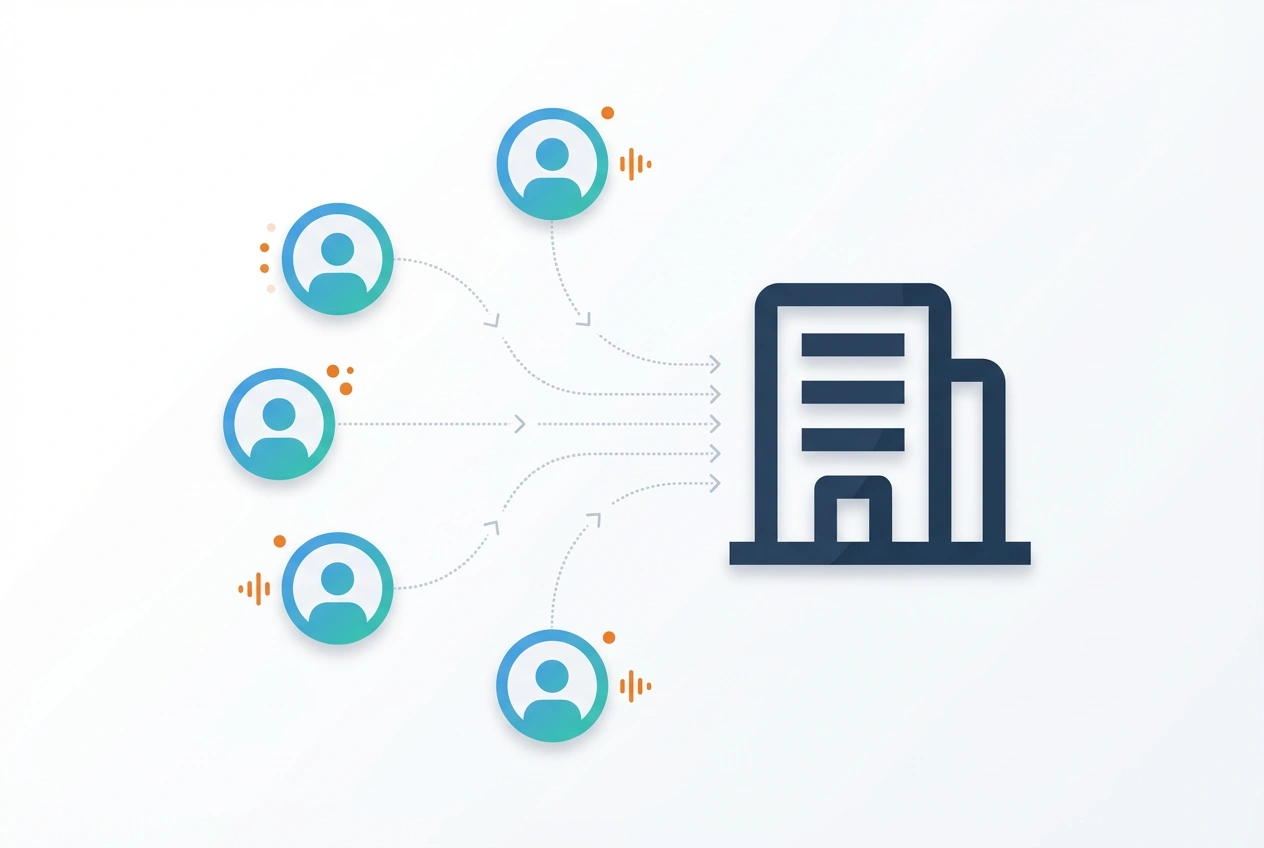

TL;DR:
- Account-level tracking attributes marketing touchpoints and revenue to company accounts rather than individual contacts, solving the B2B buying committee attribution challenge where 6-10 stakeholders influence purchase decisions.
- This methodology rolls up all contact interactions within an organization into a unified account view, enabling accurate multi-touch attribution across complex enterprise sales cycles and proper ABM ROI measurement.
- Unlike contact-level tracking that fragments attribution across individual leads, account-based attribution reveals true campaign influence on target accounts and eliminates revenue attribution errors caused by multiple contacts from the same company.
What Is Account-Level Tracking?
Account-level tracking is an attribution methodology that aggregates all marketing interactions and conversion events at the company account level rather than the individual contact level.
In B2B environments, purchase decisions involve buying committees averaging 6.8 stakeholders according to Gartner research. When you track at the contact level, you fragment the customer journey across multiple individual records.
Account-level tracking solves this by treating the account as the primary attribution unit.
Every touchpoint—whether from the VP of Marketing, IT Director, or CFO—rolls up into a single account record. This unified view reveals which campaigns influenced the entire buying committee, not just isolated contacts.
The methodology maps directly to how B2B companies structure their CRM. Salesforce, HubSpot, and other enterprise platforms organize data hierarchically: accounts contain contacts, contacts don’t exist in isolation.
Your attribution model should mirror this reality.
Test LeadSources today. Enter your email below and receive a lead source report showing all the lead source data we track—exactly what you’d see for every lead tracked in your LeadSources account.
The Account-Based Attribution Framework
Account-based attribution operates on a hierarchical data model that mirrors enterprise organizational structures.
At the foundation sits the account record—the company entity. This becomes your attribution anchor point.
All contacts associated with that account inherit the account’s properties while maintaining their individual interaction histories. When Contact A from Acme Corp downloads a whitepaper and Contact B attends a webinar, both touchpoints attribute to Acme Corp’s account journey.
The framework requires three core components:
Account identification and matching. Your tracking system must recognize when multiple contacts belong to the same organization. This uses domain matching, company name normalization, and parent-subsidiary relationship mapping.
Touchpoint aggregation logic. All digital interactions, form submissions, ad clicks, and content engagement across contacts roll up to the account level. The system maintains granular contact-level data while creating the aggregated account view.
Multi-touch attribution models applied at account scale. Whether you use first-touch, last-touch, linear, time-decay, or algorithmic attribution, the model distributes credit across all touchpoints that influenced the account’s progression through the funnel.
This framework enables account scoring that reflects collective engagement rather than individual contact behavior. An account with moderate engagement across eight buying committee members signals stronger intent than an account with one highly engaged contact.
Why B2B Attribution Requires Account Focus
Contact-level attribution systematically misrepresents B2B marketing performance because it ignores buying committee dynamics.
Consider this scenario: Your demand gen campaign generates five MQLs from different contacts at Enterprise Company X. Contact-level tracking shows five separate lead sources, fragmenting attribution across multiple channels and campaigns.
The reality? All five contacts were influenced by your integrated campaign. The CFO saw your LinkedIn ads. The VP of Marketing downloaded your ROI calculator. The Director of Operations attended your webinar.
Without account-level visibility, you can’t measure true campaign influence.
The financial implications are significant. According to Forrester, B2B companies that implement account-based strategies see 208% increases in marketing-influenced revenue. But you can’t optimize what you can’t measure accurately.
Account-level tracking solves three critical attribution problems:
Revenue attribution accuracy. When a $500K deal closes, which marketing efforts deserve credit? Contact-level tracking might attribute it to the last contact who submitted a demo request. Account-level tracking reveals the 18-month journey across seven buying committee members and 43 touchpoints that actually drove the deal.
ABM ROI measurement. You’re running targeted campaigns against 200 named accounts in your TAM. Contact-level metrics show lead volume. Account-level metrics show account penetration, buying committee coverage, and pipeline influence—the metrics that actually matter for ABM.
Channel optimization decisions. That expensive sponsorship generated only three contact-level conversions. But account-level analysis reveals those three contacts came from your top 10 target accounts, each with ACV potential exceeding $1M. Completely different optimization decision.
The Mechanics of Account Attribution
Account-level tracking operates through a four-stage data pipeline that transforms fragmented contact interactions into unified account intelligence.
Stage 1: Identity resolution. The system captures anonymous visitor data and known contact information, then matches both to company accounts using IP intelligence, email domain parsing, form data, and CRM enrichment services.
When someone from acme.com visits your site, the tracking system identifies the account before they even fill out a form.
Stage 2: Touchpoint capture and tagging. Every marketing interaction gets captured with full UTM parameters, channel attribution, campaign identifiers, and content engagement data. Each touchpoint links to both the individual contact record and the parent account record.
This dual-layer tracking maintains granularity while enabling aggregation.
Stage 3: Account-level aggregation. The attribution engine rolls up all contact-level touchpoints to the account, applying deduplication logic to prevent double-counting. If three contacts from the same account click the same LinkedIn ad, it counts as one account-level touchpoint with multiple stakeholder engagements.
Stage 4: Attribution model application. Your chosen attribution model—whether rules-based or algorithmic—distributes credit across the account’s touchpoint sequence. A U-shaped model might give 40% credit to first touch (how the account entered your ecosystem), 40% to opportunity creation touch, and 20% distributed across the journey.
The system continuously updates as new touchpoints occur. An account’s attribution story evolves as more buying committee members engage, providing real-time visibility into account progression and campaign influence.
Account-Level vs Contact-Level Tracking
The fundamental difference lies in the attribution unit and how it maps to B2B buying reality.
Contact-level tracking treats each individual as an independent entity. Every lead gets its own source attribution. Every conversion event ties to a single contact record. This works for B2C and transactional B2B, where individuals make purchase decisions independently.
It fails in enterprise B2B where committees decide collectively.
Account-level tracking recognizes that companies buy, not just people. It aggregates all stakeholder interactions into a unified account journey. Revenue attributes to accounts. Pipeline reports by account. Campaign influence measures account penetration.
The tracking approaches also differ in data structure:
| Dimension | Contact-Level Tracking | Account-Level Tracking |
|---|---|---|
| Attribution Unit | Individual contact/lead | Company account |
| Journey Visibility | Single contact’s touchpoints | All buying committee touchpoints |
| Revenue Attribution | Last/first contact before close | All influences across account journey |
| Campaign Measurement | Leads generated | Target accounts influenced |
| Best For | B2C, SMB, single-decision-maker sales | Enterprise B2B, ABM, committee-based buying |
Most sophisticated marketing organizations use both approaches simultaneously. Contact-level data feeds lead scoring and personalization. Account-level data drives attribution analysis and strategic decision-making.
The key is ensuring your tech stack can aggregate contact data into account views without losing individual-level granularity.
Implementation Strategy
Deploying account-based attribution requires coordinating your tracking infrastructure, CRM architecture, and data governance policies.
Configure Account Matching Rules
Start with your CRM account structure. Define how contacts map to accounts using email domain matching as your primary identifier.
Build a domain-to-account mapping table that handles edge cases: subsidiaries, acquisitions, multiple brands under one parent company, and domains that host multiple businesses (gmail.com, consultant emails, etc.).
For contacts with non-corporate emails, use form-declared company names matched against your account database with fuzzy matching algorithms to handle variations in company name format.
Implement Dual-Layer Tracking
Your attribution platform must capture data at both contact and account levels simultaneously.
Deploy tracking that creates two parallel records for every interaction: one linked to the contact identity, one rolled up to the account. This maintains granular data while enabling aggregated analysis.
Use a tracking platform like LeadSources.io that natively supports account-level attribution and automatically aggregates contact touchpoints to the account record in your CRM.
Define Account-Level Conversion Events
Reframe your conversion events from contact-based to account-based milestones.
Instead of “Contact became MQL,” track “Account reached engaged status.” Instead of “Contact requested demo,” track “Account entered sales conversation.” Your attribution model should measure account progression, not just individual contact advancement.
This requires updating your funnel definitions and stage criteria to reflect account-level thresholds.
Sync Account Attribution Data to CRM
Account-level attribution only creates value when it lives where your sales team works—in the CRM.
Configure your attribution platform to write account-level data back to custom fields on the account object: first touch campaign, primary lead source, number of buying committee members engaged, attribution touchpoint count, and attributed pipeline value.
This gives sales reps context on how marketing influenced each account before their first call.
Build Account-Based Reporting Frameworks
Restructure your marketing dashboards around account-level metrics.
Replace “Leads Generated” with “Target Accounts Engaged.” Replace “MQL Volume” with “Accounts Reaching Engagement Threshold.” Replace “Contact-to-Opportunity Rate” with “Account-to-Pipeline Rate.”
Your attribution reports should show which campaigns drove account penetration, increased buying committee coverage, and influenced pipeline at the account level.
Best Practices for Account Attribution
Segment account tracking by ICP tier. Not all accounts deserve equal attribution weight. Apply different tracking and scoring thresholds for enterprise strategic accounts versus SMB transactional accounts. Your Tier 1 accounts might require three buying committee members engaged, while Tier 3 accounts follow contact-level logic.
Track buying committee coverage as a leading indicator. The number of engaged contacts per account predicts close probability better than aggregate engagement scores. According to Forrester, deals with four or more engaged stakeholders close 37% faster. Use account-level tracking to monitor committee penetration and identify gaps.
Attribute pipeline influence, not just closed revenue. Account-level attribution should measure marketing’s impact on pipeline creation, not just closed-won deals. This reveals campaign influence earlier in the sales cycle and prevents the “sales closed it anyway” attribution debate.
Integrate account scoring with attribution data. Feed attribution insights into your account scoring model. Accounts with high engagement across multiple channels and buying committee members should score higher than accounts with concentrated contact-level engagement.
Use account-level attribution to optimize ABM targeting. Analyze which campaigns successfully penetrated target accounts in previous quarters. Double down on the channels and tactics that drove buying committee engagement at accounts matching your ICP. Cut spend on tactics that generate contact volume without account-level influence.
Align attribution windows to your sales cycle. Enterprise B2B sales cycles average 6-18 months. Your account-level attribution window must capture the full journey. Using a 30-day attribution window misses 90% of the touchpoints that influenced the deal.
Create feedback loops between marketing and sales on account attribution. Schedule monthly reviews where sales validates marketing’s attributed account influence. This qualitative feedback reveals attribution model blind spots and builds trust in the data driving budget allocation decisions.
Frequently Asked Questions
How does account-level tracking handle contacts from the same company with different entry points?
The system maintains individual contact source attribution while rolling up all touchpoints to the account record. If Contact A came from paid search and Contact B from a webinar, both sources attribute to the account’s journey.
Your attribution model then determines credit distribution across these multiple entry points based on your chosen methodology—first touch, multi-touch, or algorithmic.
What happens when you can’t match a contact to an account?
Unmatched contacts remain in contact-level tracking until account association occurs. Most attribution platforms use progressive profiling—as more data gets captured (company name from forms, domain from email, IP intelligence), the system automatically links the contact to the appropriate account and backfills historical touchpoints.
For Gmail addresses and non-corporate emails, you rely on form-declared company information matched against your account database.
Can you track account-level attribution without implementing ABM?
Yes. Account-level tracking is an attribution methodology, not an ABM tactic. Even if you run demand generation campaigns targeting broad audiences rather than named accounts, you still benefit from understanding which companies are engaging and how marketing influences account-level pipeline.
The attribution approach works independently of whether you’re running ABM campaigns or traditional funnel-based marketing.
How do you attribute revenue when multiple accounts are involved in a single deal?
In complex enterprise deals involving parent companies, subsidiaries, and partner organizations, define your attribution hierarchy in advance. Most B2B teams attribute to the account that signs the contract (the billing account).
Some organizations split attribution across all involved accounts proportionally. The key is consistency—choose one approach and apply it uniformly across all multi-account deals.
What’s the minimum tech stack required for account-level attribution?
You need three core components: a CRM with robust account architecture (Salesforce, HubSpot, or similar), a marketing attribution platform that supports account-level tracking and can aggregate contact touchpoints (LeadSources.io, Bizible, Dreamdata), and consistent UTM tagging across all marketing campaigns.
The attribution platform must integrate bidirectionally with your CRM to read account relationships and write attribution data back to account records.
How does account-level tracking affect lead routing and assignment?
Account-level tracking improves routing by providing account context before assignment. When a new contact converts, the system checks for an existing account record. If found, it routes to the rep already managing that account rather than creating a duplicate opportunity.
This prevents the common problem where different reps contact multiple people from the same buying committee, creating a disjointed prospect experience.
Should attribution credit decrease as more buying committee members engage?
No—more buying committee engagement increases attribution confidence, not dilution. If your campaign influenced seven stakeholders at an account versus just one, that campaign deserves more credit, not less.
Your attribution model should reward campaigns that drive broad account penetration. This aligns marketing incentives with sales outcomes, since deals with more engaged stakeholders close at higher rates.