
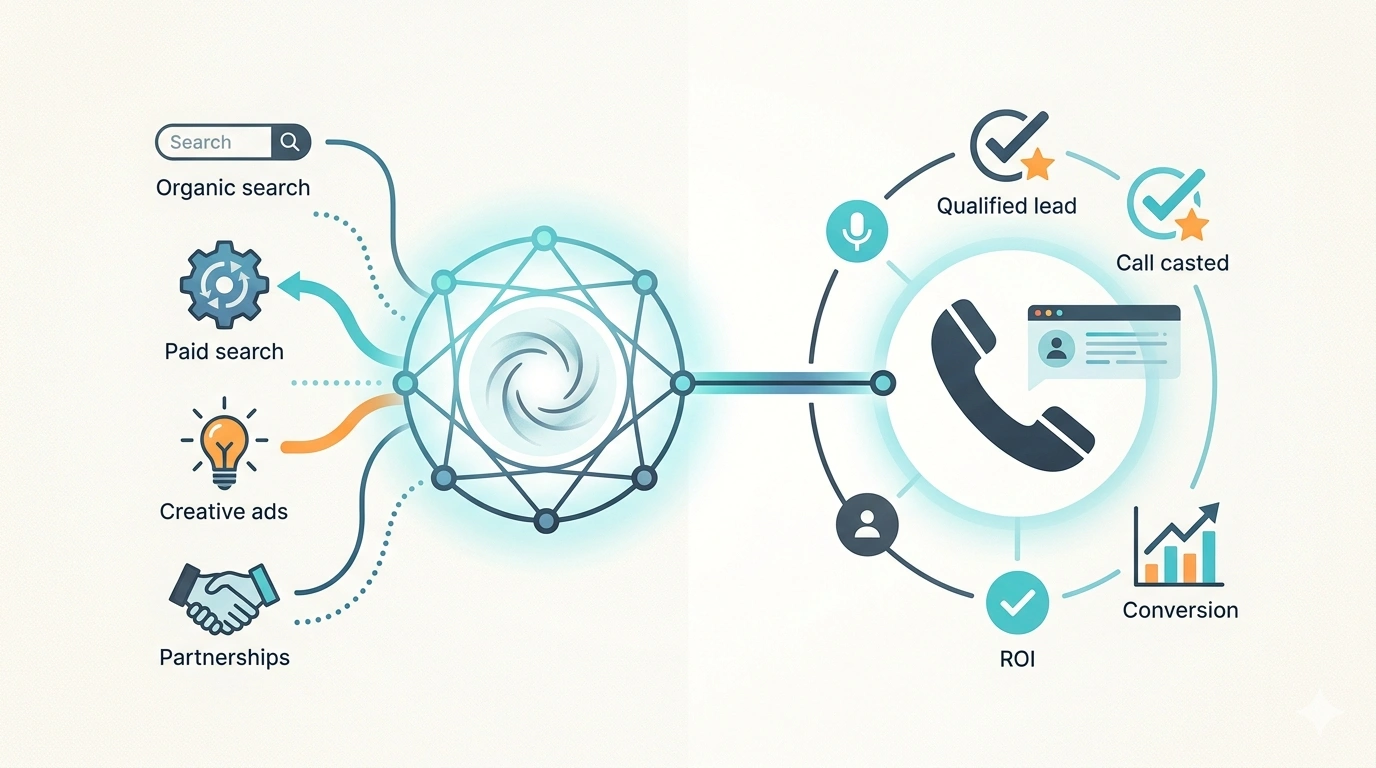

Your agency’s Google Ads campaign generated 340 clicks last month. GA4 shows 14 form submissions. Your client’s revenue is up 40%.
Where did the rest of the leads come from? The phone. And nobody tracked them.
Phone leads convert at 10 times the rate of web forms — for local service businesses, the phone call is the primary conversion channel. Yet for most agencies managing these clients, it is completely invisible.
Small and mid-sized businesses lose more than $126,000 a year to missed calls on average. Your client is losing revenue through a channel you have no data on — and when results disappoint, the agency takes the blame.
A call tracking software for agencies fixes this. In this guide, we cover the pain points, the solutions, and what to look for in a platform built for agency workflows.
Call tracking for agencies: why phone calls break your attribution reporting
Most agency reporting stacks are built around digital events. A visitor fills out a form — GA4 fires an event, the CRM creates a contact, the attribution model assigns credit. The loop is closed. The data is clean.
A visitor picks up the phone and calls — nothing. The session ends. The source disappears. The lead exists only in the client’s missed call log, if they kept one at all.
When marketing performance is not clearly tied to inbound leads, agencies struggle to justify spend, optimise campaigns, and provide actionable client reporting. For most industries this is a manageable gap. For local service businesses — where the phone call is the dominant conversion action — it is a structural problem that distorts every report the agency produces.
Here is what that looks like in practice.
The report looks worse than reality. An agency running Google Ads for a plumbing company shows their client 11 tracked conversions this month. The client knows their calendar is full. They start questioning whether the agency’s campaigns are really responsible — or whether the business just runs itself. Without call data, the agency cannot prove what drove the bookings.
Campaigns get optimised on incomplete signals. Google’s Smart Bidding algorithm learns from the conversion data you feed it. Without syncing call data back to Google Ads, the platform has no signal from phone calls and cannot optimise bidding toward the keywords and ads that actually drive revenue. An agency managing a dental practice’s paid search without call tracking is essentially teaching Google to optimise for form submissions — which may represent a fraction of actual new patient enquiries.
The client sees total calls, not attributed calls. Most clients know roughly how many calls they receive in a busy week. What they cannot see is which calls came from paid search, which came from organic, which came from a billboard, and which were existing customers calling to reschedule. Phone calls often remain a black box — clients understand clicks and form fills, but without call tracking there is no way to explain the origin or outcome of a call. When the agency cannot answer “which campaign drove that call?”, the entire attribution conversation collapses.
Missed calls are invisible revenue losses. The average home service business loses $47,000 per location annually from untracked or mishandled calls. Those calls happened. They were driven by campaigns the agency managed. But without call tracking in place, there is no record of them — no missed call alert, no source attribution, no signal to the agency that the client’s staff are dropping leads that cost real money to generate.
The common thread across all four problems is the same: agencies lack the tools to connect phone calls, the most common conversion action for their clients, directly to the campaigns, keywords, and channels that generated them. Form submissions get tracked meticulously. Phone calls — often the more valuable lead — fall off the map entirely. Research.com
This is the core problem that call tracking software for agencies is designed to solve.
How call tracking software for agencies works: DNI explained
The technology requires one JavaScript snippet on the client’s website — similar to installing Google Analytics — and a pool of tracking phone numbers. That’s it.
Here’s what happens:
When a visitor lands on the website, a unique tracking number is automatically assigned based on their traffic source — Google Ads campaign, keyword, organic search, or social channel. The number on the page swaps in under 100 milliseconds. The visitor sees a real, callable number and has no idea anything changed.
When they call, the platform matches the call to their session and records the full attribution: source, campaign, keyword, landing page, device, talk time, recording, and whether the call was answered or missed. The call routes transparently to the client’s real phone. They answer as normal.
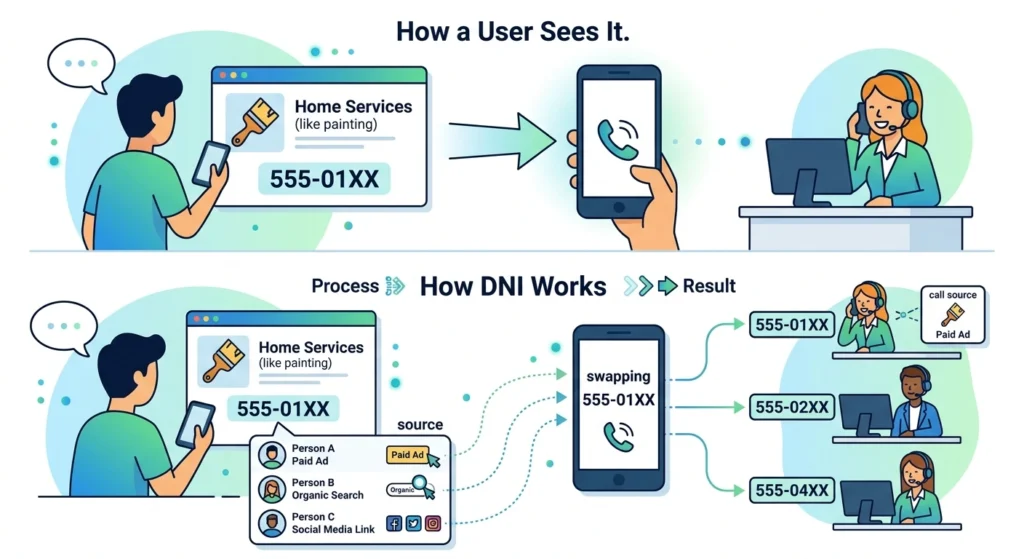
The result: every phone call gets the same attribution depth as a form submission.
A practical example: a dental practice runs three Google Ads campaigns. Without call tracking, the agency sees clicks — but not which campaign drove actual enquiries. With call tracking software in place, the report shows teeth whitening drove 9 calls (7 qualified), new patient drove 8 calls (6 qualified), branded drove 3 calls (1 qualified). Now the agency knows exactly where to concentrate spend.
Two modes agencies use in practice:
- Static numbers — one number per channel (Google Ads, Facebook, GMB). Any call to that number is attributed to that channel.
- Dynamic Number Insertion (DNI) — session-level attribution down to the exact keyword and ad. Required for agencies running paid search.
Setup for a new client takes less than a day. Calls start flowing with full attribution data immediately.
What to look for in call tracking software for agencies
Not all call tracking software is built for agencies. Most platforms are designed for a single business tracking their own calls. An agency managing 15 clients needs something fundamentally different.
Agencies need multi-account dashboards, white-label reporting, and per-client billing — capabilities that vary widely across vendors. Here is what actually matters.
White-label dashboards. Your clients log in under your brand — your domain, your logo, your colours. The platform’s name never appears. This is non-negotiable: if a client can find the software you are using, they can go around you.
Unlimited sub-accounts. One account per client, fully isolated. Each sub-account has its own numbers, call logs, attribution data, and reports. Without this, client data bleeds together and per-client reporting becomes manual work.
Markup billing. The agency pays wholesale rates to the platform and sets its own client-facing rates. This turns call tracking from a cost centre into a billable line item on the monthly retainer — and gives agencies a margin on every number provisioned and every minute tracked.
Per-client spend caps. Agencies on fixed retainers need predictable costs. A spend cap per client guarantees that call tracking costs never exceed a set threshold without approval.
Google Ads conversion import. Qualified calls should feed back into Google Ads as conversion events via GCLID. Without this, Smart Bidding optimises for clicks rather than calls — the wrong signal for any local service business.
Agency roll-up view. A single dashboard showing call volume, answer rate, qualified leads, and missed calls across all clients. This is how you catch a problem — a client’s missed call rate spiking, a campaign going dark — before the client does.
One platform built specifically around this model is Call Tracking Software.
It combines white-label dashboards, unlimited sub-accounts, markup billing, and per-client spend caps under a usage-based pricing model — no flat subscription, pay only for numbers provisioned and minutes used. Every call is captured with full attribution data: source, campaign, keyword, landing page, device, talk time, and recording. Agencies can start with one client and scale to thirty without changing plans or renegotiating pricing.
Closing the loop: call tracking for agencies and Google Ads
Tracking calls is only half the job. The other half is feeding that data back to where it changes campaign performance.
Most agencies running Google Ads for local service clients have the same problem: Smart Bidding optimises for the conversions you tell it about. If you only report form fills, the algorithm optimises for form-filling audiences and keywords — and misses phone call leads entirely. For a dental practice where 70% of new patient enquiries come via phone, that means Google’s algorithm has been flying blind on the majority of actual conversions.
The fix is Google Ads conversion import.
How it works: every Google Ads click generates a unique Google Click ID (GCLID). When a visitor clicks an ad and later calls the tracking number, the GCLID is stored with the call record. When that call is marked as a qualified lead, the platform sends it back to Google Ads as an offline conversion — matched to the exact campaign, ad group, and keyword that generated the call.
Once you know which ads and keywords lead to your most valuable calls, you can adjust bids on keywords that drive the most sales calls, or use an automated bid strategy like Target CPA to optimise for more of these conversions.
The practical impact for agencies is significant. A client spending $3,000/month on Google Ads, optimised only on form submissions, is essentially running a campaign that ignores its best-performing conversion action. Once call conversions feed back into Google Ads, Smart Bidding recalibrates — bidding up on keywords that drive calls, pulling back on those that only drive clicks. Campaigns that looked average start performing measurably better without changing a single ad or budget.
One important detail: only qualified calls should be sent back as conversions — not every answered call. Conversion rules based on minimum call duration, lead score, or qualification status ensure Smart Bidding optimises for quality leads, not just any call. An existing customer calling to reschedule is not a conversion. A new patient enquiring about teeth whitening is. The distinction matters because Google’s algorithm will optimise toward whatever signal you feed it.
CallTrackingSoftware handles this automatically: qualified calls are sent to Google Ads via the API within minutes of the call ending, matched by GCLID, with configurable qualification rules per client account. The attribution loop — from ad click to phone call to conversion signal — closes without any manual work from the agency.
This is where call tracking software for agencies stops being a reporting tool and becomes a campaign performance tool. The data does not just explain what happened. It actively improves what happens next.
Call tracking for agencies: the client reporting advantage
Campaigns perform better with call data. But call tracking software for agencies delivers a second, equally valuable benefit: it changes the client relationship.
The question every agency dreads is “what am I actually getting for my retainer?” Without call data, the honest answer is partial at best. Form submissions, click-through rates, and impression share are legitimate metrics — but for a local HVAC company or dental practice, none of them answer the question the client is actually asking: how many new customers called me because of your campaigns?
According to the SoDA Report, agencies with live client dashboards retain clients 34% longer than those delivering static monthly reports. Call tracking is one of the most direct ways to get there — because a call log with source attribution is concrete, verifiable, and impossible to dispute. The client can listen to the recordings. They know which calls were real leads. The data is theirs as much as it is the agency’s.
What a call tracking report shows that a standard report cannot:
- Total inbound calls this month — broken down by source, campaign, and keyword
- Answered vs missed — including which days and hours calls are being dropped
- Qualified leads — calls that resulted in a booking, quote request, or genuine enquiry
- New vs repeat callers — separating first-time leads from existing customers
- Average talk time — a proxy for lead quality that clients immediately understand
A client who sees that their Google Ads campaign drove 34 inbound calls last month, 22 of which were qualified new enquiries, 8 of which went unanswered on Friday afternoons, has a clear, actionable picture of their business. The agency is no longer selling outputs. It is delivering outcomes.
The missed call conversation is particularly powerful. Most clients have no idea how many calls they are dropping. The average home service business loses $47,000 per location annually from untracked or mishandled calls. When an agency surfaces that data — “you missed 8 calls last Friday between 4pm and 6pm, here are the recordings” — it shifts the conversation entirely. The agency becomes an operational adviser, not just a media buyer. That is a position that is very difficult to replace.
The white-label advantage compounds this. When clients log into a dashboard under the agency’s brand, the reporting experience reinforces the agency’s value at every touchpoint. Agencies that include call tracking dashboards in quarterly reviews to show campaign results and real-world ROI keep clients loyal through data that clearly demonstrates the value provided. The software is invisible. The agency’s expertise is what the client sees.
Done right, call tracking for agencies is not just a measurement tool. It is a retention tool — the data layer that turns a month-to-month client relationship into a long-term partnership built on transparent, verifiable results.
The complete picture: call tracking software combined with lead source tracking
Call tracking for agencies solves the phone attribution gap. But phone calls are one conversion type, not all of them. Most local service clients also receive leads through contact forms, booking widgets, and live chat. Tracking calls without tracking those channels produces attribution data that is better than nothing — but still incomplete.
This is where call tracking software and a lead source tracking tool like LeadSources work as a pair, not as alternatives.
LeadSources gives agencies the attribution data to tie every lead and every dollar of revenue back to the campaigns they run, across all clients, in one account. It captures the full marketing context behind every form submission — source, campaign, keyword, landing page, device, and multi-session journey — and syncs it directly to the CRM.
Every lead is enriched with a complete marketing context, so agencies can make revenue-backed decisions with confidence. The platform captures the complete multi-session journey behind every conversion — understanding which marketing investments truly influence pipeline and revenue, not just last-click.
Call tracking covers the phone. LeadSources covers the form. Together, they give a complete view of every inbound lead.
What that looks like in a monthly client report:
| Channel | Form leads | Phone leads | Total | Cost per lead |
|---|---|---|---|---|
| Google Ads — emergency-hvac | 4 | 22 | 26 | $18 |
| Google Ads — brand | 2 | 6 | 8 | $41 |
| Organic search | 3 | 8 | 11 | $0 |
| 6 | 3 | 9 | $28 |
Without call tracking, the agency reports 15 form leads. With call tracking added, the real number is 39. The Google Ads emergency campaign looks twice as expensive as Facebook on form leads alone — and three times more efficient when calls are included. Budget decisions made on the incomplete data are wrong. Budget decisions made on the complete data are defensible.
This is the reporting standard agencies increasingly need to hold onto clients. Proving ROI beyond vanity metrics is particularly critical for agencies where attribution clarity makes the difference between client retention and churn. A monthly report that shows every lead — phone, form, and chat — attributed to its exact source is the kind of transparency that justifies a retainer without the agency having to argue for it.
The setup for both tools is straightforward. LeadSources installs via a tracking snippet and connects to the client’s form builder in one click. CallTrackingSoftware installs via a DNI snippet and starts attributing calls immediately. Neither requires changes to the client’s website beyond a script tag in the header. Both can be live for a new client in under a day.
For agencies serious about call tracking software as a long-term competitive advantage — not just a reporting add-on — the combination of phone attribution and form attribution is the complete stack. Every lead, every channel, every campaign. Fully attributed, fully reported, fully yours.
Conclusion
Phone calls are not a legacy conversion channel. For the local service businesses most agencies represent — HVAC, dental, legal, plumbing, home services — they are the primary one. Phone leads convert at 10 times the rate of web forms. Leaving them untracked is not a minor reporting gap. It is a structural blind spot that distorts every campaign decision an agency makes on behalf of their client.
Call tracking software for agencies closes that gap — attributing every inbound call to its exact source, feeding qualified calls back to Google Ads as conversion signals, surfacing missed calls before the client notices them, and delivering all of it inside a branded dashboard the client logs into under the agency’s name.
The agencies that adopt call tracking now are not just improving their reporting. They are changing the nature of the client relationship — from “here is what we spent and what we got” to “here is every lead your business received this month, where it came from, and what we are doing about it.” That is a conversation that retains clients.
Combined with a lead source tracking tool like LeadSources to capture form and digital leads, the result is a complete attribution stack: every lead, every channel, every campaign — fully tracked, fully attributed, and fully defensible.
The tools are available. The setup takes a day. The data starts immediately.
If your agency is still reporting on half your clients’ leads, call tracking software is where that changes.
CallTrackingSoftware is a white-label call tracking platform built for marketing agencies. If you want to see how it fits your agency’s workflow, book a free agency consultation.